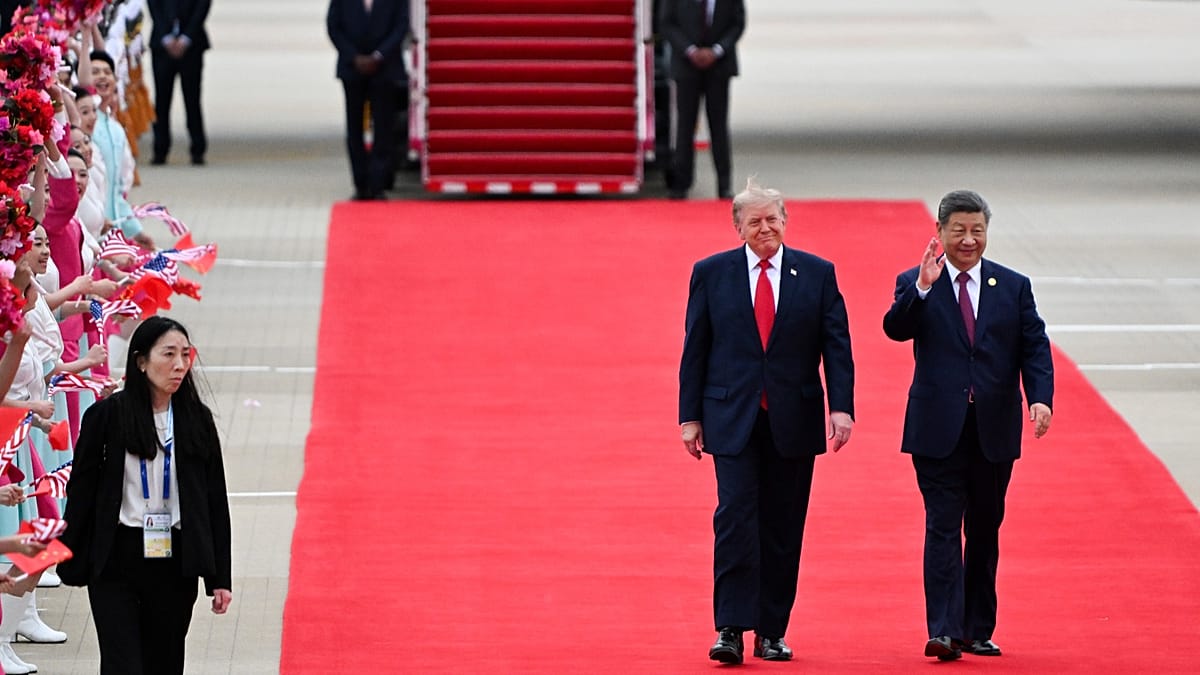
US President Donald Trump arrived in Shenzhen on Wednesday for a high-stakes Asia-Pacific Economic Cooperation (APEC) summit, where he will join Chinese President Xi Jinping and Russian President Vladimir Putin for an unprecedented trilateral meeting on Thursday. The encounter marks the first time the leaders of the world's three largest military powers have sat down together in such a format.
Xi greeted Trump with a hug on the tarmac, a gesture that reciprocated the warmth Trump showed during Xi's state visit to Washington in September. Notably, Xi did not extend the same personal welcome to Putin, who arrived earlier in the day, despite their often-stated close relationship.
Trump said he intends to use the trilateral session to press for an end to Russia's full-scale invasion of Ukraine, declaring on Tuesday that "I think it's very close to getting it done." He added, "We are going to have a good meeting on that."
Beijing described the trilateral as an opportunity for "in-depth exchanges on safeguarding world peace and promoting strategic stability in major-power relations." Putin, for his part, said he expected the summit to be "highly useful."
The meeting comes at a time when Washington's relations with its traditional allies, including Europe and Canada, have deteriorated sharply. Trump's "America First" trade policies and his unpredictable diplomatic style have unsettled partners across the Atlantic. European leaders will be watching closely to see whether the trilateral produces any concrete outcomes on Ukraine, a conflict that has reshaped Europe's security architecture and energy supplies.
Putin targets sanctions, Xi champions open trade
Speaking at a CEO forum on the sidelines of the summit, Putin took aim at the Western sanctions imposed after the 2022 invasion, calling them "instruments of economic dominance" that have "outlived their usefulness and have largely lost their intimidating effect." He also stressed Russia's desire to deepen economic ties with the Asia-Pacific, which now accounts for more than half of Russia's total trade.
Xi, addressing business executives, called for the region to pursue "more open trade and equitable growth" to remain stable and dynamic. "China will not only cut tariffs and expand market access, but also go a step further. We will carry out reform in challenging areas such as rules, regulation, and standards," he said, reiterating Beijing's pledges to improve conditions for global investors.
Neither Xi nor other APEC leaders directly criticised the US shift toward protectionism, but the tension was palpable. Trump's tariff hikes and export controls—particularly on advanced computer chips from Nvidia and other US firms—run counter to APEC's long-standing goal of creating a Pacific Rim free trade zone. The looming congressional hearing for Nvidia's Jensen Huang underscores the depth of the technology rift.
Trump, however, struck a conciliatory note on chip policy, saying there were "differences of opinion" inside his administration and that "we have a very good relationship with China, and you don't want to insult them." His emphasis on friendly ties may extend the trade truce reached last year after a series of tariff escalations.
On Taiwan, Trump said he did not plan to raise the issue himself but expected Xi to do so. "I'm sure he'll raise it," Trump said. "I won't have to raise it." Taiwan is the world's leading manufacturer of advanced semiconductors, including those designed by US companies.
Trump also floated the possibility of a separate private meeting with Putin and a sit-down with North Korean leader Kim Jong-un, though neither had been confirmed by the time he landed in Shenzhen. Beijing has denied any knowledge of a potential Trump-Kim encounter.
The APEC summit is being held in Shenzhen, a city that China has transformed over four decades from a fishing village into a skyscraper-studded hub of export manufacturing and technology. The 21 APEC economies account for 60% of global economic activity, half of global trade, and 40% of the world's population. While APEC does not take binding decisions, it has served for 37 years as a forum for building consensus on cooperation and open trade.
For Europe, the outcome of this trilateral will be closely scrutinised. Any movement on Ukraine could have profound implications for the continent's security and energy policy. Meanwhile, the broader US-China rivalry over technology and trade continues to shape global supply chains, with European companies caught in the middle. As the EU seeks to bolster its own competitiveness, the push for electrification is seen as one way to reduce dependence on Chinese manufacturing.