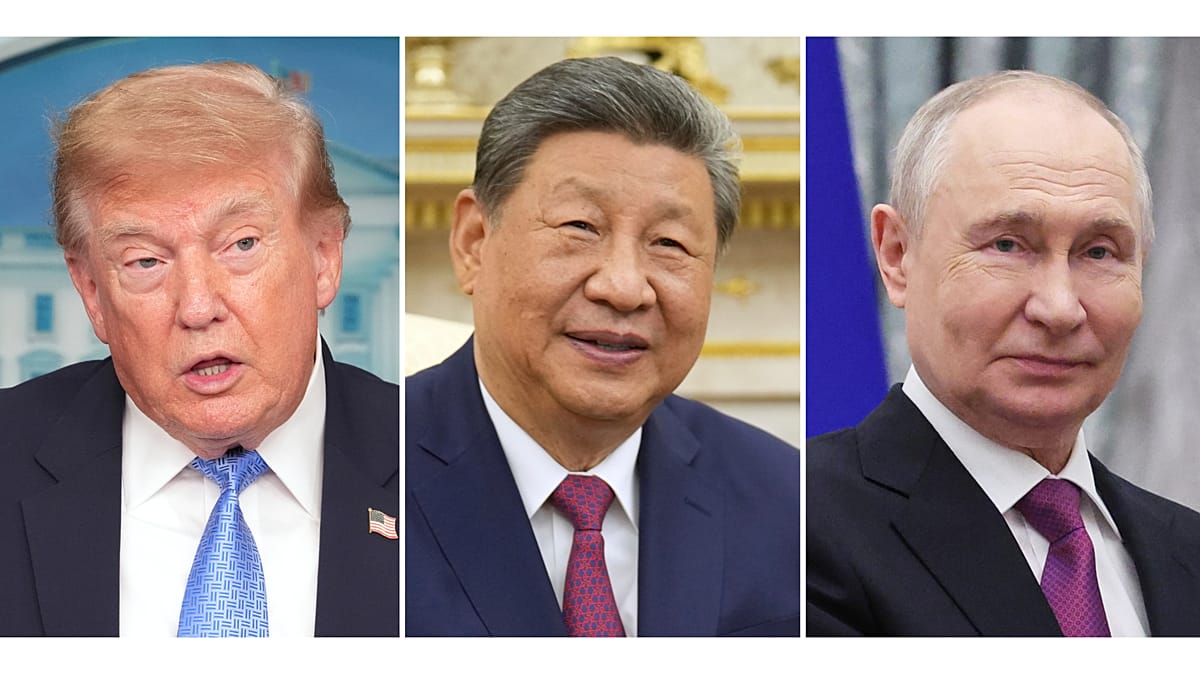
The White House has confirmed that US President Donald Trump will hold a trilateral meeting with his Russian and Chinese counterparts, Vladimir Putin and Xi Jinping, in the southern Chinese city of Shenzhen next week. The encounter is scheduled to take place on the sidelines of the Asia-Pacific Economic Cooperation (APEC) summit, which brings together leaders from 21 member economies from 18 to 19 November.
According to White House spokesperson Olivia Wales, President Trump intends to raise the issue of global nuclear disarmament. "The president has made it clear that, among other topics, he will discuss the reduction of nuclear weapons in the world. This proliferation, President Trump believes, is very dangerous," she told reporters.
US officials, speaking to the AFP news agency, indicated that the Iran conflict will also be on the table. However, the war in Ukraine will not be part of the trilateral discussions. A senior US official, who requested anonymity, explained that Washington has a separate negotiation track with Kyiv and Moscow aimed at ending the conflict. "China is not really a part of that track, so it doesn't seem appropriate to have the Ukraine discussion there," the official said.
The decision to exclude Ukraine from the Shenzhen agenda may raise eyebrows in European capitals, where leaders have been increasingly vocal about wanting a seat at the table in any talks concerning the continent's security. The recent US-Russia contacts have already sparked concern among EU member states about being sidelined in negotiations that directly affect them.
Bilateral talks and a high-profile guest
In addition to the trilateral meeting, President Trump is expected to hold bilateral discussions with President Xi in Shenzhen. The US president will depart Washington on Monday for the Philippines, where he will attend a meeting of the Association of Southeast Asian Nations (ASEAN) before travelling to China.
Tesla and SpaceX CEO Elon Musk is slated to accompany Trump on the trip, but officials have clarified that Musk will not participate in the meeting with Xi and Putin. His presence is likely to be linked to business interests, particularly given Tesla's significant manufacturing operations in Shanghai.
Neither Moscow nor Beijing has yet commented publicly on the reported trilateral meeting. However, Mao Ning, a spokesperson for China's foreign ministry, expressed anticipation for the APEC summit, saying Beijing looks forward to achieving "more practical results" with partners in areas such as artificial intelligence, trade, connectivity and the digital economy.
The APEC summit itself will focus on key issues including artificial intelligence, trade tensions and economic growth. The gathering comes at a time of heightened global trade friction, with the US and China having imposed tariffs on each other's goods, and the EU also navigating a complex trade relationship with both powers.
For European observers, the Shenzhen meeting underscores the shifting dynamics of global diplomacy. While the EU is not directly involved in the trilateral talks, the outcomes could have significant implications for transatlantic relations and Europe's strategic interests. The bloc has been seeking to strengthen its own engagement with Beijing, as evidenced by recent investment deals in renewable energy and efforts to diversify supply chains.
The exclusion of Ukraine from the agenda is particularly noteworthy, given that European leaders have repeatedly called for a more inclusive peace process. The US-Russia contacts have already raised concerns in Brussels and other European capitals about being left out of crucial security discussions.
As the world's major powers prepare to converge in Shenzhen, the meeting will be closely watched for any signs of progress on nuclear arms control, a topic that has been a priority for the Trump administration. The last major arms control agreement between the US and Russia, the New START treaty, is set to expire in 2026, and there has been little movement on a successor.
The trilateral meeting also highlights the growing role of China as a mediator in global affairs, a role that Beijing has been keen to cultivate. With tensions simmering in the Middle East and Eastern Europe, the Shenzhen talks could provide a platform for dialogue, even if concrete outcomes remain uncertain.
For now, European governments will be watching closely, aware that decisions taken in Shenzhen could shape the continent's security and economic landscape for years to come.