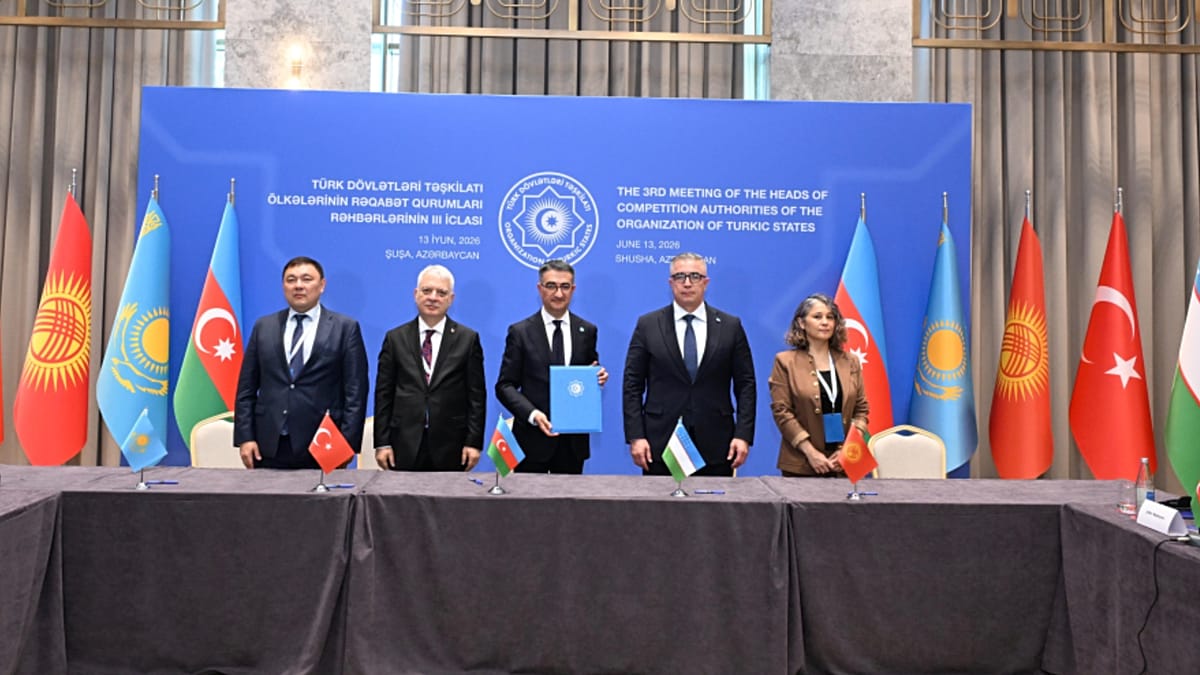
From the Caspian Sea to Central Asia, the countries of the Turkic world are moving beyond shared language and culture toward a more ambitious goal: deeper economic integration, digital cooperation, and strategic connectivity. The 3rd Meeting of Heads of Competition Authorities of the Organisation of Turkic States (OTS), held in Shusha, Azerbaijan, on Saturday, underscored this shift as delegates discussed aligning antitrust policies and strengthening regional trade.
Birol Küle, President of the Turkish Competition Authority, urged participants to abandon “general theoretical discussions” and focus on practical international cooperation. “It is now imperative that we leave theoretical studies aside and decisively transition to practical implementation,” he said. “The enforcement of competition law across the entire geography where these states are located is of utmost importance.”
The OTS, which includes Turkey, Kazakhstan, Kyrgyzstan, Uzbekistan, and Azerbaijan, spans a vast territory from the Balkans to the borders of China. Küle noted that “these countries' desire for development is highly remarkable and valuable,” reflecting a collective ambition to attract talent, encourage knowledge exchange, and build cross-border enforcement mechanisms.
From Energy Corridors to Digital Markets
What began as a political and cultural platform is now placing greater emphasis on trade, transport, energy, investment, and emerging technologies. The latest meetings ventured into regional market cooperation, focusing on shaping antitrust policy as a driving force by aligning competition regulations. The idea is to institutionalise coordination through the newly established Competition Council of the Turkic States, which would work to prevent monopolistic practices and promote fair trade.
The region is gaining strategic importance as OTS member states sit along key trade and transport routes, including the Middle Corridor linking China, Central Asia, the South Caucasus, and Europe. For Azerbaijan, the organisation offers a chance to strengthen its role as both an energy supplier and a regional transit hub. This comes as European energy markets face disruptions, with EU Energy Ministers considering releasing jet fuel reserves amid the Hormuz crisis.
Elnur Baghirov, Chairman of the State Agency for Antimonopoly and Consumer Market Control under the President of Azerbaijan, emphasised the importance of sharing best practices. “The importance of this cooperation lies in the fact that in today's world competition matters may be of the same nature across the different markets so therefore we as Turkic states can face similar challenges in our economies,” he said. He stressed the need to address “common challenges” and “work behind resolutions of those issues.”
According to the OTS, member states are increasingly exploring joint investment initiatives, trade facilitation measures, and infrastructure projects designed to improve regional connectivity and economic resilience. Recent discussions have also focused on digital infrastructure, skills development, and innovation ecosystems that can support future growth, including artificial intelligence.
However, questions remain about how quickly these ambitions can translate into practical outcomes. While member states share historical and linguistic ties, they face different economic realities, regulatory frameworks, and geopolitical pressures. The growing focus on technology and AI reflects a wider shift across the region, but implementation will require sustained political will and institutional capacity.
The Turkic world's push for integration comes at a time when Europe is reassessing its own economic and energy security. The OTS's efforts to create a unified market could offer new opportunities for European businesses and investors, particularly in sectors like transport, energy, and digital services. As the bloc deepens its ties with Central Asia and the South Caucasus, it may also help diversify supply chains and reduce dependence on traditional routes.