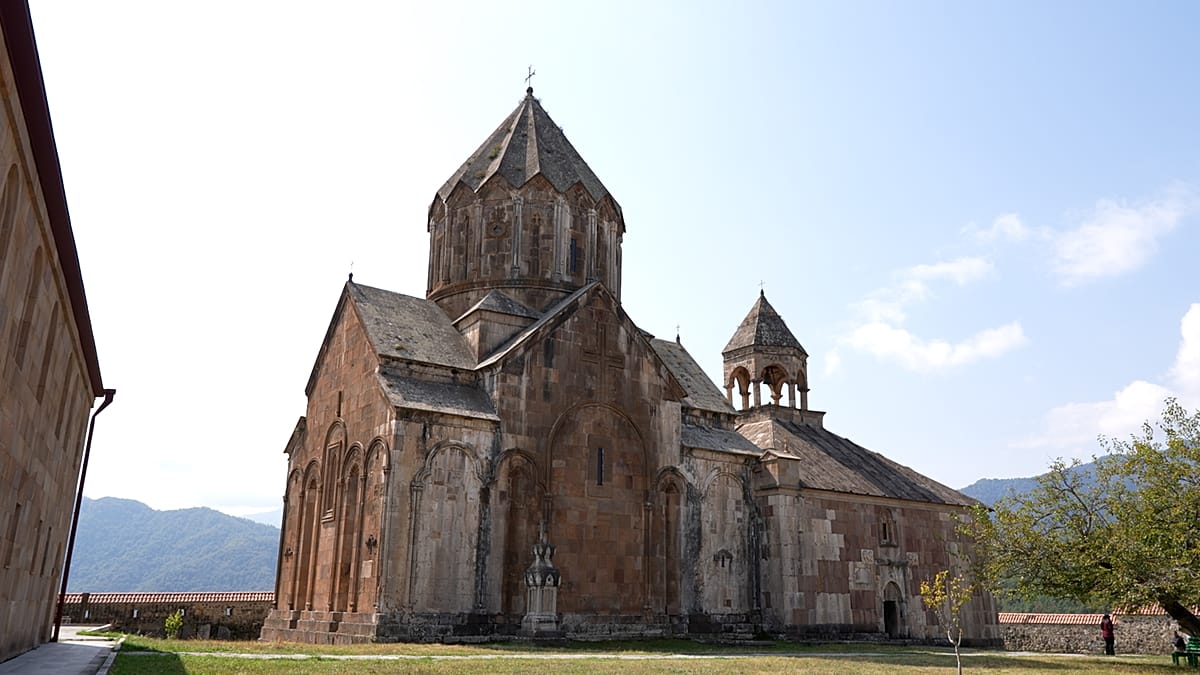
As the South Caucasus edges toward a fragile peace, Azerbaijan's Udi Christian community has returned to the ancient monasteries of Karabakh, reviving a pilgrimage tradition that predates the region's modern conflicts. On 21 September, a congregation gathered at Gandzasar, near the village of Vangli in the Aghdara district, for a service conducted in the Udi language—a moment that carried both spiritual and political weight.
The event was part of a government-facilitated media tour aimed at showcasing Azerbaijan's commitment to preserving Christian heritage. Journalists, including from Euronews, were invited to witness the service and speak with community leaders and officials responsible for the site's upkeep. The visit came just days after a diplomatic delegation, including EU Special Representative for the South Caucasus Magdalena Grono, toured Gandzasar and Khudavang monasteries on 12 September.
A contested legacy
Gandzasar's main church was built between 1216 and 1238 by Prince Hasan-Jalal Dawla. But its historical identity is fiercely disputed. Azerbaijan links it to the Caucasian Albanian Christian tradition, while Armenia claims it for the Armenian Apostolic Church. These competing narratives have long complicated the peace process between Baku and Yerevan, and they remain unresolved even as diplomatic channels reopen.
For the Udi people—an indigenous, predominantly Christian ethnic group concentrated in the village of Nij in the Gabala district—the return to Gandzasar is deeply personal. "Today, thanks to the acquisition of independence, we are in the monastery built by our holy fathers. We are proud of our history," said Danakari Rafiq Arami, Deputy Chairman of the Alban-Udi Christian Community. His words underscored the emotional significance of worshipping in a place that had been inaccessible for decades.
The Udi community also makes pilgrimages to other historic sites in Karabakh, including Khudavang in Kalbajar, Ağoğlan in Lachin, and Amaras in Khojavend. All are part of Azerbaijan's official preservation programme, which frames them as integral to the country's multi-religious heritage. Azerbaijan has long touted its tradition of peaceful coexistence among Muslims, Christians, and Jews, and UNESCO's documentation on the Historic Centre of Sheki notes that Christianity arrived in the region as early as the 1st century CE.
One of the most significant sites is the church at Kish, near Sheki, which is associated with the early spread of Christianity in the Caucasus. The Udi legacy is also visible in Nij, where the community continues to practice its faith in a dedicated church. These sites are not just relics; they are living places of worship for a community that has endured centuries of change.
The diplomatic visit earlier in September was intended to brief foreign envoys on the history and architecture of the monasteries, as well as Azerbaijan's concerns about alleged alterations to the monuments. That briefing reignited a row with Armenia over who owns the heritage. Grono acknowledged the impasse, noting that there remain "deeply divergent views and narratives" about the origins of some sites. Her comments reflect the broader challenge of reconciling historical claims with the need for a durable peace.
For the Udi Christians, however, the focus is on continuity. The service at Gandzasar was not a political statement but a restoration of a link to their ancestors. As one community leader put it, the pilgrimage is about reclaiming a heritage that was nearly lost. The presence of clergy in black robes and gold-embroidered vestments, holding icons of the Virgin Mary and Christ, was a reminder that faith endures even amid geopolitical turbulence.
Azerbaijan's efforts to protect these sites are part of a broader strategy to position itself as a guardian of religious diversity in the region. The government has invested in restoration and maintenance, and it regularly invites foreign journalists and diplomats to witness its work. This approach has drawn both praise and skepticism, with critics arguing that it is as much about political messaging as about preservation.
As the peace process between Azerbaijan and Armenia continues, the fate of these monasteries remains a sensitive barometer. For now, the Udi community is content to pray in a place that feels like home. Whether that sentiment can be translated into a shared understanding between Baku and Yerevan is another question entirely.