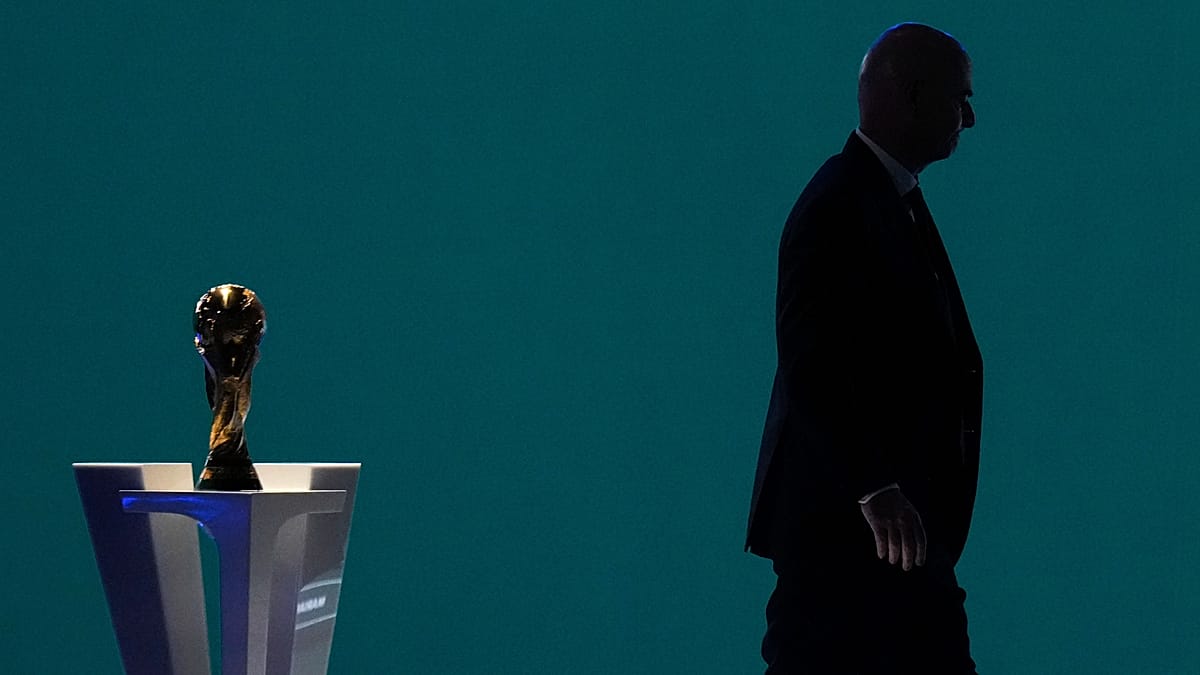
Gianni Infantino's leadership of FIFA is facing its most serious challenge yet, as European and North American football bodies publicly turned against him over a hastily abandoned plan to sell private equity stakes in the World Cup. The proposal, which was withdrawn on Saturday, has triggered a wave of criticism that threatens to destabilise the Swiss-Italian president's grip on world football's governing body.
UEFA, the governing body for European football, issued a scathing statement on Saturday, declaring that it had "lost confidence" in Infantino and accusing him of orchestrating a "shabby, back room, opaque deal." The European body, which represents 55 national associations, said it would now work with other confederations to ensure such a situation cannot recur.
"We cannot keep going on like this with secret schemes on fast-track timescales, cooked up by faceless individuals and of dubious benefit to the game," UEFA said. "We must identify those responsible and hold them to account."
The controversy began on Tuesday, when FIFA floated a proposal to create a new commercial subsidiary, the FIFA Forward Enterprise (FFE), which would manage events such as the World Cup and the Club World Cup. FIFA claimed the venture could raise up to $4.2 billion, based on a $20 billion valuation, and promised each of its 211 member associations a one-off payment of $20 million in early 2027, along with increased funding for the 2027-2030 cycle.
However, the plan was met with immediate backlash from within the football community, with many questioning the lack of transparency and the speed at which it was being pushed through. By Saturday, FIFA had withdrawn the proposal, but the damage to Infantino's credibility appears to be done.
UEFA President Aleksander Čeferin, who has been at the forefront of the opposition, did not mince words. In a statement, UEFA said that Infantino had "failed to deliver" on promises made during his first election campaign in 2016, when he pledged to be transparent and to treat FIFA's money as belonging to the member associations, not the president.
"The shabby, back room, opaque deal he hatched and tried to force through were anything but transparent," UEFA said. "And with reserves standing at over $5bn, he has also failed to use associations' money for the benefit of the game."
The criticism was not limited to Europe. CONCACAF, the governing body for North and Central America and the Caribbean, called for "a comprehensive reckoning with this presidency," slamming Infantino's "poor governance and leadership." CONCACAF noted that the plan had "advanced outside every established governance framework, without transparency, consultation or due process."
National associations also joined the chorus. The English Football Association (FA) demanded "a full and robust review of FIFA's leadership and governance," while the German FA (DFB) called for a complete overhaul within FIFA.
This is not the first time Infantino has faced criticism over his management style. His tenure has been marked by a series of controversies, from the expansion of the World Cup to 48 teams to his close ties with controversial regimes. His recent Instagram rant, in which he told critics to meditate, did little to quell the discontent.
The fallout from this episode could have significant implications for the governance of world football. UEFA's statement suggests that European associations are prepared to push for structural changes, and the coming weeks may see a coordinated effort to reform FIFA's decision-making processes.
As the football world watches, the question remains whether Infantino can survive this latest storm. With UEFA and CONCACAF, two of the most powerful confederations, openly calling for accountability, the pressure on the FIFA president is mounting. Whether he can rebuild trust or whether this marks the beginning of the end of his presidency remains to be seen.