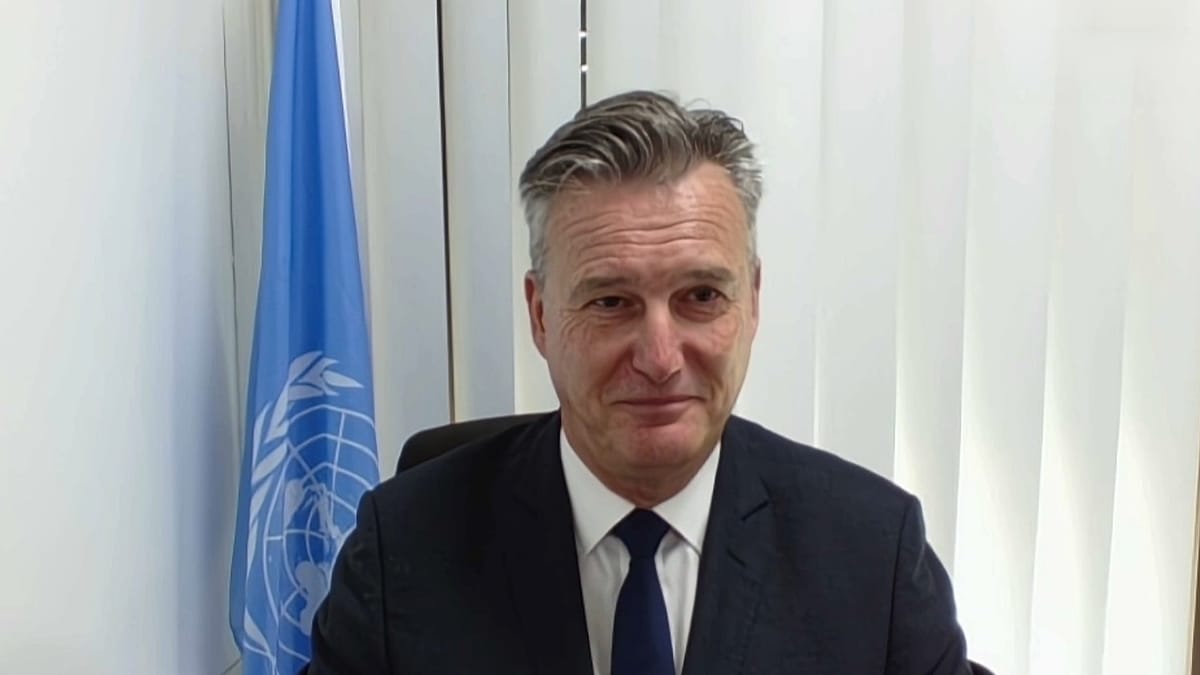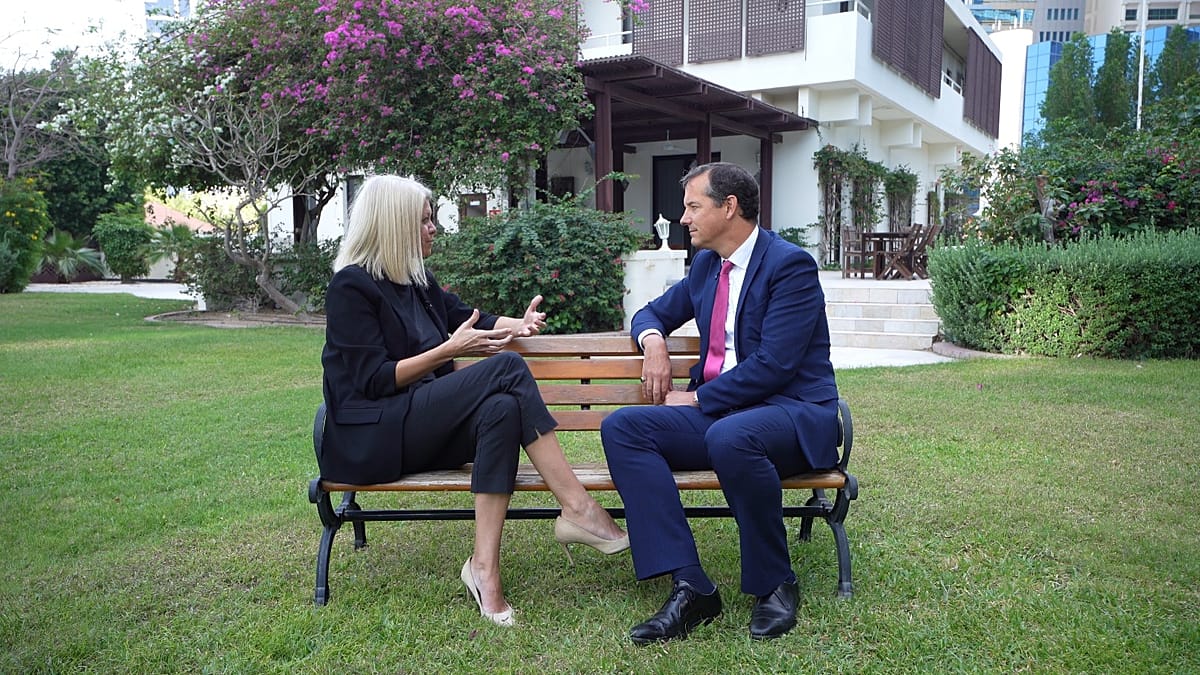
In the Gulf, the ceasefire between the United States and Iran is holding, but only just. For Edward Hobart, the British Ambassador to the United Arab Emirates, this fragile pause is the only barrier between contained tension and renewed escalation. In an interview with Euronews, Hobart stressed that “the important thing is that there is a ceasefire still… we’re not going to resolve the war while we’re still fighting.”
The message is blunt: diplomacy cannot begin in parallel with conflict. It follows it. For now, the region is suspended in that narrow gap between the two. “I think we don’t know yet… but we hope, of course, that it’s part of the beginning step into something which brings us to a sustainable resolution,” Hobart added.
Strait of Hormuz: A Global Pressure Point
Whether that hope holds depends largely on a stretch of water just 33 kilometres wide. The Strait of Hormuz is not just a regional flashpoint; it is a global pressure point, carrying a significant share of the world’s oil supply. When it closes, the consequences are immediate and far-reaching. “You can’t talk very easily while you’re firing missiles across the Straits of Hormuz,” Hobart said. The urgency is already shaping diplomatic engagement between London and Abu Dhabi, particularly in recent talks between the UK Foreign Secretary and the UAE Foreign Minister. “They obviously focused fundamentally on the current regional situation and Iran and in particular on the critical importance of getting the Straits of Hormuz open again,” according to Hobart.
This aligns with broader concerns about energy security. As EU Energy Chief Warns of Prolonged Price Hikes from Middle East Conflict, the stability of the Strait remains a key factor for European economies reliant on Gulf oil.
Security Cooperation and Resilience
Behind the immediate crisis sits a broader strategic calibration. Security cooperation between the UK and UAE is being reinforced, but so too are the systems that underpin long-term resilience, from energy transition to financial security. “We agreed a framework of cooperation between our countries,” Hobart says, including work “not just in foreign policy and in defence, but also in AI… in the energy transition… in tackling global crime and illicit finance.”
On the ground, that partnership has already been tested. The recent attacks were not incremental; they marked a step change, “unprecedented, unwarranted and hugely dangerous, risking lives.” Yet the outcome could have been significantly worse. The UAE’s defensive systems held. “They’ve intercepted 95% of the projectiles fired at this country.” That figure is more than a statistic; it is a signal of preparedness, coordination, and a defence architecture functioning under pressure.
For the UK, the response has been deliberately controlled: support without escalation. “This wasn’t the UK’s war… but particularly in defence of the Gulf countries, we have enabled the US to help support that defence.” At the same time, the crisis has triggered a wider international alignment. Maritime security, once a technical issue, has become a geopolitical priority. “What we want is the law of the sea to be followed… these international thoroughfares… open and flowing.” That position is now backed by scale. “There were over 50 countries taking part… who are there to support freedom of navigation… in the Straits de Hormuz.”
Underlying Risk and Cautious Normality
Even so, the underlying risk has not disappeared; it has been managed, not removed. “I think the risk is there… the risk is reduced while there isn’t fighting and while there is a prospect of talking.” For residents in the UAE, that translates into a cautious normality. Daily life continues, but with an awareness that conditions can shift quickly. “For expats that are here… at the moment you can live a pretty normal life, but you need to pay attention to what the authorities are saying.”
That balance, between reassurance and realism, has defined the response. “I think it’s getting the balance right between a kind of calming message… but also the need to respond to a very unusual situation.” Zooming out, a more structural picture emerges. The UAE operates in a region it cannot control. Its strength lies in how it responds. “The UAE can’t control the whole of that environment, so it’s about how does it flex and respond to that overall.”
And despite the pressure, those fundamentals remain intact. “The fundamentals for the UAE haven’t changed… it also has a brilliant geography… and a business environment which is very conducive and open.” This resilience is echoed in broader regional dynamics, as seen in Syrian President's Gulf Tour Advances Economic Ties and Regional Reintegration, highlighting the Gulf's role in shaping stability.