Kyiv has dismissed Moscow's proposal for a temporary truce coinciding with Russia's Victory Day parade on 9 May, insisting that only a long-term ceasefire can form the basis for genuine negotiations. The Kremlin floated the idea to US President Donald Trump during a phone call with Vladimir Putin, but Ukrainian President Volodymyr Zelenskyy made clear that a few hours of quiet to protect a military display in Moscow is not a substitute for a sustainable end to hostilities.
“We will clarify what exactly this is about — a few hours of security for a parade in Moscow or something more,” Zelenskyy wrote on X on Thursday. “Our proposal is a long-term ceasefire, reliable and guaranteed security for people, and a lasting peace.” He added that he had instructed Ukrainian negotiators to contact the US side for further details.
Moscow's Narrow Offer
The Kremlin's press secretary, Dmitry Peskov, confirmed that Putin had raised the idea with Trump, and that the US president “actively backed the initiative, noting that the holiday marks the shared victory over Nazism in the Second World War.” Peskov said specific dates for the proposed ceasefire would be announced separately. Notably, Moscow communicated the offer exclusively to Washington, maintaining its refusal to engage directly with Ukrainian officials.
This is not the first time Russia has proposed a short-lived halt in fighting. Earlier in April, the Kremlin announced a ceasefire for Orthodox Easter, which was also met with scepticism in Kyiv. For Putin's administration, Victory Day carries immense symbolic weight — far more than a mere commemoration of the Second World War's end. Since the full-scale invasion of Ukraine began in February 2022, the Kremlin has weaponised the imagery and rhetoric of the “Great Patriotic War” to justify its aggression, portraying Ukraine as a neo-Nazi state that must be “denazified.”
A Parade Without Tanks
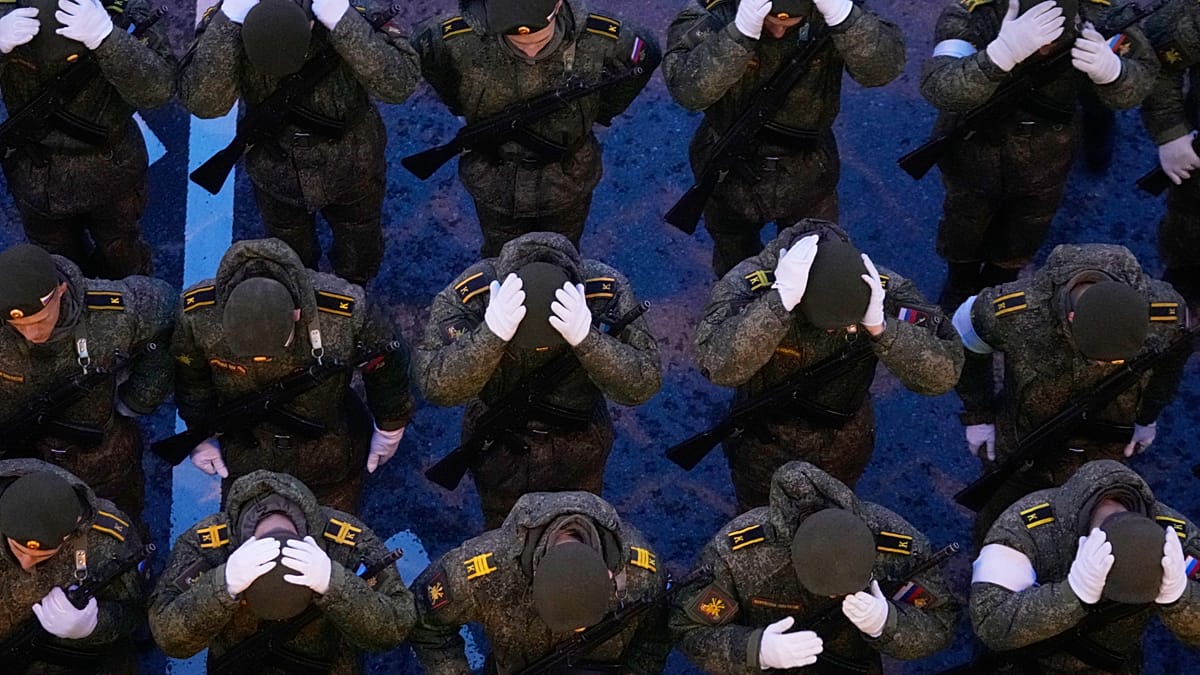
This year's Victory Day parade in Moscow will be markedly subdued. For the first time in years, no armoured columns will roll across Red Square. The Kremlin cited the “current operational situation” and the need to “minimise the danger” from what it calls a “terrorist threat” from Ukraine. The absence of military vehicles and cadets is widely seen as a telling indicator of Russia's mounting personnel and equipment shortages after more than three years of war.
The decision to scale back the parade underscores the strain on Russia's armed forces, even as the Kremlin continues to mobilise resources for its campaign. The event has become a centrepiece of Putin's domestic propaganda, with the orange-and-black St George's Ribbon — once a symbol of the Soviet victory in 1945 — now ubiquitous among supporters of the invasion. Slogans such as “We can do it again” and “We can repeat it,” borrowed from Soviet-era messaging, are plastered on military vehicles and social media posts.
Putin has repeatedly claimed that “the Soviet people were fighting alone” in the Second World War, downplaying the role of the Allies. This revisionist narrative feeds into a broader phenomenon known in Russian as pobedobesie — a derogatory term for grotesque, hyperbolic celebrations of victory, or “victorymania.”
Ukraine Aligns with European Commemoration
Ukraine has consciously distanced itself from Soviet-era traditions. In 2023, Zelenskyy signed a law moving the country's Second World War remembrance day to 8 May, aligning it with most of Europe. The shift reflects a broader effort to break with Moscow's historical narratives and integrate more closely with European norms.
The rejection of the Victory Day truce is consistent with Kyiv's longstanding position: any ceasefire must be comprehensive and verifiable, not a tactical pause that allows Russia to regroup. As the war grinds on, the gap between Moscow's symbolic gestures and the reality on the ground continues to widen.