Russian forces launched a fresh wave of aerial attacks on Ukraine overnight Sunday, deploying over 200 attack and decoy drones across northern and eastern regions. Ukraine’s Air Force reported that air defence units intercepted 212 unmanned aerial vehicles, including Shahed, Gerbera, and Italmas types, but 14 drones struck 11 separate locations.
In the Chernihiv region, a drone hit a company site in Koryukiv district, killing a 58-year-old man and sparking a fire that destroyed seven lorries. Local authorities in Rivne confirmed a strike on a non-operational enterprise, though no injuries were reported. In Dnipro, a logistics warehouse caught fire, and across Dnipropetrovsk region, around 20 drone and artillery strikes damaged a kindergarten, a medical office, and several residential buildings, injuring two people.
Zelensky Calls for More Air Defence
President Volodymyr Zelensky reported that over the past week, Russian forces fired more than 2,300 attack drones, roughly 1,560 guided aerial bombs, and 108 missiles at Ukraine. “All these strikes are just on ordinary civilian infrastructure – residential buildings, energy,” he said, reiterating his appeal to Western partners for additional surface-to-air missiles. Zelensky noted that Ukraine received a new IRIS-T launcher from Germany on Saturday, thanking Berlin for its continued support. “We are counting on both the US and European partners. Strong air defence can give more protection for our people and deprive Russia of its last advantage,” he added.
The attacks come amid broader concerns about civilian safety, as seen in recent incidents such as the drone strike in Galați, Romania, which underscored the cross-border risks of the conflict.
Ukrainian Drones Hit Russian Oil Infrastructure
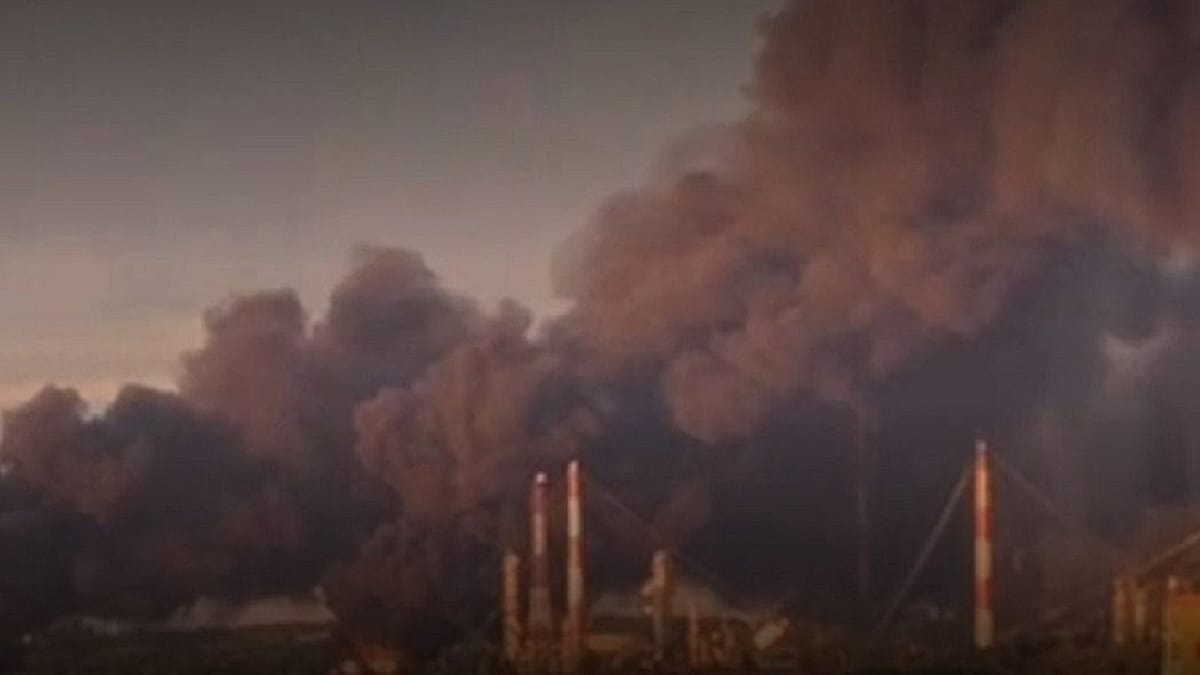
In a coordinated counter-strike, Ukrainian drones targeted oil facilities deep inside Russia. The Saratov oil refinery, one of the largest in the Volga region and part of Rosneft, was hit and caught fire. The facility has a design capacity of about 7 million tonnes of oil per year. Regional governor Roman Busargin acknowledged damage to civilian infrastructure but provided no further details. Ukraine’s General Staff and Unmanned Systems Force confirmed the attack, stating that operators from the 1st Separate Centre of the Unmanned Systems Forces, in cooperation with the Security Service and Main Directorate of Intelligence, successfully struck the refinery.
In the Kirov region, Ukrainian drones attacked the Lazarevo linear production and dispatch station, a key node in the Surgut-Polotsk oil pipeline that transports crude from Siberia to Baltic ports and Belarus. The station also connects to the Druzhba pipeline system, allowing rapid oil transfer between two major pipelines in European Russia. Regional governor Alexander Sokolov confirmed a fire at an enterprise in Urzhum district but did not name it, stating there were no casualties. Ukraine’s Special Operations Forces said the strike hit a “key node of the largest oil pipelines from Siberia to Europe,” located nearly 1,200 kilometres from the Ukrainian border.
In the Rostov region, a fuel storage facility in Matveevo-Kurgan district caught fire after a drone strike. Governor Yury Slyusar reported damage to a pharmacy, two shops, and a car. Ukrainian forces identified the target as the Agroprodukt oil depot, which houses large tanks and loading terminals near the border.
Ukraine’s Special Operations Forces stressed that degrading Russia’s oil refining and logistics infrastructure reduces its economic capacity to wage war. The strikes follow a pattern of Ukrainian operations aimed at disrupting Russian energy exports, which are a major source of revenue for the Kremlin. Earlier this week, Russian drone barrages hit Kharkiv, highlighting the ongoing tit-for-tat escalation.
The conflict continues to ripple across Europe, with neighbouring countries like Romania facing spillover risks. As Zelensky noted, the need for robust air defence remains urgent, and European partners are under pressure to accelerate deliveries of systems such as IRIS-T and Patriot to protect Ukrainian cities and infrastructure.