When Ukrainian soldier Yevgen lost his foot to a mine, he spent two days stranded on the front line, convinced he would not make it out. Then a comrade told him help was coming from above: a flying evacuation drone.
“I said, ‘you're kidding, right? You're just trying to cheer me up’,” Yevgen, whose surname is withheld for security reasons, told AFP from his hospital bed. He was among the first Ukrainian troops to be evacuated by an aerial medical drone.
Nearly five years after Russia's full-scale invasion, drones have reshaped warfare along the front. The area is now a “kill zone” several kilometres deep, where any movement can trigger a strike from explosive-laden machines hovering overhead. That has made ground rescue missions for wounded soldiers almost suicidal for medics and fellow troops.
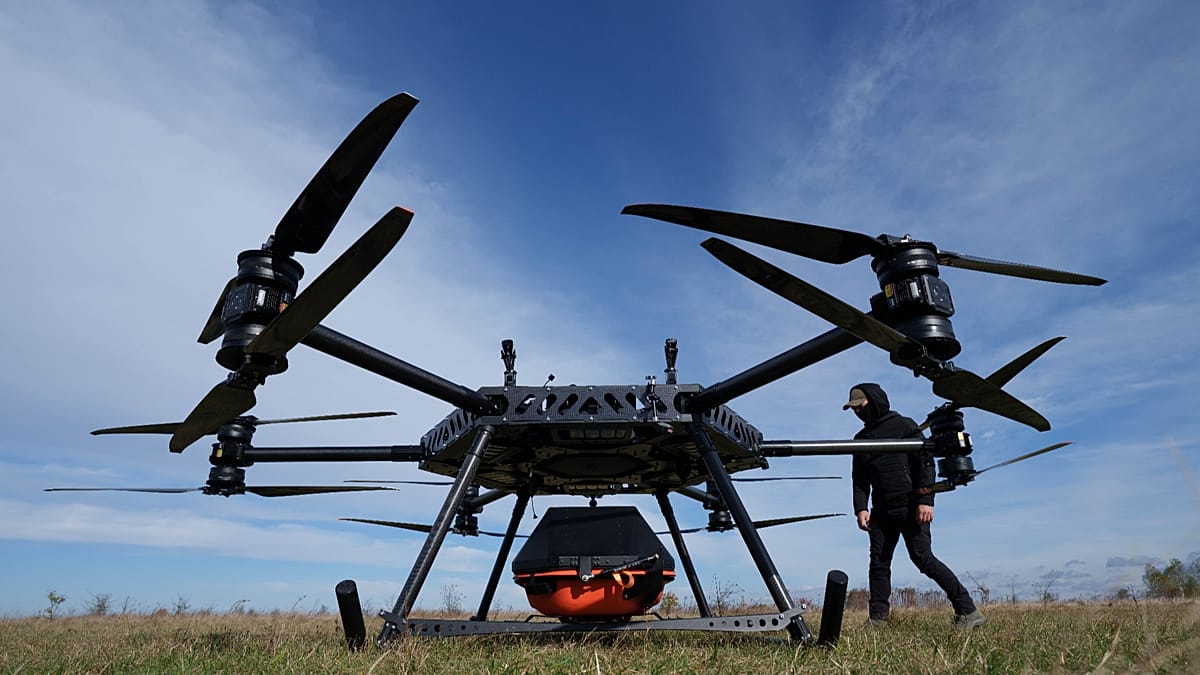
In response, Ukrainian drone manufacturers have pivoted to building evacuation craft. The Stargate, developed by the company Skyfall, is one such machine. It has already completed three rescue missions, including the one that saved Yevgen.
“Later in the evening the company commander called me and said: ‘Well, are you ready to fly?’,” Yevgen recalled. Footage from the drone's camera shows him being placed in a pod — a flying stretcher with a lid — as he clutched a rifle to his chest in the dark. Supply and surveillance drones buzzed around him during the flight, their silhouettes visible against the moon. “There was no other option,” he said.
From battlefield need to flying ambulance
The Stargate was born out of a direct request from the commander of Ukraine's CODE 9.2 assault brigade. “A year later, we had the Stargate,” a Skyfall representative told AFP, speaking on condition of anonymity. The company stresses that the drone is not a technological breakthrough but a response to an operational necessity.
Ukraine had previously used ground drones to evacuate the wounded, but those vehicles crawl at just 10 km/h and struggle with rivers, minefields, and other rough terrain. “They are also easy targets,” the spokesperson said. “A mission can last several hours.”
The Stargate, by contrast, can fly at 105 km/h, carry up to 150 kilograms, and has a range of 30 kilometres. Each unit costs about €45,000. The carbon-fibre machines are assembled in a secret hangar that resembles a laboratory, with several lined up along a central aisle and prototype frames gathering dust behind them. Skyfall aims to produce 1,000 drones per month by the end of 2026.
Outside the factory, a test flight showed the 400-kilogram machine lifting off with a roar like an approaching thunderstorm. Trainee pilots, who had previously only flown supply or bomb-carrying drones, were at the controls.
Silence in the cockpit
The pilot who rescued Yevgen, known by the call sign “KVN”, described the tension of flying with a human on board. “As soon as I picked him up everyone went quiet,” he told AFP. “There was just silence, library silence. This time there was a person on board.”
The mission was not without drama. Russian attack drones were spotted before take-off, forcing two aborted attempts. On the third try, the Stargate climbed to 100 metres, only for Russian electronic jammers to briefly cut KVN's link with the drone. For a nerve-wracking moment, the machine hovered in the middle of the aerial battlefield until its onboard artificial intelligence took over and the connection was restored.
The entire evacuation took about 15 minutes, monitored closely by a team of Ukrainian troops. The army is cautiously optimistic about the technology. “We need more examples in the field to really assess the system, but it looks promising,” one officer said, speaking anonymously.
For KVN, these drones represent “a future, driven by technology, that will bring soldiers back to their families”. Yevgen, now recovering, has become something of a preacher for the new method. “I send them messages to explain that they have nothing to fear,” he said.
The development comes as Ukraine continues to innovate in drone warfare, with AI playing an increasing role in both attack and rescue operations. Meanwhile, European allies are watching closely, with Brussels unveiling a €45bn loan to support Kyiv's defence efforts. As the war grinds on, the Stargate offers a glimmer of hope for those trapped in the most dangerous stretch of the front.