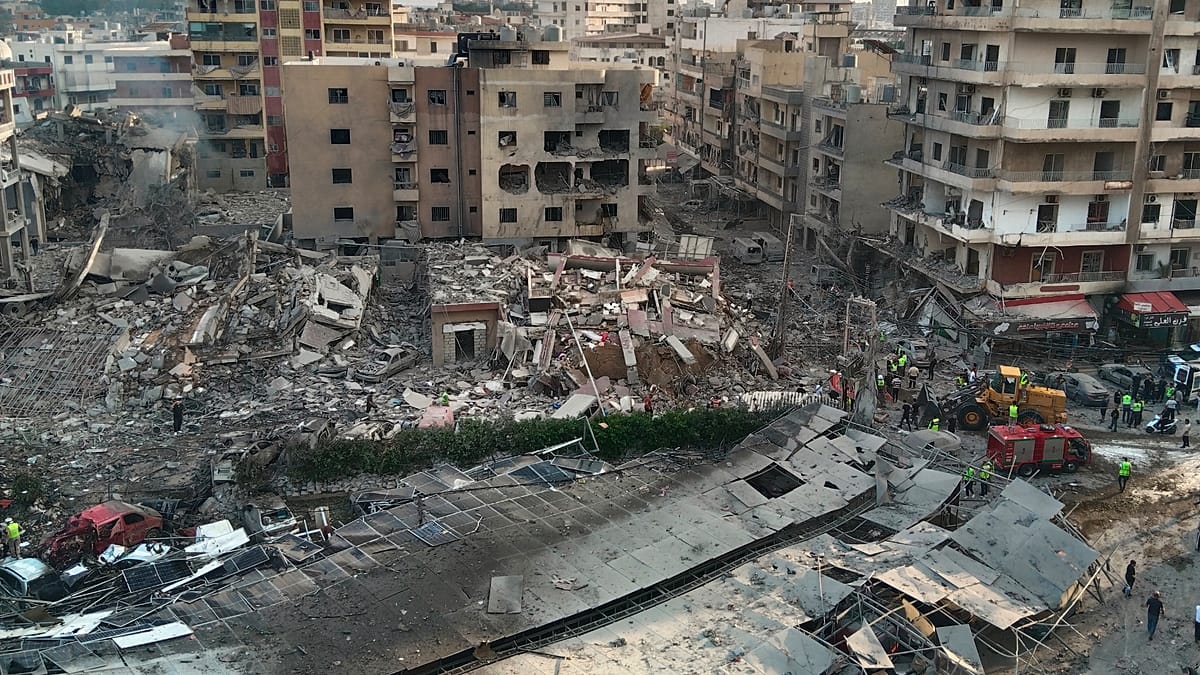
The United Nations has issued an urgent appeal for all parties to uphold the ceasefire after Israeli military operations expanded into southern Lebanon, a development that threatens to unravel ongoing US-Iran negotiations. Stephane Dujarric, spokesman for UN Secretary-General António Guterres, expressed deep alarm over the rising military activity. "We urge all actors to respect the cessation of hostilities and avoid further escalation," he said.
On Monday, the Israeli government ordered strikes on Beirut's southern suburbs, a day after its ground forces reached their deepest point inside Lebanon in 26 years. In response, Hezbollah launched rockets toward northern Israel, including the outskirts of Haifa. A source close to Hezbollah told AFP that the group would not stop targeting northern Israel, arguing that there was no reason to cease attacks while Israel continued to bombard Lebanon.
Israeli Defence Minister Israel Katz warned that "if there is no calm in the north, there will be no calm in Beirut." A senior US official outlined a proposed sequence: Hezbollah must halt all attacks on Israel, and in return, Israel would refrain from escalation in Beirut. The situation has put the US-mediated talks between Washington and Tehran on the brink of collapse, as Trump claims he brokered the Lebanon ceasefire, leaving the door open for further Iran negotiations.
Iran Threatens to Open New Fronts
On the same day, Iran's Revolutionary Guards warned they would open "new fronts" and maintain the closure of the Strait of Hormuz in response to Israel's offensive in Lebanon. State media quoted the Guards' intelligence organisation as saying, "Iran considers crossing the red lines in Lebanon and Gaza to mean direct war. In return, it is determined to carry out defensive operations by taking meaningful actions and opening new fronts, in addition to preserving the Strait of Hormuz equation."
Mohsen Rezaee, a military adviser to Iran's supreme leader Ayatollah Mojtaba Khamenei, posted on X that "the escalation of tensions in Lebanon will not be tolerated" and added that "the patience of the armed forces of Iran has a limit." The Tasnim news agency reported that Iran and its allies would "activate other fronts, including the Bab al-Mandab Strait" at the entrance of the Red Sea. Iran's Yemeni ally, the Houthis, have previously attacked shipping in that strait, forcing vessels to take long detours around Africa rather than transit the Red Sea and Suez Canal. The Red Sea also hosts the Saudi port of Yanbu, through which Riyadh exports millions of barrels of oil, bypassing Iran's effective closure of the Strait of Hormuz.
The threat to the Strait of Hormuz has already driven oil prices to surge as Iran halts talks and threatens the key waterway.
A Lebanese Hospital Struck
The escalation continues to exact a heavy toll on Lebanon. An Israeli airstrike heavily damaged the Jabal Amel Hospital in the port city of Tyre on Monday afternoon, shattering windows and blowing out facades. Footage released by the Lebanese Health Ministry showed panicked women and children inside the debris-strewn facility. The attack followed a wave of overnight bombardments across southern Lebanon that killed six people, according to the state-run National News Agency. Tyre residents are now clearing rubble after the strikes hit the historic city.
Hezbollah also carried out rocket and missile attacks on northern Israel on Sunday, and early Monday confirmed it attacked Israeli troops in Zawtar al-Sharqieh, just north of the Litani River, and struck what it said was Israeli military infrastructure in Tiberius, a few dozen miles south of the border.
Both sides blame each other for the escalation. Hezbollah agreed to halt attacks on Israel when the ceasefire was signed in mid-April, but the militant group resumed assaults after Israeli strikes in Lebanon that Israel characterised as self-defence. The UN's call for calm comes as the region teeters on the edge of a broader conflict, with European capitals closely watching the developments for their potential impact on energy markets and migration flows.



