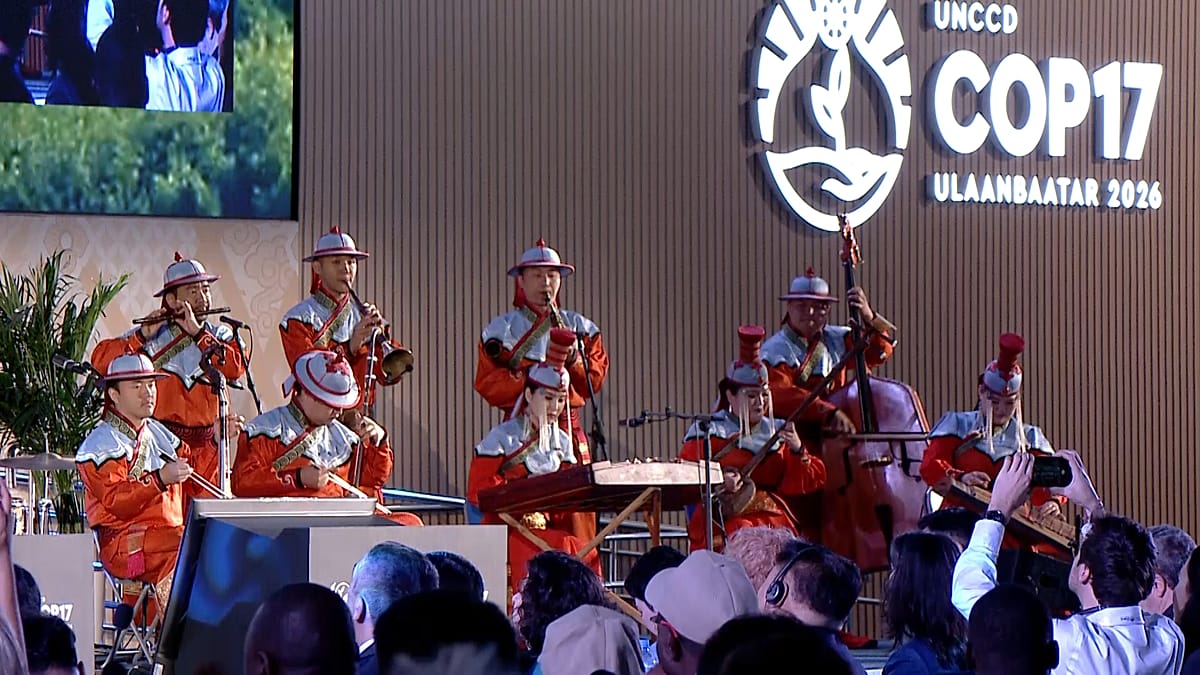
When diplomats and scientists gathered in Ulaanbaatar in mid-August for the seventeenth conference of parties to the UN Convention to Combat Desertification (UNCCD), they did so against a backdrop of alarming statistics. Roughly 40% of the world's soil is now degraded, and the proportion of habitable land is shrinking as deserts expand and droughts become more frequent. The meeting, which runs until late August, has drawn delegates from 179 member states and more than 400 organisations, including community representatives and business partners.
The UNCCD, adopted in 1994 and in force since 1996, remains the only legally binding international agreement focused on land degradation. Its 197 signatories meet regularly to coordinate action. This year, Mongolia was chosen to host the talks, a decision reflecting both its own vulnerability and its growing role in global efforts to restore degraded land.
A crisis that hits close to home
Mongolia's Prime Minister Nyam-Osoryn Uchral opened the summit by describing the situation in his own country. "On this vast territory, where there are only two people per every square kilometre, 77% of the country, or in other words, eight out of every ten steps of the land, are affected by desertification and is increasingly being covered by the encroaching sands," he said. Over the past eight decades, average temperatures in Mongolia have risen by 2°C, rainfall has declined, and sand from the Gobi desert now reaches as far as South Korea and Japan.
The host nation has launched several initiatives to combat the problem, including the Billion Trees National Movement, the Food Revolution, and the White Gold programme, alongside a recently adopted climate change law. Foreign Minister Battsetseg Batmunkh, who now serves as COP17 president, also highlighted Mongolia's role in securing a UN General Assembly resolution declaring 2026 the International Year of Rangelands and Pastoralists.
Global impact, local costs
The scale of the challenge is immense. Nearly 3.5 billion people are affected by land degradation, and the economic cost is estimated at $900 million annually for affected states and communities. Droughts have increased by two-thirds since 2000, and water demand is projected to outstrip supply by 40% by 2030. Some 85% of those affected live in low- and middle-income countries, where the loss of arable land often forces people to migrate in search of food and income.
Dr. Yasmin Foudh, Executive Secretary of the UNCCD, warned at the opening ceremony that droughts are no longer just an environmental issue. "They are a systemic risk to food and water security, to international commerce, energy supply, livelihood and, simply, to stability and prosperity," she said. Her remarks echoed experiences across Europe, where this summer's heatwaves disrupted river transport, strained energy production, and fuelled wildfires.
The conference is not merely a forum for speeches. Delegates are working on concrete plans and funding mechanisms, while hundreds of experts from academia, NGOs, and government institutions are sharing data and strategies. The urgency is underscored by the fact that land degradation is not a distant threat but a present reality, as the cost of a loaf of bread in Mongolia has tripled in a decade.
Mongolia's role as host is also a signal of its commitment. "Today, Mongolia is contributing to global efforts through national initiatives aimed at protecting ecosystems, combating desertification, restoring degraded land, strengthening food security and increasing the resilience of our people and communities," said Batmunkh. The country's nomadic heritage, she added, is inseparable from the health of its grasslands.
As COP17 continues, the focus is on finding solutions that can be scaled up. There is no single fix, but the combination of political will, scientific innovation, and community engagement offers a path forward. For Europe, the lessons are clear: land degradation is a shared challenge that requires coordinated action, and the outcomes of this summit will have implications far beyond Mongolia's borders.