A US technical delegation has concluded discussions in Baku on the Trump Route for International Peace and Prosperity (TRIPP) corridor, as Washington moves to implement its new strategic partnership with Azerbaijan through concrete infrastructure projects. The US Trade and Development Agency (USTDA) wrapped up the visit on Wednesday, stating its objective was “advancing the shared strategic infrastructure priorities” between the two nations—part of the US-Azerbaijan Charter on Strategic Partnership signed in February when Vice President JD Vance visited the Azerbaijani capital.
“Azerbaijan's strategic geographic position makes it an indispensable hub along the Trans-Caspian Transit Route linking Central Asia to the West,” Sara Leming, USTDA country manager for Europe and Eurasia, said in a statement. “The Trump Route for International Peace and Prosperity will make this corridor even more important. Regional connectivity is a key area for cooperation under our Strategic Partnership Charter and something USTDA is exploring during these missions.”
What Is the TRIPP Corridor?
The TRIPP corridor is a 42-kilometre rail and road link through Armenian territory, brokered by US President Donald Trump as part of the August 2025 White House peace declaration between Armenia and Azerbaijan. It forms the South Caucasus segment of the broader Middle Corridor—also known as the Trans-Caspian International Transport Route—which connects China and Central Asia through Azerbaijan, Georgia, and Turkey to Europe.
The USTDA is now exploring projects with Azerbaijani counterparts across liquefied natural gas, civil nuclear energy, electricity transmission, AI infrastructure, cybersecurity, and digital connectivity—sectors it says support Azerbaijan's long-term energy security “while advancing US economic and strategic interests.” Leming noted that the agency aims to move early-stage infrastructure concepts forward through feasibility studies, technical assistance, and pilot programmes designed to attract private capital.
“We see real opportunities in Azerbaijan,” she added. “Since Vice President Vance and President Aliyev signed the Charter in February, the US government has been working with our Azerbaijani partners to fully implement this historic agreement through concrete projects and programs, like those offered by USTDA, to benefit both our countries.”
Energy Security and European Dependence
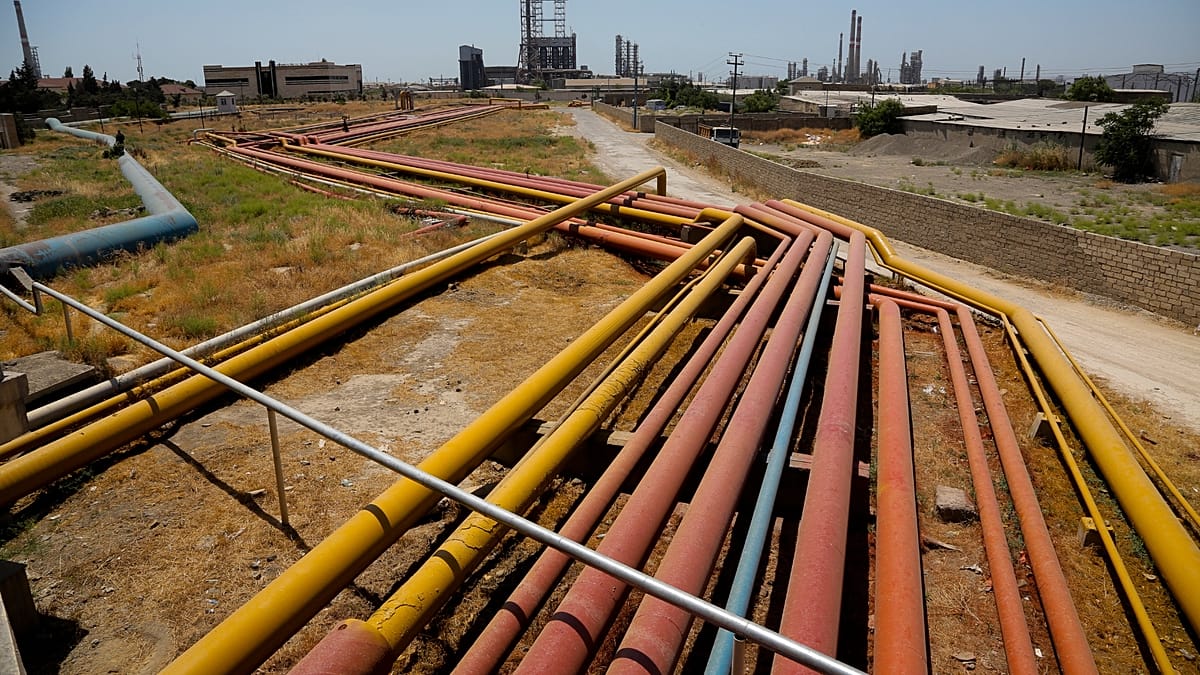
Azerbaijan's centrality to the TRIPP corridor is no coincidence. The country has spent two decades building pipeline infrastructure that now makes it one of Europe's most strategically significant energy partners. The Baku–Tbilisi–Ceyhan (BTC) pipeline and the Southern Gas Corridor (SGC) together connect Caspian energy resources directly to Turkey and Europe, bypassing both Russia and the Strait of Hormuz.
The BTC, linking the Caspian, Black Sea, and Mediterranean, has a capacity of around 1.2 million barrels per day and has carried crude from Kazakhstan and Turkmenistan as well as Azerbaijan, reinforcing its role as a regional diversification tool. According to Azerbaijan's State Statistical Committee, the country holds proven reserves of approximately 7 billion barrels of oil and 2.6 trillion cubic metres of natural gas. In 2025, it produced more than 27 million tonnes of crude oil and 51.5 bcm of gas—more than triple its 2007 gas output. Azerbaijan now exports oil to nearly 30 countries and gas to 16, including 10 EU member states.
With the EU's gas import dependency now exceeding 85%, the SGC has become a key pillar of European supply security. It opened the bloc's fourth gas supply corridor when Azerbaijani gas first reached Europe via the Trans Adriatic Pipeline (TAP) in 2020. Around 13 bcm of gas were delivered to European markets in 2025—roughly 60% more than in 2021. The Shah Deniz field, the corridor's primary supply source, has produced 267 bcm of gas and more than 52 million tonnes of condensate to date.
The EU and Azerbaijan are also developing three green energy corridors to bring renewable electricity to Europe, following a strategic partnership agreement signed in Bucharest in 2022 by Azerbaijan, Georgia, Romania, and Hungary. The corridors—spanning the Caspian–Black Sea–Europe route, the Azerbaijan–Turkey–Europe route, and a Central Asia–Azerbaijan–Europe link—are designed to enable large-scale electricity trade from renewable sources.
EU Parallel Efforts
On Wednesday, as the USTDA delegation wrapped up its visit to Baku, EU foreign policy chief Kaja Kallas was in Luxembourg and told foreign ministers gathered there that Azerbaijan “remains an important partner on energy and connectivity.” “We want to deepen our ties and will resume negotiations of a new bilateral cooperation agreement soon,” she said at a press conference before the Foreign Affairs Council meeting. Ministers stressed that Europe has a strategic interest in a stable and secure South Caucasus, with Kallas saying the Armenia-Azerbaijan normalisation process was “extremely important” to the EU.
The TRIPP corridor and related projects could further reduce European reliance on traditional supply routes, particularly as disruptions elsewhere—such as Kazakhstan's halt of oil shipments to Germany via Russia—highlight the fragility of existing energy chains. Meanwhile, the first cross-border trade between Armenia and Azerbaijan in years, recorded earlier this year, signals a gradual thaw that could support the corridor's development.