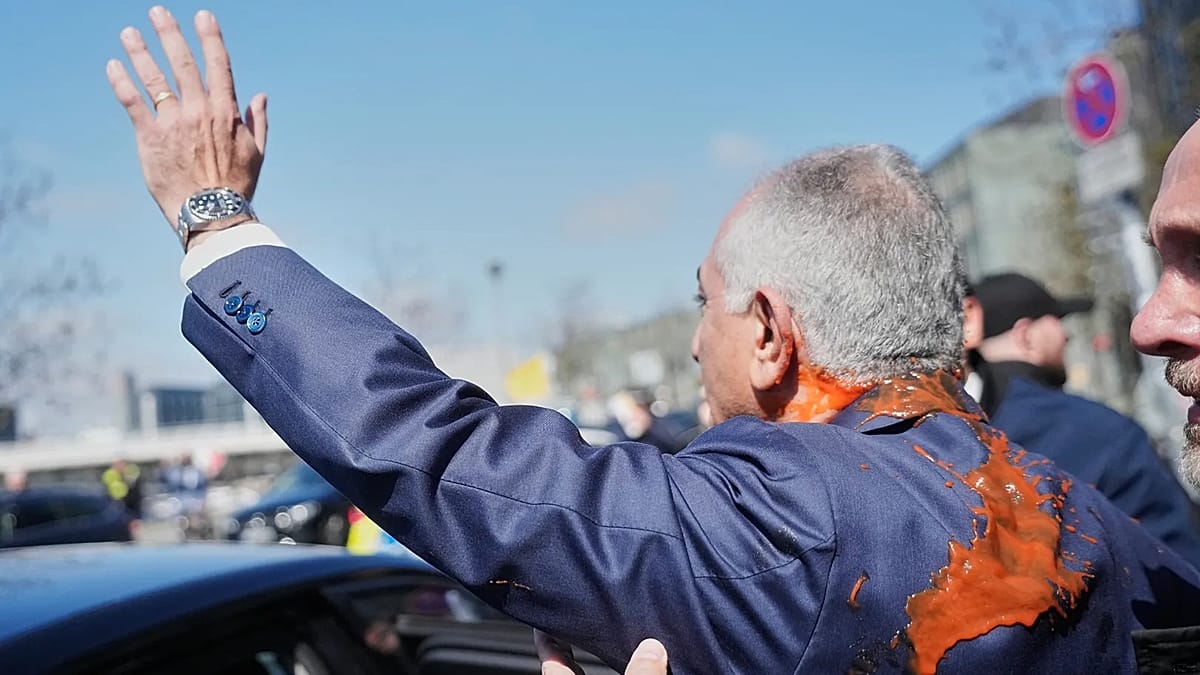
Berlin — Reza Pahlavi, the exiled son of Iran's former shah, was doused with a red liquid on Thursday as he left a news briefing in the German capital. Police said the substance appeared to be tomato juice. The alleged perpetrator, whose identity was withheld under German privacy laws, was immediately taken into custody.
Pahlavi, 65, had just finished addressing journalists at Germany's federal press conference building, where he sharply criticised the recent ceasefire agreement between the United States and Iran. As he walked outside, the liquid struck the back of his jacket and neck. He appeared unharmed, waved to supporters, and entered a waiting vehicle.
Political Context and Exile
Pahlavi is the son of Mohammad Reza Pahlavi, the last Shah of Iran, who was overthrown in the 1979 Islamic Revolution. The crown prince has lived in exile for nearly five decades, primarily in the United States. Despite this, he has sought to position himself as a potential leader in a post-theocratic Iran, though his support within the country remains uncertain.
Hundreds of his supporters gathered near the Bundestag on Thursday, according to German news agency dpa. Pahlavi was not invited to meet with any German government officials during his visit.
In his remarks, Pahlavi argued that the ceasefire agreement rests on a flawed assumption. "You're going to deal with people who all of a sudden have become pragmatists," he said. "I don't see that happening. I'm not saying that diplomacy should not be given a chance, but I think diplomacy has been given enough chance."
Pahlavi has openly supported US-Israeli military intervention in the Middle East and is positioning himself for a return should the Shia theocracy collapse. He also called on European nations to do more to support Iranians fighting for democracy, claiming that 19 political prisoners had been executed in the past two weeks and another 20 people sentenced to death. "Will the free world do something or watch the slaughter in silence?" he asked.
More than an hour after the incident, German Chancellor Friedrich Merz issued a statement welcoming the extension of the ceasefire. "This presents an important opportunity to resume diplomatic negotiations in Islamabad with the aim of making peace and averting further escalation of the war," Merz said. "Tehran should seize this opportunity."
The incident in Berlin comes amid broader European efforts to address instability in the Middle East. EU leaders recently gathered in Cyprus to discuss the Ukraine war, the Hormuz crisis, and mutual defence obligations, as reported by European Pulse. Meanwhile, the bloc continues to push for structural reforms under the AccelerateEU plan, which experts argue must shift from crisis response to long-term resilience, as detailed in our analysis.
Pahlavi's visit and the subsequent protest highlight the ongoing tensions surrounding Iran's political future and the role of exiled opposition figures. Whether his message resonates inside Iran remains an open question, but the incident in Berlin underscores the deep divisions that persist decades after the revolution.