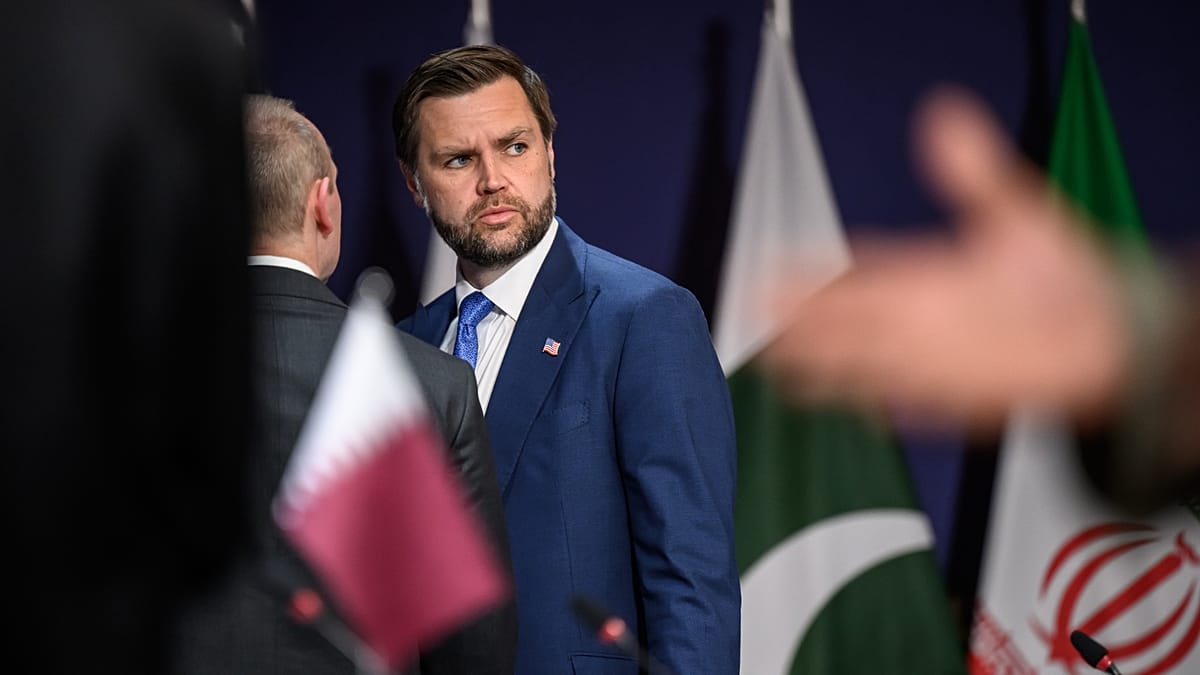
Talks between the United States and Iran in Switzerland have yielded a preliminary agreement to keep the Strait of Hormuz open and uphold the ceasefire in Lebanon, despite a fresh round of bellicose threats from US President Donald Trump. The negotiations, hosted at the Bürgenstock resort near Lucerne, lasted 18 hours and were described by mediators as producing “significant progress.”
US Vice President JD Vance told reporters on Monday that the two sides had “laid a very good foundation for a successful final deal.” He emphasised that while “the house” of a comprehensive accord was not yet built, the mechanism for ensuring safe passage through the Strait of Hormuz was already in place. “The Strait of Hormuz is open,” Vance stated.
Iran’s Foreign Ministry spokesperson Esmail Baghaei confirmed that a safe-passage mechanism had been agreed, calling it “important” without offering further details. The agreement also includes provisions to maintain the fragile ceasefire in Lebanon, where Hezbollah—a key Iranian proxy—has been under pressure from continued Israeli operations.
Pakistan’s Prime Minister Shehbaz Sharif, who thanked Qatar for its mediating role, welcomed “the constructive spirit that Washington and Tehran have shown in implementing the memorandum of understanding.” Iranian President Masoud Pezeshkian is scheduled to visit Islamabad on Tuesday for further consultations as part of the ongoing mediation effort.
Trump’s Threats Cast a Shadow
The diplomatic progress was overshadowed by Trump’s remarks on Truth Social, where he threatened to bomb Iran “very hard again, just like we did last week, only harder,” accusing Tehran of failing to rein in Hezbollah’s violations of the Lebanon ceasefire. In a separate interview with Fox News, Trump warned that Iran “won’t have a country” if it closes the Strait of Hormuz, and reportedly added that the negotiators “won’t even make it back to your f***ing country.”
Ebrahim Azizi, head of Iran’s parliamentary National Security and Foreign Policy Committee, responded sharply on X. “You make threats, we take action. The Strait of Hormuz is neither your personal casino nor the backyard of the pirates of the new age,” he wrote, asserting that the waterway remains under Iranian sovereignty.
Vance dismissed reports that Trump’s words nearly derailed the talks, telling reporters that the US negotiating team had explained to their Iranian counterparts that the president was “setting the record straight.” He added, “When you guys engage in what us Millennials might call trash talk, you can’t expect the president of the United States not to respond.”
Meanwhile, Tasnim News Agency, affiliated with Iran’s Islamic Revolutionary Guard Corps, claimed that the Iranian delegation had secured a role for Tehran in Lebanon’s future security arrangements, alongside the US and the Lebanese government—but not Israel. Neither Washington nor Lebanese officials confirmed that claim. A senior US diplomat told the Associated Press that progress had been made on mechanisms for both the Strait of Hormuz and the Lebanon ceasefire.
Domestic Distractions and Strategic Calculations
As the talks stretched into their eighteenth hour on Sunday night, Iran’s national football team drew 0-0 with Belgium in Los Angeles, with goalkeeper Alireza Beiranvand named player of the match. Iranian Foreign Minister Abbas Araghchi quickly linked the sporting result to the broader national struggle, posting an image of Beiranvand surrounded by depictions of children killed in a suspected US missile strike on a school in Minab. “From the football pitch to the negotiating table and the battlefield, every step we take as Iranians is part of a larger struggle,” Araghchi wrote.
The posts drew criticism on Iranian social media, with users questioning the fate of former national team goalkeeper Rashid Mazaheri, who was arrested days before the war began for criticising the late Ayatollah Ali Khamenei. Beiranvand is a known supporter of the Islamic Republic, having publicly backed the regime during the Israel-Iran conflict in June 2025 and the latest war.
The Washington-based Institute for the Study of War assessed that Iran’s earlier announcement of a Hormuz closure was designed primarily to generate psychological pressure rather than impose an actual blockade. “The continued passage of ships through the Strait after Iran’s announcement shows that the statement was probably issued more to create a psychological effect,” the ISW said. It added that Tehran was likely seeking to secure funds from the current agreement before engaging on nuclear issues, aiming to reduce US leverage in future talks.
The developments come amid a broader context of US-Iran tensions, including earlier threats and counter-threats during the Swiss talks. The reopening of the Strait of Hormuz after a brief closure had already been documented in timelapse footage showing vessel traffic resuming. Meanwhile, Iran’s Supreme Leader had endorsed a previous framework deal despite reservations, indicating the complex internal dynamics at play.