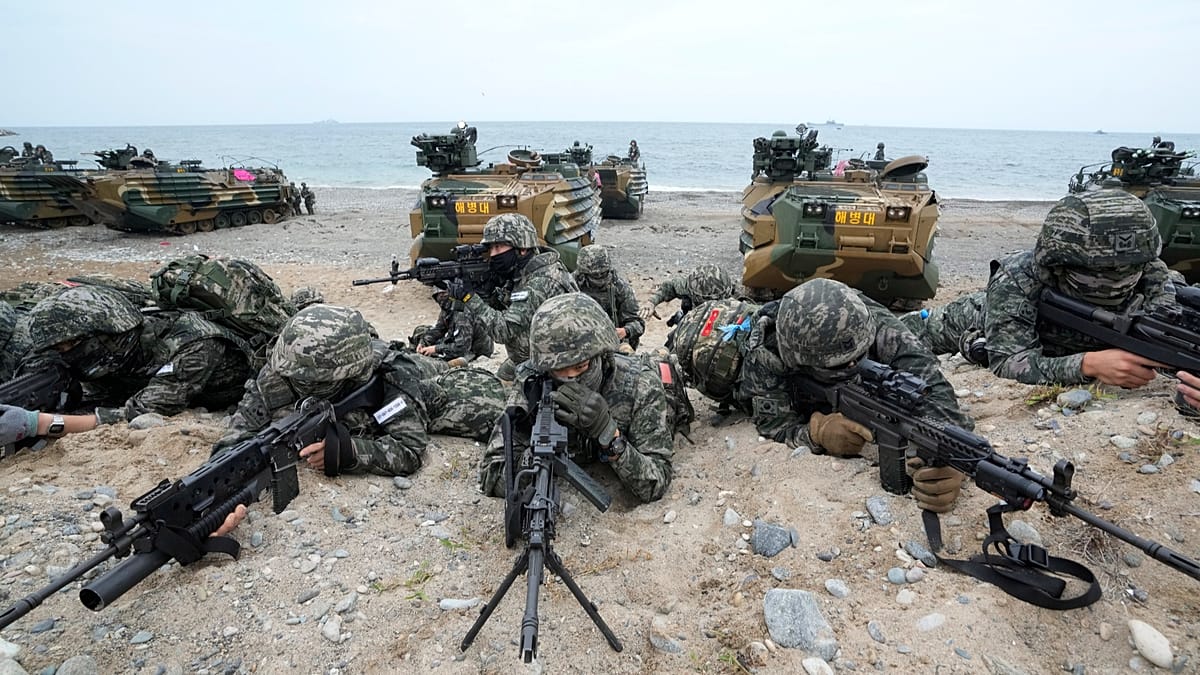
South Korea announced on Monday that the United States has called off a major joint amphibious landing exercise scheduled for next month, attributing the cancellation to force availability constraints stemming from the ongoing war in Iran.
The biennial Ssangyong drills, which involve marine forces from both countries, are designed to enhance combined operational capabilities. Typically, they include warships, aircraft, and ground troops rehearsing amphibious landings along the Korean peninsula.
The cancellation follows President Donald Trump's directive last week to reduce the scale of the separate annual Ulchi Freedom Shield exercises, cutting the joint drills from eleven days to five. At the time, Trump cited the high cost of the exercises and said they sent an “inappropriate and hostile” signal to North Korea, while emphasizing his personal rapport with leader Kim Jong-un.
“The US Marine Corps formally notified our forces in June that its ability to deploy forces during this year's Ssangyong exercise would be constrained due to the situation in the Middle East,” said Han Seung-jeon, a spokesperson for the South Korean Marine Corps, during a press briefing.
Seoul and Washington are continuing consultations on resuming the amphibious exercise, Han added, without providing further details. The Pentagon did not immediately respond to a request for comment on Seoul's announcement.
Shifting military posture
Trump's decision to scale back the Ulchi Freedom Shield exercise comes as he seeks to revive the relationship he cultivated with Kim during his first term. The US president said on Wednesday that it was important to “get along” with Kim, adding that Pyongyang now possesses 57 “very powerful” nuclear weapons. Seoul estimates that North Korea has around 80 to 120 such weapons.
The reduction in joint exercises marks a significant shift in the US-South Korea military alliance, which has long relied on large-scale drills as a deterrent against North Korean aggression. Analysts in Brussels and other European capitals are watching closely, as the move could affect regional stability and transatlantic security commitments.
European Union foreign policy officials have repeatedly stressed the importance of maintaining a robust deterrence posture on the Korean peninsula, given North Korea's continued missile tests and nuclear ambitions. The cancellation of Ssangyong, coupled with the shortened Ulchi Freedom Shield, may raise concerns among allies about the reliability of US security guarantees.
Meanwhile, the Iran war continues to strain US military resources, with deployments in the Middle East limiting the availability of amphibious and marine forces for exercises elsewhere. This is not the first time such constraints have affected allied training; similar cancellations occurred during the Iraq and Afghanistan conflicts.
For South Korea, the cancellation is a diplomatic and military setback. The country relies heavily on the US alliance for its defense, and the joint exercises are seen as a tangible demonstration of that commitment. The decision to cancel Ssangyong, without a clear timeline for resumption, may prompt Seoul to reassess its own defense posture and invest more in indigenous capabilities.
In the broader context, the US military's pivot toward great-power competition with China and Russia, combined with ongoing commitments in the Middle East, is forcing Washington to make difficult choices about where to deploy its forces. European allies, too, are grappling with similar trade-offs as they bolster their own defenses in response to Russia's war in Ukraine.
The cancellation of the Ssangyong drills is likely to be discussed at upcoming NATO and EU defense meetings, where allies are expected to press for clarity on US commitments in the Indo-Pacific. As the situation evolves, European policymakers will be watching closely to see how Washington balances its global obligations.