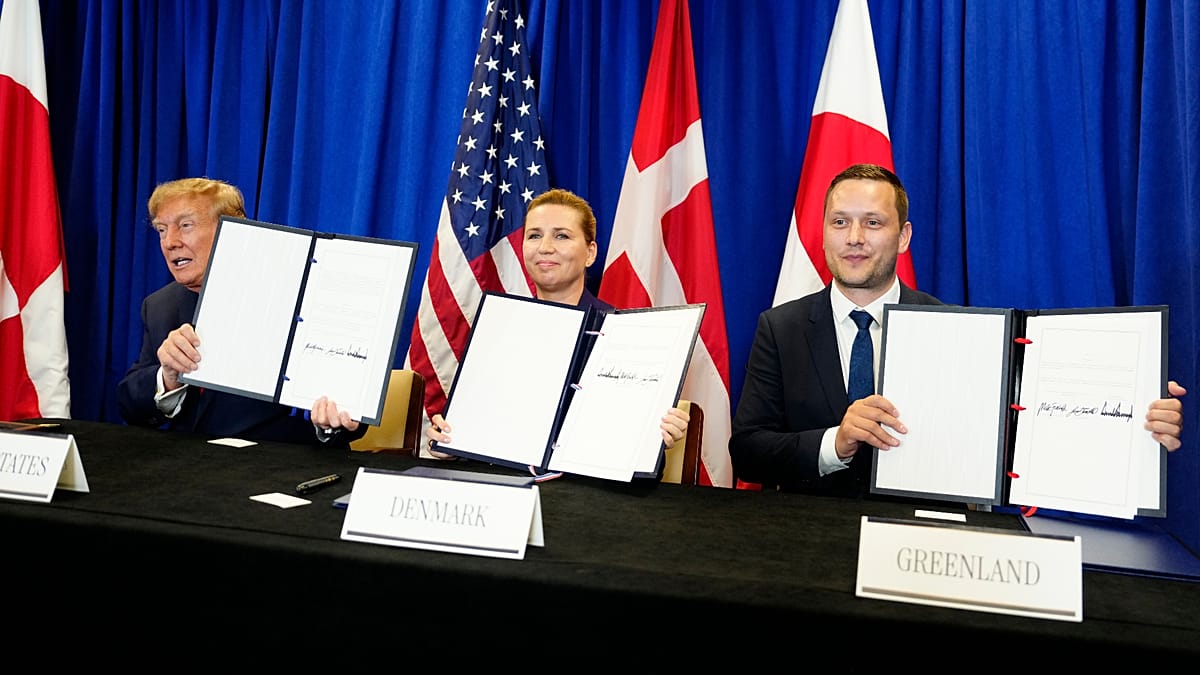
A revised defence agreement between the United States and Denmark, ratified by the Danish parliament last week, significantly expands Washington's military footprint in Greenland while explicitly reaffirming the Kingdom of Denmark's sovereignty and the island's right to self-determination. The pact, which builds on a 1951 defence treaty, comes after months of heightened tensions over President Donald Trump's repeated suggestions that the US should acquire Greenland.
What does Washington gain?
The US already operates the Pituffik Space Base in northwestern Greenland, a critical site for missile warning and space surveillance. Under the new agreement, Washington can expand operations there and establish two additional defence areas: Narsarsuaq in the south and Mestersvig in the east. American aircraft will also gain broad overflight and landing rights across the island, and US vessels will have access to Greenlandic territorial waters.
The deal also leaves the door open for the deployment of Trump's proposed Golden Dome missile-defence system, though no specific troop numbers, construction budgets, or deployment timelines have been set. For Greenland, the agreement promises potential economic benefits, including a commitment from Washington to award construction and maintenance contracts to Greenlandic companies wherever possible, which could create jobs and business opportunities.
Implications for Europe
The EU is not a party to the agreement, and Greenland's status as an Overseas Country and Territory remains unchanged. However, the deal carries significant strategic and economic implications for Europe. The investment restrictions could help limit Chinese and Russian influence over critical infrastructure and natural resources in the Arctic, a region of growing geopolitical importance.
European investors are not excluded. The EU already has a raw-materials partnership with Greenland, and the European Commission announced a separate €200 million investment package in September covering connectivity, energy, and critical raw materials. Yet there is a strategic trade-off: the agreement reinforces a US-centred security framework in the Arctic, and the EU has no formal role in deciding the island's new American military arrangements.
Mineral rights and foreign investment
The agreement restricts certain foreign investments in sensitive sectors, including critical infrastructure and natural resources. Rasmus Leander Nielsen, an associate professor at the University of Greenland, told Euronews that the move is aimed at preventing China from gaining a foothold in large mining projects, but he noted that such restrictions have "de facto" been in place for years, so the change is not entirely new.
Greenland must implement these rules in cooperation with Denmark, whose authorities will consult Washington on investment decisions. The goal is to limit potentially hostile foreign influence, particularly from countries outside the Western alliance. For Greenland, however, this could narrow the pool of investors available to develop its economy and natural resources. The agreement does not give the US ownership of Greenland's minerals or ban all non-Western investment, but it does give Washington a more formal role in overseeing certain foreign investments on the island.
As the Arctic becomes a focal point for great-power competition, this deal underscores the delicate balance between security cooperation and sovereign rights. While Washington has secured a stronger military presence, the agreement's explicit reaffirmation of Danish sovereignty and Greenlandic self-determination suggests that the island is not being handed over to the US—but its strategic importance has certainly been elevated.