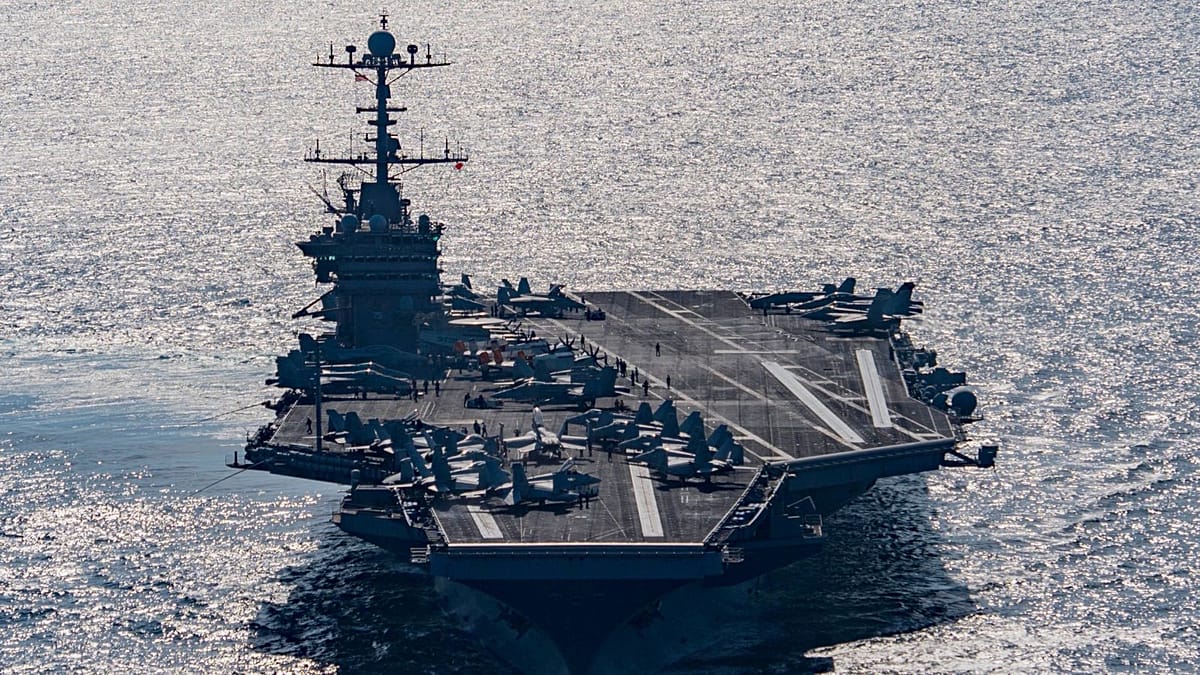
The United States is reinforcing its naval presence in the Middle East with a third carrier strike group, marking the most significant military buildup in the region since the 2003 invasion of Iraq. The USS Theodore Roosevelt, a Nimitz-class nuclear-powered supercarrier, left San Diego on Sunday without the usual ceremonial send-off, according to ship-spotter photographs. It is accompanied by the guided-missile cruiser USS Chosin, destroyer squadrons, and Carrier Air Wing 11, which includes F-35C and F/A-18 Super Hornet jets, as well as electronic warfare and early-warning aircraft.
A day later, the amphibious ready group led by the USS Makin Island also sailed from San Diego, carrying the 13th Marine Expeditionary Unit of more than 2,000 Marines aboard three ships, including the USS John P Murtha and USS Anchorage. According to the Associated Press, citing US officials, the combined deployment adds 9,000 to 10,000 additional troops, with arrivals expected by the end of November. The US already has more than 50,000 military personnel in the Middle East, potentially bringing the total to over 60,000.
A US official told Al Jazeera that by the end of November, three carrier strike groups and two amphibious ready groups would be in place around Iran, adding that "leaders will have many options for dealing with Iran." The USS George HW Bush and USS George Washington are currently in the Arabian Sea conducting operations against Iran, according to the US Naval Institute's report from Tuesday. The Navy has maintained a two-carrier presence since the US and Israel launched the war on Iran on 28 February, and the USS Boxer amphibious-ready group is already in theatre.
Rotation or escalation?
The Theodore Roosevelt is scheduled to relieve the USS George Washington, according to USNI News. Whether the George Washington departs before or after the Theodore Roosevelt arrives will determine if the US briefly operates three carrier strike groups simultaneously. If all three overlap, it would be only the second such deployment since April, which was itself the first time since 2003 that the US had three carriers in the region at once.
The Wall Street Journal reported that if the USS George Washington remains on station until the Theodore Roosevelt arrives, all three carrier groups would be in theatre together. Whether that represents a sustained increase in posture or a temporary overlap during rotation remains unclear.
This buildup comes amid heightened tensions across the region, with ripple effects felt in Europe. For instance, fuel costs now eat 15% of Bulgaria's minimum wage as the crisis deepens, highlighting the economic strain on European households. Meanwhile, Russian strikes have crippled Ukraine's power grid as winter approaches, a reminder of the broader security challenges facing the continent.
European leaders are watching the US deployment closely, as any escalation in the Middle East could have significant implications for energy prices, migration flows, and security cooperation. The European Union has repeatedly called for de-escalation, but the US and Israel have shown no signs of slowing their military campaign against Iran.
The presence of three carrier strike groups, each with a formidable air wing, gives US commanders a wide range of options, from airstrikes to a potential blockade. The amphibious ready groups add the capability for a Marine expeditionary unit to conduct beach landings or evacuations, further expanding the potential scope of operations.
For now, the US military is positioning itself for a prolonged presence in the region, with no clear end in sight. The coming weeks will reveal whether this is a temporary surge or a new normal in the Middle East's volatile security landscape.