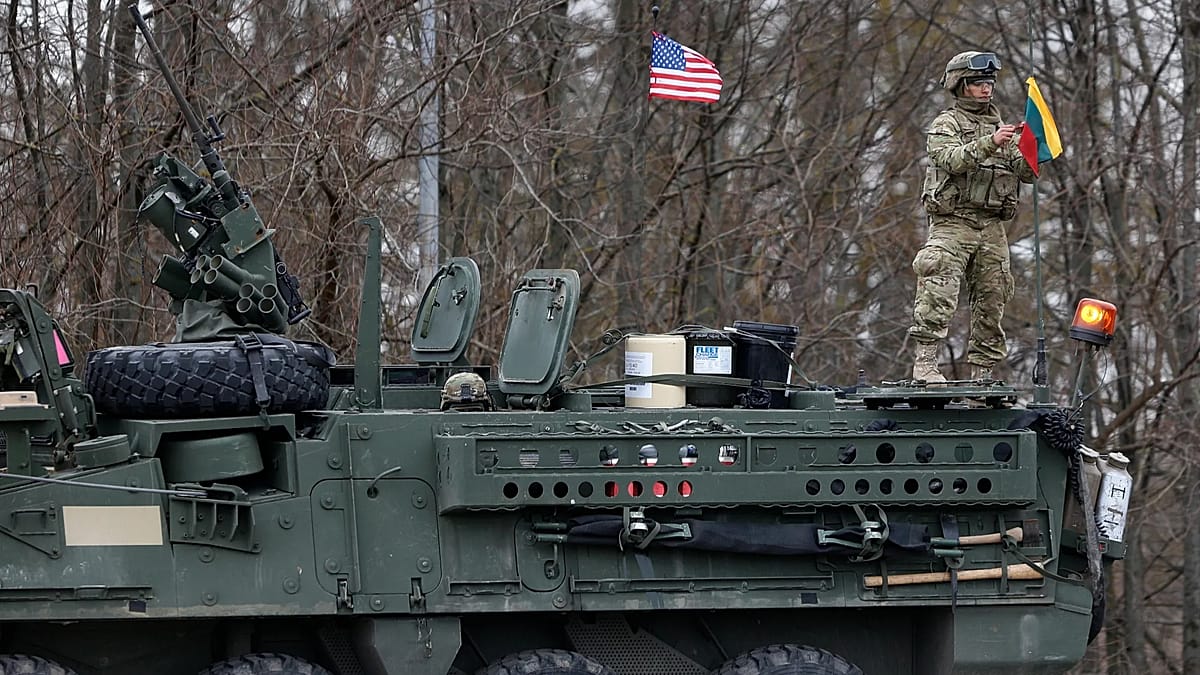
Lithuanian President Gitanas Nausėda said on Tuesday that a fresh rotation of American soldiers is en route to the Baltic state, offering Vilnius reassurance even as Washington signals a broader shift of attention away from Europe.
"I have just received confirmation that the new rotation of U.S. troops is already on its way," Nausėda wrote in a social media post, thanking the Trump administration for the decision. He described the American military footprint in Lithuania as "an indispensable part of our deterrence and collective defence," adding that it matters "not only for Lithuania, but also for the security of the entire region."
The announcement lands awkwardly against the backdrop of repeated threats from US President Donald Trump to scale back America's military presence on the continent, as his administration increasingly prioritises the Middle East and Latin America. Lithuanian media reported in June that roughly 1,000 US troops had begun leaving the country as their deployment cycle ended, raising questions in Vilnius about what would follow.
Size of the new contingent
Deividas Matulionis, a presidential adviser, told LRT Radio on Tuesday that the incoming force would be no smaller than the previous one. That suggests the US footprint in Lithuania will hold steady rather than shrink, at least for now.
Foreign Minister Kęstutis Budrys framed the decision as a signal of allied solidarity. "The decision on continued U.S. military presence in Lithuania is a powerful signal of Allied unity and resolve," he wrote on X. He also pointed to Lithuania's own contribution, noting that the country spends 5% of GDP on defence, is strengthening national capabilities and offers what he called the best training conditions for allied forces.
"Lithuania stands proud as committed Ally, leading by example with 5% defence spending." — Kęstutis Budrys, Lithuanian Foreign Minister
A frontline state on NATO's eastern edge
Lithuania occupies a strategically exposed position on NATO's eastern flank. It borders Russia's Kaliningrad exclave to the southwest and Russian ally Belarus to the east and south, with the Suwałki corridor — a narrow strip of land linking the Baltics to Poland — sitting just beyond its border.
Along with Latvia and Estonia, Lithuania has felt the ripple effects of Moscow's war in Ukraine, including a rising number of drone and airspace incidents in recent months. In May, after a drone incursion over Vilnius, Defence Minister Robertas Kaunas told Euronews that the Baltic states must brace for further such threats.
The wider region has also been contending with hybrid pressure. In one recent episode, an elderly Russian swimmer was turned back after crossing the Nemunas river into Lithuania, a reminder of the everyday friction along the border. Vilnius has separately warned that EU sanctions enforcement remains uneven, arguing that a delisting of Usmanov could expose EU weakness in the sanctions regime.
What it means for the alliance
The rotation is unlikely to settle the deeper anxiety in Vilnius, Tallinn and Riga about Washington's long-term commitment to Article 5. Trump's public scepticism toward NATO has pushed European capitals to accelerate their own defence spending and industrial planning, with Poland, Estonia and Lithuania among those leading on GDP share.
For now, the arrival of a new US contingent offers a measure of continuity. But the political signal is mixed: a rotation that continues under a president who has repeatedly questioned the value of America's European presence is a reminder that allied reassurance in the Trump era is transactional, reversible and closely watched from Moscow.