The United States' decision to withdraw 5,000 troops from Germany, coupled with similar threats directed at Italy and Spain last week, has cast uncertainty over the future of the approximately 12,000 US military personnel stationed on Italian soil. Prime Minister Giorgia Meloni responded by scheduling a meeting with US Secretary of State Marco Rubio on Friday, following his Thursday visit to Pope Leo XIV at the Vatican.
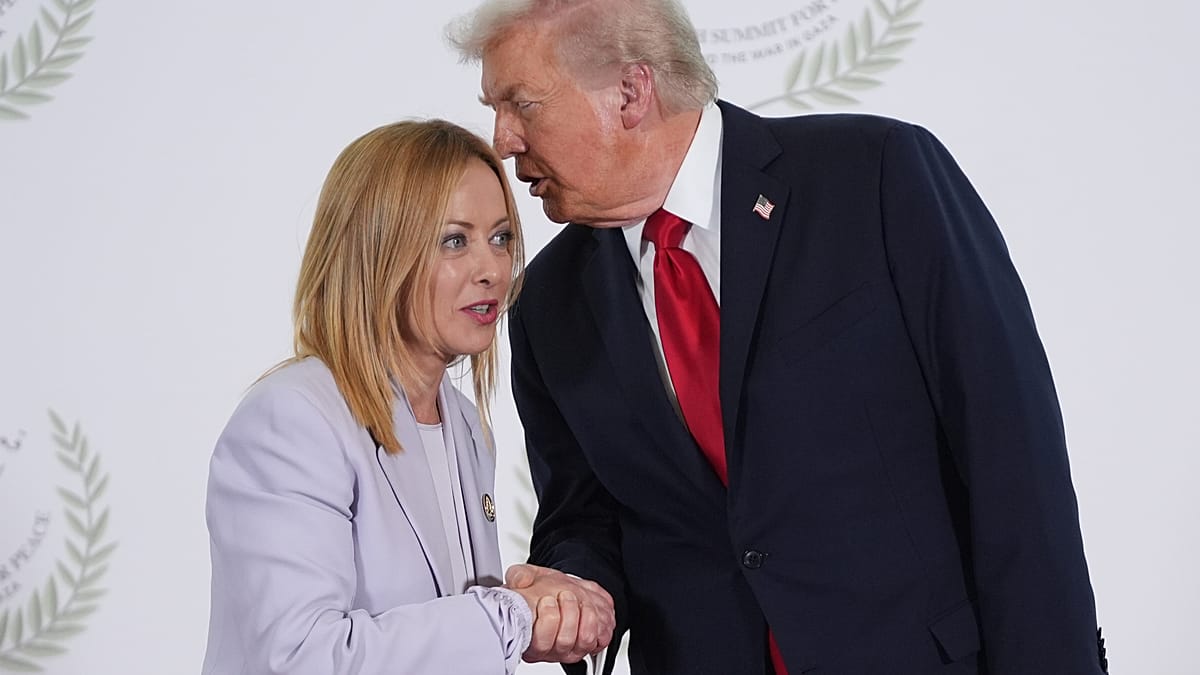
The once-privileged relationship between Meloni and President Donald Trump has frayed rapidly since Trump returned to the White House. Last month, Meloni described as unacceptable Trump's accusations of “weakness” against the Pontiff, while Trump accused her of lacking courage for not supporting his ally in the war against Iran.
“Italy has always honoured the commitments it has undertaken within NATO,” Meloni stated on Monday at the European Political Community summit in Armenia. “A downsizing of the US presence would not be something we could support,” she added, noting that the decision not to go to war in the Middle East was also firm.
The refusal to expand the use of the US base at Sigonella for offensive operations against Iran has irritated Trump. However, several factors suggest this spat will not lead to a rupture between the two NATO allies, and Italy may continue to serve as a privileged interlocutor for the White House in Europe.
Why a US Withdrawal from Italy Is Unlikely
According to Gregory Alegi, professor of History and Politics of the United States at Luiss University in Rome, Trump's “verbal outbursts” should remain superficial and not damage relations between Washington and Rome for historical, strategic, and economic reasons.
“Italy and the United States have had extremely solid relations for 80 years, in the interests of both sides, and no Italian government has ever been anti-American,” Alegi told Euronews. “Just think what would happen if Sigonella were closed: you would need two or three aircraft carriers in the Mediterranean. The US has a strategic interest in maintaining its position in Italy.”
The professor notes that discussions of a strategic reorientation toward Asia have persisted since the Soviet Union's collapse, but Trump's transactional behavior as a former businessman does not signal a change in strategy. “For the United States, what is privileged in Europe is the quality of its presence, thanks to technological capabilities that only it possesses, such as space and command centres and cyber capabilities,” Alegi explains. “That does not change with the withdrawal of 5,000 troops.”
As an example, he cites the Alliance Ground Surveillance (AGS) programme, NATO's aerial reconnaissance and intelligence system using aircraft and radar stations, which relies on US installations in Sicily. “The AGS system at Sigonella has no alternatives, and Italy has done a good job in creating the regulatory framework that allows these UAVs to coexist with conventional aviation.”
The Role of Defense Contracts and Crosetto's Trip to Washington
Like the rest of Europe, “Italy has always spent on social programmes and relied on other people's defence,” but “the context has clearly changed” with the wars in Ukraine and the Middle East, leading Europe to rearm, argues Alegi, who recently edited the volume What Defence for Europe (Rubbettino). “There is a need for a cultural leap, to make people understand that spending on defence and security is not unproductive, but a service for citizens and a sector with high added value.”
Orders placed by the US Navy with Fincantieri and investments in the United States by Leonardo, another partly state-owned company, underscore this interdependence. Defence Minister Guido Crosetto is preparing a visit to Washington, where discussions may include several old and new defence contracts.
“One example is the M-346 training aircraft, which could be acquired by the US Navy. If the deal were to go through, it would be like receiving a mark of quality and would give the United States the possibility of selling it on in other markets that would otherwise be difficult to access,” Alegi explains, “as happened with the purchase of the C-27 by Australia.” The M-346, a twin-seater aircraft used to train pilots for new-generation fighters, is already in service in Italy, Poland, Greece, Israel, Qatar, and Singapore. The C-27J Spartan, also produced by Leonardo, is a tactical transport aircraft used by numerous countries, including the United States.
“Consider also the F-35 production line in Cameri, which has become a key hub for the delivery and maintenance of these fighters,” the academic adds, referring to the Italian Air Force base in Novara province, one of two assembly and checkout lines for the F-35 outside the US (the other is in Nagoya, Japan).
Rubio's stopover at the Vatican, meanwhile, is tied to discontent among the Catholic electorate toward Trump, but Alegi argues it will not have lasting consequences for Italy. For more on the broader tensions, see our coverage of Trump's feud with Pope Leo XIV and the legal questions surrounding troop cuts.