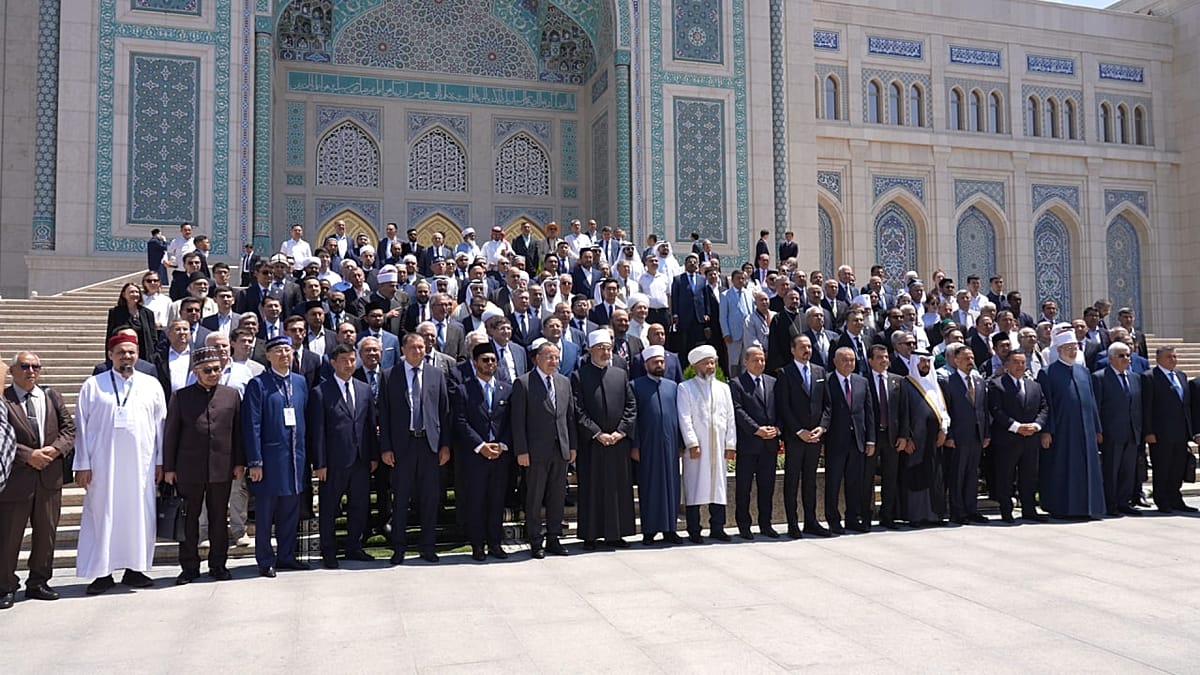
More than 450 scholars, religious leaders, diplomats, and researchers from over 50 countries have gathered in Uzbekistan for the first International Forum of Islamic Civilisation, a five-day event spanning Tashkent, Samarkand, and Termez. The forum, organized by the Centre of Islamic Civilisation in Uzbekistan, seeks to reframe global perceptions of Islam by emphasizing its historical contributions to science, education, and intellectual life.
In a message delivered at the opening ceremony, President Shavkat Mirziyoyev described the current global climate as one of deep transformation, marked by conflict, mistrust, extremism, and Islamophobia. He argued that science, education, culture, and shared moral values remain essential foundations for peace, dialogue, and sustainable development.
Challenging Stereotypes Through Scholarship
One of the forum's central aims is to challenge the persistent association of Islam with violence or extremism. Rustam Jabborov, Scientific Secretary of the Centre of Islamic Civilisation in Uzbekistan, told Euronews: “The main purpose of this forum is to once again demonstrate the contribution of Muslim scholars to world civilisation and to show that Islam has always called for knowledge, education and humanism. Associating Islam with violence or extremism contradicts its true nature.”
The discussions place particular emphasis on the legacy of scholars from Central Asia whose work transformed mathematics, astronomy, medicine, and philosophy. Dr. Salem bin Mohammed Al-Malik, Director General of the Islamic World Educational, Scientific and Cultural Organization (ICESCO), noted that modern technologies like artificial intelligence owe a debt to these pioneers. “AI could not exist without the principles that were laid down by Al-Khwarizmi. Astronomy would not be where it is without Ulugh Beg and Al-Biruni. We have to be proud of our Islamic scholars,” he said.
The forum is also examining how artificial intelligence can help preserve, catalogue, and study ancient manuscripts, alongside broader initiatives to expand academic exchanges and international research partnerships. This focus on technology and heritage reflects a growing trend across Europe and the wider region, where digital tools are increasingly used to safeguard cultural assets. For context on how AI is reshaping other sectors, see our analysis of Global Economic Risks for Late 2026: Oil, Trade, and AI Uncertainty.
Uzbekistan's Growing Role in the Islamic and Turkic Worlds
Abdul-Ati Al-Sharqawi, Chairman of the Board of the Science Foundation for the Revival of Heritage and Digital Services in London and Cairo, highlighted the breadth of Uzbekistan's scientific heritage. “This country used to export great science, literature and creativity to the whole world,” he said. According to Al-Sharqawi, researchers have identified close to 100,000 manuscripts produced by scholars from Transoxiana that are now preserved in libraries worldwide, with new discoveries continuing to emerge.
Türkiye's Deputy Chairman of the Justice and Development Party (AK Party), Kürşad Zorlu, described the forum as another sign of Uzbekistan's growing influence. “Today Uzbekistan is home to a very important organisation for the Turkic and Islamic world. We see that the reforms carried out over the past ten years are crowned by this important institution,” he explained. “With its strength from more than 3,000 years of history, Uzbekistan has now become one of the important centres of Islamic civilisation. In this sense, Uzbekistan is of great importance to Türkiye.”
The forum's programme continues until 10 July, with participants expected to present more than 70 collaborative initiatives involving universities, museums, research institutions, and international organisations. These projects aim to foster scientific cooperation, education, and the preservation of Islamic heritage, offering a counter-narrative to extremism and Islamophobia that resonates far beyond Central Asia. For European readers, this initiative parallels ongoing debates about freedom of expression and religious sensitivity, as seen in recent controversies such as the arrest of Turkish Comedian Deniz Göktaş over jokes about Islam and Erdoğan.