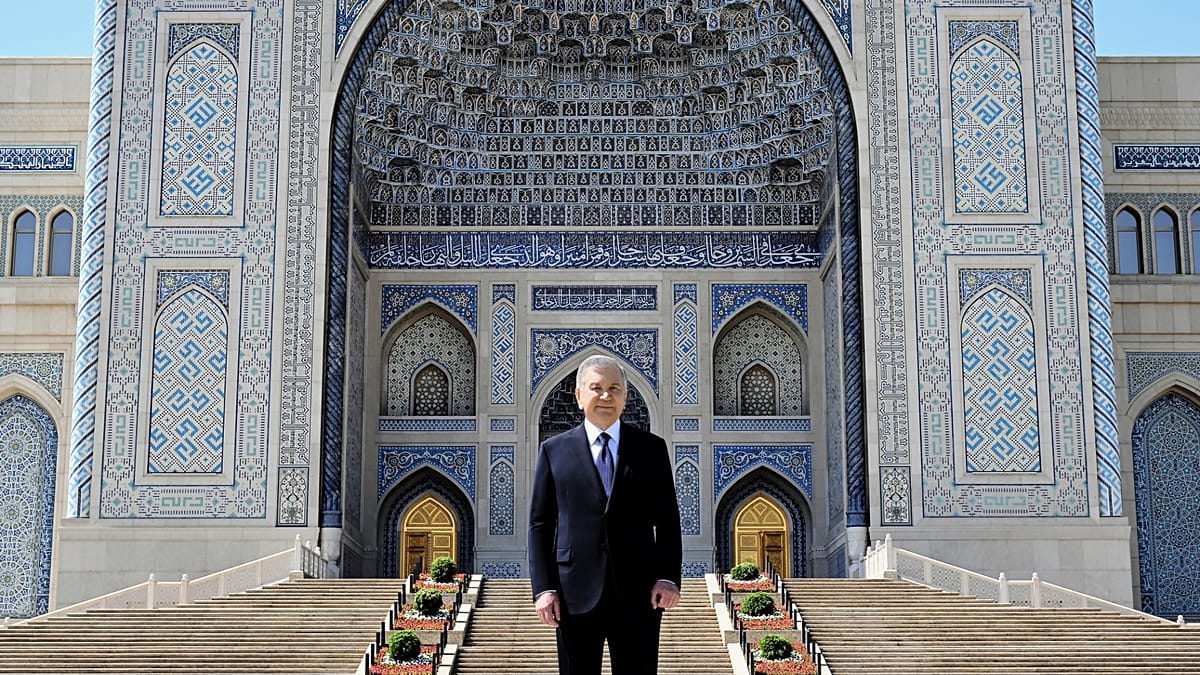
In Tashkent, a monumental cultural project has opened its doors, aiming to connect scholarship, faith, art, and dialogue across centuries and continents. The Center for Islamic Civilization in Uzbekistan, first proposed by President Shavkat Mirziyoyev at the United Nations in 2017, is now a fully operational institution dedicated to preserving and sharing the intellectual and artistic heritage of Uzbekistan and the wider Islamic world.
Opened to the public on March 17, 2026, the complex combines a museum, research units, a library, archives, restoration laboratories, educational spaces, and platforms for international exchange. Spanning more than ten hectares, the architecture draws on Timurid traditions while incorporating contemporary engineering, digital interpretation, and multimedia technologies.
A Hub for Dialogue and Enlightenment
During a visit while the Centre was under construction, United Nations Secretary-General António Guterres praised Uzbekistan’s emphasis on dialogue and enlightenment, calling President Mirziyoyev a leader who consistently promotes these ideas from the UN rostrum. The Centre has since hosted major international events, including the First International Forum “Islamic Civilization: The Path of Peace, Tolerance and Enlightenment” in July 2026, which brought together 500 representatives from 50 countries.
At the forum, Muslim World League Secretary-General Mohammed bin Abdulkarim al-Issa described Uzbekistan as “one of the brightest pages in the history of Islamic civilization.” The forum concluded with a declaration affirming the role of education, science, and culture in countering extremism, radicalism, and Islamophobia while advancing peace and intercultural dialogue.
President Recep Tayyip Erdogan of Turkey sent a message calling the initiative of great historical importance not only for Uzbekistan but for the entire Islamic world and the common future of mankind. He noted that under Mirziyoyev’s leadership, Uzbekistan is becoming the standard-bearer of this historic mission.
Treasures and Recognition
At the heart of the Centre is the Holy Quran Hall, set beneath a 65-meter dome. Among its treasures is the Mushaf of Uthman, one of the most revered manuscripts in the Islamic world, inscribed on UNESCO’s Memory of the World International Register. Alongside it are 114 Quran manuscripts connected to the territory of modern Uzbekistan.
The Centre has received six international awards, including recognition by the Guinness Book of World Records as the largest museum of Islamic civilization, the “Best Islamic Heritage Site of the Year” at the Halal in Travel Global Summit 2026, and inclusion by Prix Versailles among the world’s most beautiful museums. Smithsonian Magazine also listed it as one of the year’s most anticipated museums.
President Alexander Stubb of Finland, who visited in November, praised the contemporary approach to presenting three thousand years of history as “the highest art.” Shaikha Al Nuwais, Secretary-General of UN Tourism, remarked, “I think I've never seen anything like it before.”
Restitution and Scholarship
The exhibition presents more than 2,000 rare artifacts, including items returned to Uzbekistan through cooperation with the OSCE, the Art Loss Register, London’s Metropolitan Police Service, and international experts. At the handover ceremony, Economic Crime Unit Chief Carrie Wood highlighted the extensive collaboration with partners in the UK and worldwide.
The library holds over 2,500 manuscripts and lithographs, about 40,000 printed publications, and more than 350,000 digital materials, supported by archives, restoration laboratories, a printing house, a calligraphy school, and next-generation educational spaces. Louis Ng, Director of the Hong Kong Palace Museum, called the investment “truly worthy on a global scale.”
For European audiences, this project offers a window into the shared heritage of the Islamic world and its connections to Europe through trade, scholarship, and cultural exchange. Similar efforts to balance heritage and modernity can be seen in places like Baku's Icherisheher, a living museum in Azerbaijan that navigates similar challenges.