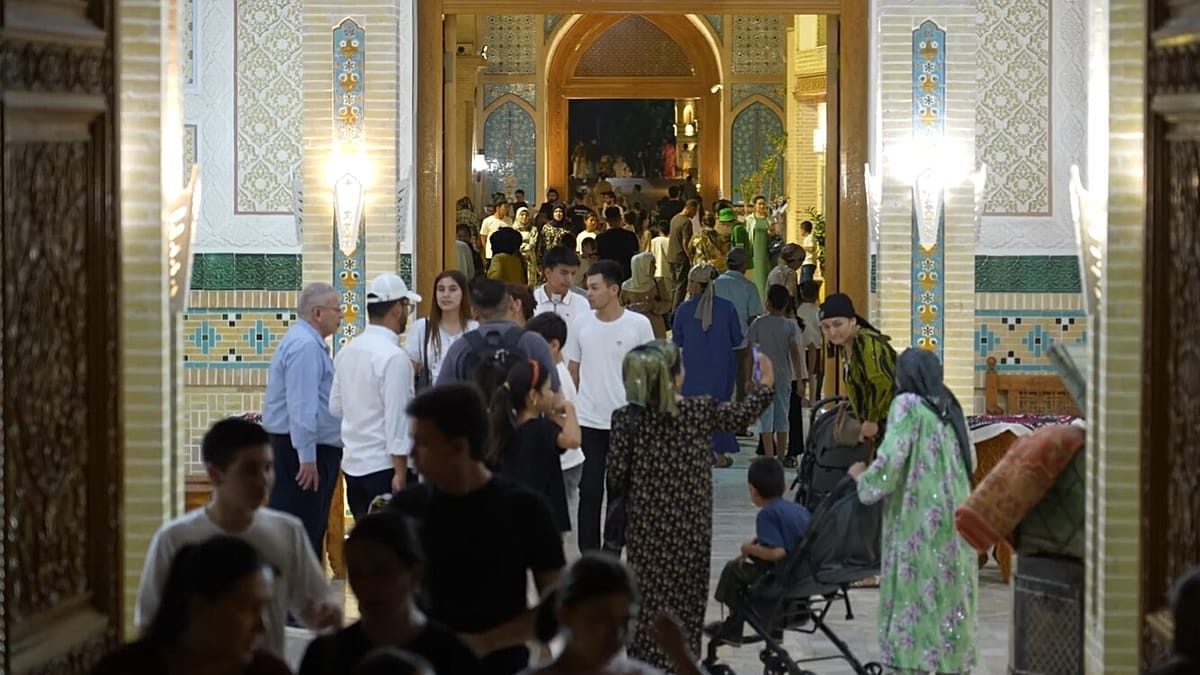
Uzbekistan's ancient cities have long drawn travellers to their turquoise domes and bustling bazaars, but the country's tourism story is no longer confined to the classic Silk Road circuit. New figures show that visitors are staying longer, spending more, and pushing deeper into regions that were once off the beaten track.
According to the country's Tourism Committee, Uzbekistan recorded 9.1 million visits by foreign nationals in the first eight months of 2026, a 21.1% increase compared with the same period last year. Tourism services exports jumped 53.5% to $4.6bn (€3.98bn), a sign that the economic impact of travel is growing faster than arrival numbers alone.
Yet the headline figure masks a more nuanced picture. Uzbekistan's statistics include visits to relatives, business trips, and other purposes alongside leisure travel. In the first eight months of 2025, for instance, visits to relatives accounted for 5.17 million of the 7.5 million total arrivals, while only 1.15 million were classified as travel. The latest data, however, suggest that the mix is shifting toward genuine tourism.
Longer stays, higher spending
Oybek Hakimov, adviser to the chairman of Uzbekistan's Tourism Committee, told Euronews that average spending per tourist has reached $503 (€436), up from $197 (€171) in 2017. Surveys conducted in May and June also put the average stay at eight days, up from shorter visits in previous years.
“We are also seeing more visitors travelling beyond the classic route of Tashkent, Samarkand, Bukhara and Khiva,” Hakimov said, pointing to growing interest in the Fergana Valley, Kashkadarya and Surkhandarya, as well as Muynak and Nukus in Karakalpakstan.
That broader geographic spread is supported by improved transport links. The new Jaloliddin Manguberdi high-speed train between Tashkent and Khiva began operating in May, cutting the journey from around 14 hours to about seven and a half. By late July, the service had already carried almost 30,000 passengers.
Tourist Sabina Flandrick said getting around by rail had been straightforward. “We got around by train, which was great,” she said, also praising the hotels, restaurants and service she encountered.
Long-haul markets on the rise
Some of the fastest growth is coming from markets far beyond Central Asia. In the first eight months of 2026, arrivals from China increased 2.3-fold, Malaysia doubled, and Japan rose 1.5-fold. Among European markets, Germany saw a 25% increase, while France and the United Kingdom were both up 21%, according to the Tourism Committee.
Data from Uzbekistan's National Statistics Committee show that the 'travel' category accounts for a large share of arrivals from some European countries. Of 26,100 German visitors recorded in the first seven months, more than 23,100 were travelling for leisure. For Italy, the figure was 20,100 out of 21,000 visitors.
Hakimov attributes part of the growth to easier entry requirements. Uzbekistan's visa-free regime now covers citizens of 94 countries, although permitted stays vary by nationality. He cites China as a prime example: following the introduction of reciprocal 30-day visa-free travel, the number of Chinese visitors in 2025 was more than six times the 2023 level.
Uzbekistan has also gained recognition in the adventure travel sector, ranking fifth in Much Better Adventures' 2026 list of top destinations for solo adventure travel, which weighs safety, entry requirements, costs, hiking opportunities, and traveller feedback.
First-hand impressions
Romanian traveller Cezar Marksteiner-Ungureanu knew little about Uzbekistan before deciding to visit. Even some of his friends questioned what there was to see. “I wanted something completely new for myself,” he told Euronews. He began reading about the Silk Road and planned a journey through Tashkent, Samarkand, Bukhara and Khiva.
Once there, he said the experience challenged those expectations. “I felt very secure all the time. People are very welcoming and try to help us everywhere.”
Tessa Bradford, another visitor, was drawn by images of the country. “I've done a lot of travelling, and I had heard that Uzbekistan was really beautiful, really fun to travel,” she said. “The pictures looked incredible, so I needed to come see it for myself.”
Accommodation and service standards
The tourism boom is also reshaping the country's hospitality sector. Between January and July 2026, 705 new accommodation facilities opened, adding 22,296 beds. Uzbekistan now has 7,440 registered facilities with capacity for more than 202,000 guests.
At the Khiva Silk Road Hotel, manager Qudrat Rajabov has seen capacity grow from 38 rooms at its 2019 opening to 43 today. The hotel welcomes around 7,000 to 8,000 guests a year, with international visitors making up the larger share. Rajabov notes that competition is intense. “Service comes first now,” he said. “Competition has become very strong and there are many hotels.” The hotel is sending reception staff, chefs, and waiters to professional training centres as businesses place greater emphasis on service standards.
Better air connections through nearby Urgench are also helping. Rajabov told Euronews that direct international flights into Urgench, combined with the new rail service, are bringing more visitors to the region.
For travellers seeking a destination that combines history with a sense of discovery, Uzbekistan is increasingly offering more than the well-trodden Silk Road. As the country invests in infrastructure and opens up to the world, its tourism industry is evolving from a niche heritage stop into a broader, more diverse market.