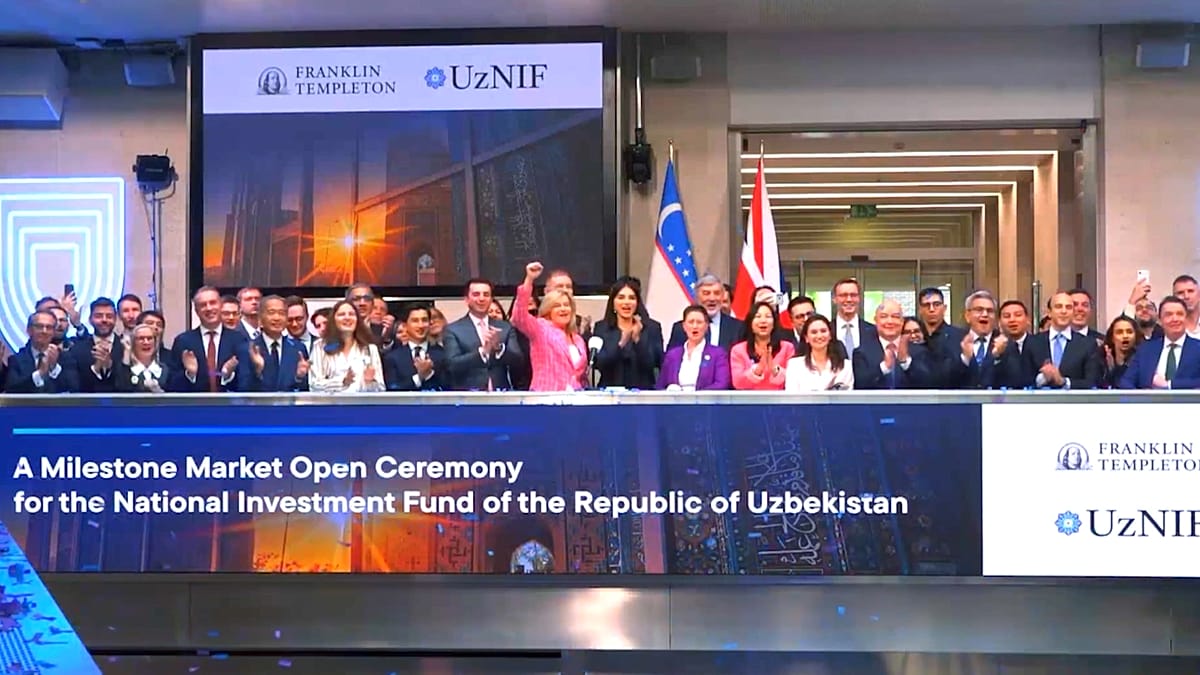
International investors have become shareholders in some of Uzbekistan's largest state-owned companies for the first time, following a dual listing in London and Tashkent that raised nearly $700 million (€615 million) and attracted more than $2.8 billion (€2.46 billion) in investor demand. The figures drew attention across financial markets, but the longer-term significance of the transaction may extend well beyond the capital raised.
Through the National Investment Fund of Uzbekistan (UzNIF), investors have acquired exposure to 13 state-owned companies operating across sectors including energy, telecommunications, transport and banking. Rather than investing in a single business, shareholders are buying into a portfolio of enterprises that have historically operated under state ownership.
Governance Over Fundraising
Julia Hoggett, Chief Executive Officer of the London Stock Exchange, said the structure of the fund allows international investors to gain exposure to several of the country's largest companies through a single investment vehicle managed by Franklin Templeton. Saida Mirziyoyeva, Head of the Presidential Administration, described the transaction as part of a broader effort to strengthen institutions and deepen international engagement.
“This IPO is not just about raising capital. It is about building trust in a new generation of Uzbek institutions,” she said during the London Stock Exchange listing ceremony.
Established by presidential decree in August 2024, UzNIF holds minority stakes ranging from 25% to 40% in some of the country's largest state-owned enterprises. The fund currently includes holdings in 13 companies with an estimated portfolio value of approximately $2.44 billion (€2.15 billion) and is managed by Franklin Templeton. While the IPO generated fresh capital, it also introduced a new group of shareholders into companies that have traditionally answered primarily to government institutions.
Quinn Martin, President of investment firm Bluestone, said the transaction introduces a new layer of oversight. “Over 150 funds who were allocated shares in UzNIF are now shareholders in 13 of Uzbekistan's leading state-owned enterprises,” Martin told Euronews. “They will participate in those companies' governance and oversight. They will demand that those companies operate as commercially viable entities.”
Bekzod Khashimov, economist and Assistant Professor at New York University in Abu Dhabi, said the longer-term significance of the IPO may lie less in the capital raised and more in the governance changes public listing can bring to state-owned companies. “The main goal wasn't necessarily the money,” he told Euronews. “The issue is to improve the governance of corporations owned by the state. Public listing requires regulation, transparency and governance practices, so that the state cannot interfere in the day-to-day running of the company.”
Jenny Johnson, Chief Executive Officer of Franklin Templeton, noted during a ceremony at London Stock Exchange that “Franklin Templeton is honoured to partner with the government of Uzbekistan in promoting good governance across state-owned enterprises, building strong and sustainable businesses that underpin Uzbekistan's economy and supporting the development of a vibrant local capital market.”
Khurshed Mustafoev, Uzbekistan's Deputy Minister of Economy and Finance, said the fund was also designed to introduce internationally recognised governance standards and prepare companies for greater participation in capital markets. “The fund is designed to introduce best-in-class international corporate governance standards to state-linked companies, paving the way for future private sector participation and further corporate listings,” he said.
Deepening Capital Markets
The transaction is also being viewed as an important step in the development of Uzbekistan's capital markets. Historically, many companies have relied primarily on state funding or bank financing. Equity markets have played a more limited role in raising capital than in more developed financial centres. Fayzulla Tashov, Chairman of the Management Board of the Republican Stock Exchange “Toshkent”, said the dual listing in London and Tashkent was intended to demonstrate that the country's capital market is increasingly ready to integrate with international financial centres. He pointed to growing contacts with other exchanges, including Hong Kong, as evidence of expanding international engagement. “What does this mean? It means that the capital market has reached a level of maturity that allows it to integrate with global markets,” he told Euronews.
One of the more notable aspects of the transaction was the participation of retail investors. According to official figures, around 4,700 domestic investors submitted applications during the local offering, providing many citizens with an opportunity to invest directly in companies linked to sectors such as energy, banking, telecommunications and transport. Khashimov said broader public participation in capital markets could gradually increase pressure on company management to improve performance and accountability. “If broader public ownership of state-owned corporations increases, it would put pressure on boards and management to run the companies well,” he said.
According to the World Bank, Uzbekistan's economy grew by 7.7% in 2025. Combined with a population approaching 40 million, this has helped attract growing interest from frontier market investors. Dmitriy Abbasov, Director of Investment Banking at Avesta Investment Group, said the level of demand reflected growing international interest in the country's economy. “Investors from across the globe have chosen to believe in Uzbekistan's potential,” he said.
The UzNIF IPO marks a significant shift for Uzbekistan, moving from a state-dominated economy toward greater integration with global capital markets. While the fundraising was substantial, the real test will be whether the new governance standards and shareholder oversight can transform how these state-owned enterprises operate. For European investors and policymakers watching frontier markets, this transaction offers a case study in how public listings can drive institutional change. As Uzbekistan deepens its ties with international financial centres, the success of this IPO could pave the way for further listings and a more vibrant local capital market.