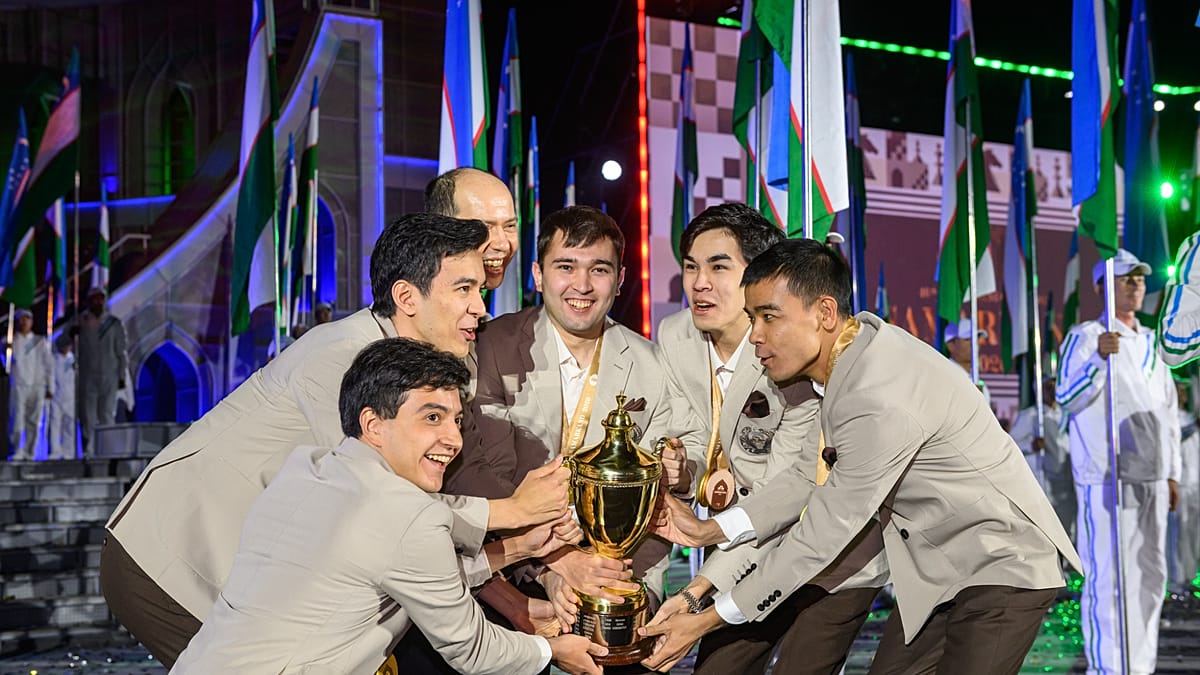
The largest Chess Olympiad ever staged concluded in Samarkand with a home triumph: Uzbekistan claimed the Open gold medal after a decisive final-round victory over Ukraine. The tournament, organised by the International Chess Federation (FIDE), brought together almost 400 national teams from more than 190 countries, a record for the event.
Uzbekistan finished with 20 out of 22 possible match points, winning ten of its eleven matches. Along the way, the team defeated defending champions India, China, and the top-seeded United States. Their only loss came against Germany, who went on to claim the bronze medal.
“This is our second Olympiad victory. Winning it at home feels different,” said Uzbek grandmaster Javokhir Sindarov. “I think we played the tournament at the highest level.” Sindarov’s next major challenge comes later this year: after winning the Candidates Tournament, he will face India’s Gukesh Dommaraju for the world title in Geneva from 22 November to 12 December. Both players will be 20 at the time, making it the youngest World Championship match in chess history.
A team effort built on individual brilliance
Nodirbek Abdusattorov, playing on Uzbekistan’s first board, was another key figure. He went through the entire Olympiad without a single loss and earned an individual gold medal for his performance. “I think we can now confidently say that Uzbekistan is unrivalled in the world of chess,” he said after the victory.
India took silver, while Germany secured bronze – their first Open team medal at a Chess Olympiad since 2000, when they finished second in Istanbul. German grandmaster Vincent Keymer called it “by far the best Olympiad we’ve had in recent years, at least as long as I’ve been playing.”
Several European nations also finished strongly: Hungary, France, and Spain all placed inside the top 10, alongside Azerbaijan and Armenia. The women’s competition saw China take gold, Kazakhstan silver, and defending champions India bronze. Indian grandmaster Koneru Humpy, part of the bronze-winning team, noted the tournament’s global appeal: “There is a lot of attention from all the spectators and followers, and this is one of the widely followed tournaments from all over the world.”
A changing of the guard at FIDE
The Olympiad also marked a leadership transition in international chess. Timur Turlov, then president of the Kazakhstan Chess Federation, was elected FIDE president during the federation’s General Assembly in Samarkand. At 38, he became the youngest person ever to hold the post. “The interest in the game is definitely rising year over year,” Turlov said. “It’s not just a professional sport. It’s a sport which is getting more and more popular almost everywhere.”
The tournament’s scale was unprecedented: 205 teams in the Open and 189 in the Women’s competition. For nearly two weeks, hundreds of games were played simultaneously in the same hall, bringing together players from every corner of the globe. At the closing ceremony, the Olympiad flag was handed to representatives of the United Arab Emirates, hosts of the next edition.
For Uzbekistan, the victory is another milestone in its chess renaissance, following the country’s cultural resurgence and growing international profile. The win also underscores the broader Central Asian chess boom, with Kazakhstan’s rise and the region’s increasing investment in the game.