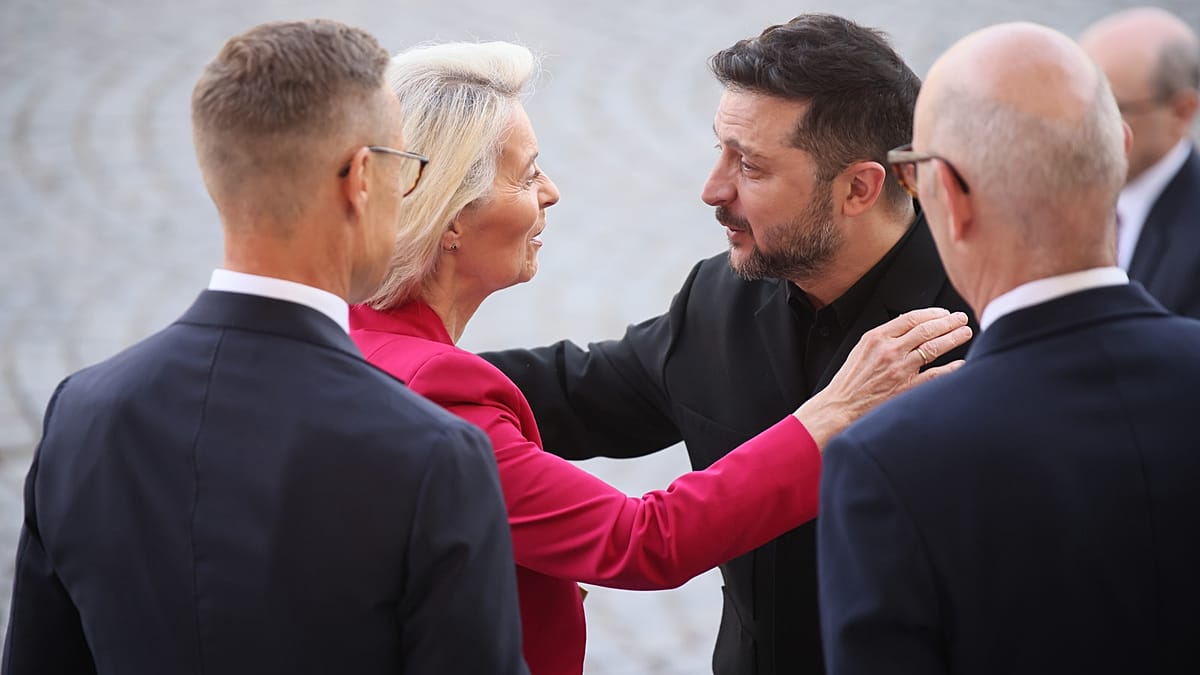
European Commission President Ursula von der Leyen arrived in Kyiv on Wednesday, telling Ukrainian President Volodymyr Zelenskyy that the war's momentum is shifting in Ukraine's favor. "Ukraine has built a strong military momentum. The tide is turning," she said upon arrival. "The EU is fully playing its part, with our €90 billion loan."
The visit marks a stark contrast to von der Leyen's last trip in late February, when Ukraine was enduring a brutal winter of Russian blackouts, the EU's loan was blocked by Hungary, and accession talks were stalled. Now, Ukraine is launching long-range strikes on Russian oil refineries, the loan is operational, and Kyiv opened another cluster of EU accession negotiations just yesterday.
Drone Deal and EU-Ukraine Industrial Partnership
Discussions between von der Leyen and Zelenskyy will focus heavily on drones, which dominate the battlefield. Zelenskyy has teased an imminent "drone deal" with the EU, expected to be unveiled Wednesday. A key novelty is the possibility of building and storing drones inside EU territory for transfer to Ukraine. Both sides frame it as a win-win: Ukraine gains from Europe's industrial scale, while Europe taps into Ukraine's technological ingenuity.
During the visit, von der Leyen will receive the newly created Order of Europe from Zelenskyy, an award recognizing those who defend Ukraine's sovereignty and advance its EU membership path. Observers will watch for any comments on enlargement, as the Commission prepares reforms to accommodate new member states.
Ukraine's Government Reshuffle
The visit coincides with a government reshuffle in Kyiv. Prime Minister Yulia Svyrydenko was removed after just a year, dissolving her cabinet and triggering a search for a replacement. The most politically sensitive decision is whether Defence Minister Mykhailo Fedorov will stay or be let go barely six months into his tenure. Fedorov, though not a public figure, is widely praised within the military and civil society for his reform-minded, low-profile management. His potential removal raises questions about who could credibly replace him at a moment when Ukrainian forces have intensified their campaign to isolate Crimea. Ukrainian troops have hit more than 100 Russian vessels in the Sea of Azov in eight days, opening a new front to choke Moscow's logistics in the peninsula.
Meanwhile, EU ambassadors meet again this morning to try to agree on the 21st package of sanctions against Russia, pushing talks to the wire before the oil price cap is automatically revised upward. Zelenskyy warned that "every day of delay in sanctions decisions" gives Moscow more time to prepare for deadly airstrikes.
Gibraltar Border Fence to Disappear
In other EU-UK news, an agreement signed in Brussels on Tuesday paves the way for the demolition of the border fence separating Gibraltar from Spain, ending checks that have been a regular feature of life for over a century. The arrangements for the British Overseas Territory became uncertain after Brexit, which 96% of Gibraltarians voted against. The new pact, governing movement of people and goods, enters into force provisionally today pending final parliamentary approval.
Spain's Foreign Minister José Manuel Albares said the deal opens "a new period in the bilateral relationship between Spain and the United Kingdom" and provides the "last missing peace" to close Brexit, adding it paves the way for a new era in EU-UK relations. However, he stressed the pact does not change Spain's claim to sovereignty over Gibraltar "a single bit." Gibraltar's Chief Minister Fabián Picardo responded by calling for focus on areas of agreement, saying the deal ensures "where there was a fence, there is now fluidity."