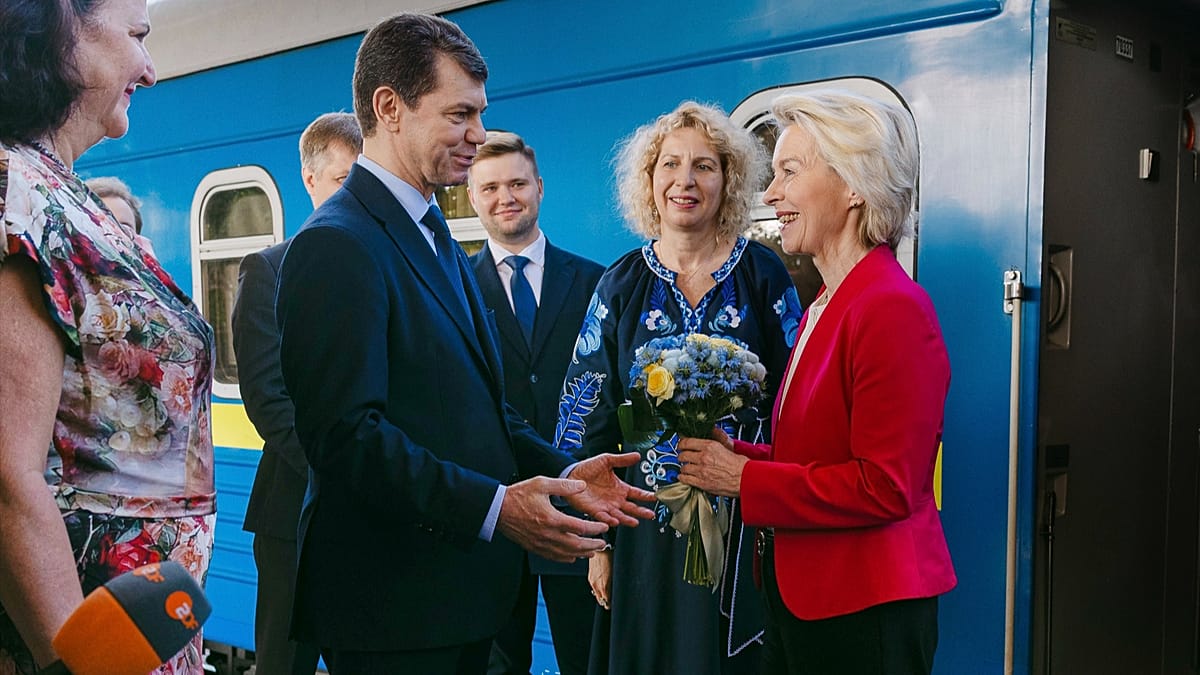
European Commission President Ursula von der Leyen touched down in Kyiv on Wednesday for talks with President Volodymyr Zelenskyy, with the agenda dominated by drone production and Ukraine's stalled but now revived EU accession process. The visit, her second to the Ukrainian capital in 2025, comes as the war enters a new phase.
In late February, von der Leyen found a country battered by Russian air strikes that had crippled the power grid, a Hungarian blockade on a €90 billion EU loan, and accession talks frozen. Today, the landscape is markedly different. Ukraine has launched audacious long-range strikes on Russian oil refineries, straining Moscow's war economy. The €90 billion loan is flowing, and on Tuesday, Ukraine opened another cluster of accession negotiations, breaking the deadlock that had persisted under Hungarian Prime Minister Viktor Orbán.
Drone Cooperation Takes Center Stage
"Ukraine has built a strong military momentum. The tide is turning," von der Leyen said upon arrival. "The EU is fully playing its part, with our €90 billion loan. In Ukraine, I will announce new initiatives to deepen the integration of our defence industries."
The centerpiece of the discussions is a long-anticipated "drone deal" between Ukraine and the European Union. Zelenskyy has teased the agreement for weeks, and details are expected to be unveiled during the visit. A key innovation will be the storage of these unmanned aerial vehicles on EU territory, a move designed to protect supply chains and ensure rapid deployment. Both sides frame the pact as a win-win: Ukraine gains access to Europe's industrial scale, while the EU taps into Ukraine's battlefield-tested technological ingenuity.
Drones have become the dominant weapon in the war of attrition, with both sides relying on them for reconnaissance, strikes, and electronic warfare. Ukraine's domestic drone industry has grown rapidly, producing models that can strike deep into Russian territory. The EU, meanwhile, has struggled to ramp up its own production capacity. This partnership aims to close that gap.
Accession Talks Back on Track
The visit also underscores the EU's renewed commitment to Ukraine's membership path. After months of paralysis caused by Hungary's veto, the bloc has now opened six accession clusters, covering everything from rule of law to economic criteria. The latest cluster, opened on Tuesday, signals that the process is moving forward despite ongoing political turbulence in Budapest, where Hungary's parliament is set to vote on a constitutional change to remove President Sulyok.
Von der Leyen's message is clear: the EU sees Ukraine's future within the bloc as a strategic imperative, not just a symbolic gesture. The drone deal and the accession progress are two sides of the same coin—both aimed at integrating Ukraine into European security and political structures.
The visit also comes as Ukraine undergoes a government reshuffle, with Zelenskyy appointing a new prime minister to steer the country through wartime governance and EU reforms. The new cabinet is expected to prioritize anti-corruption measures and judicial independence, key benchmarks for accession.
For the EU, the stakes are high. A successful integration of Ukraine would reshape the continent's security architecture, while failure could embolden Russia and destabilize the region. Von der Leyen's trip is a bet that the tide has indeed turned—and that Europe must ride it.