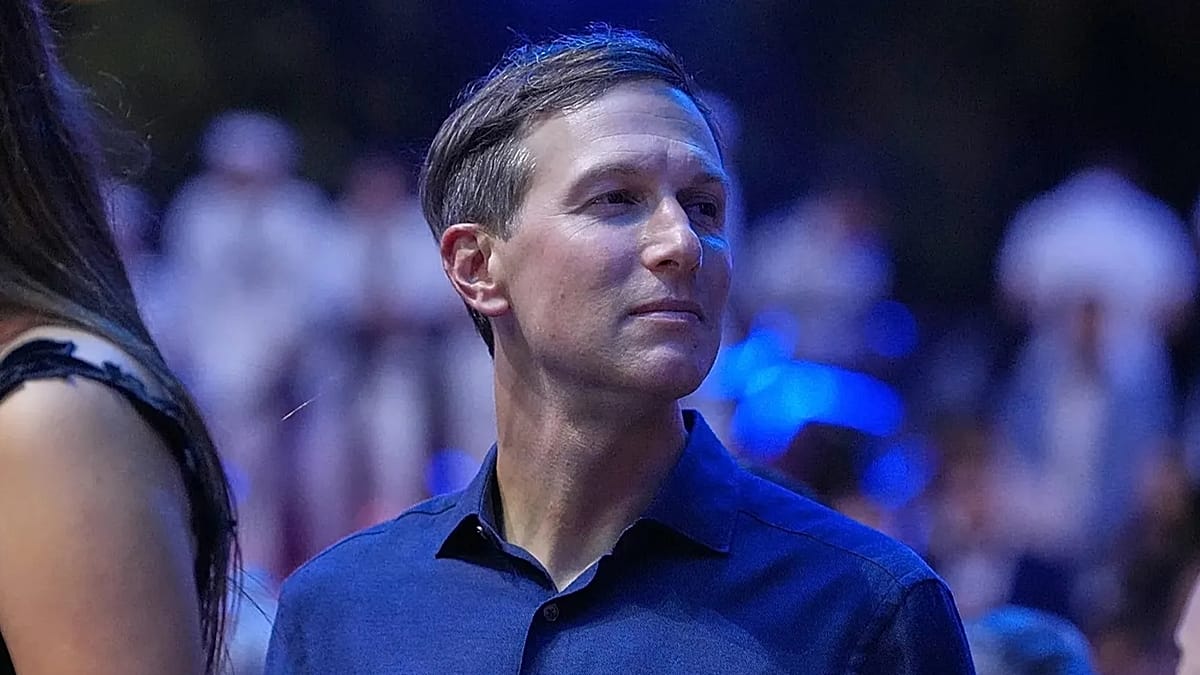
On Monday, dozens of foreign ministers convened under the Palestine Donor Group (PDG) to discuss Gaza's recovery. Among the participants, appearing via video link, was a controversial US businessman with no official government position but outsized influence: Jared Kushner, son-in-law of President Donald Trump.
Kushner's presence at the PDG meeting, hosted by EU Commissioner for the Mediterranean Dubravka Šuica, underscores a delicate reality for Brussels: while the EU has not endorsed the Board of Peace (BoP)—the Trump-chaired body tasked with overseeing Gaza's reconstruction—any European initiative in the strip must ultimately contend with Kushner, who holds a central role in the BoP.
A Necessary Engagement
The EU does not approve of the BoP and has avoided legitimising it. Yet, as one EU diplomat noted, Kushner's participation was "very choreographed" and not particularly substantive, but his mere presence marked a significant step forward for the EU's plans. The reason is straightforward: the BoP, with its almost unlimited powers, is the gatekeeper for reconstruction projects in Gaza.
During the conference, the PDG launched the "Team Gaza Initiative," a programme pooling €883.6 million from EU and non-EU countries for early recovery actions. France, Germany, the United Kingdom, and Japan have pledged funding, alongside the European Commission, the European Investment Bank, and the World Bank. Australia, Canada, and Ireland are expected to announce additional contributions soon. However, the total remains far below the estimated $71 billion needed for Gaza's reconstruction over the next decade, as calculated by the EU and the United Nations.
The United States has not joined the initiative, which EU officials insist is "not in competition" with the BoP's long-term plan. Each partner can channel its own funding through its preferred mechanism, but EU officials have ruled out member states financing projects through BoP-controlled bank accounts.
Šuica's Diplomatic Gamble
Kushner's invitation was the result of months of diplomatic groundwork by Šuica, who attended the first—and so far only—BoP meeting in Washington last February. That decision drew sharp criticism, with French Foreign Minister Jean-Noël Barrot claiming she had no mandate to represent the EU. But the gamble paid off: Šuica's relationship-building secured Kushner's participation nine months later, a feat that a non-EU country diplomat described as "not a minor achievement."
While the US declined to attend the previous PDG meeting in November, Kushner accepted this time. The EU, for its part, is seeking to avoid confrontation. "Only collective effort can help rebuild Gaza," Šuica said after the meeting, stressing the need for cooperation among all actors. The following day, she met in Brussels with Nickolay Mladenov, the former Bulgarian foreign minister who now serves as the BoP's High Representative for Gaza, signaling that dialogue with the body remains ongoing.
Kushner's Bridge to Israel
Kushner's importance extends beyond the BoP. His close ties to Israel—where he helped broker a ceasefire between Israel and Hamas last year and served as lead negotiator for the 2020 Abraham Accords—give him unique leverage. Israel retains the final say over any reconstruction projects in Gaza, and Middle Eastern governments view the US as the only global power with sufficient influence over Israel to unlock progress on the ground.
On Monday, Šuica announced the first two recovery projects to be implemented with Israeli approval, focusing on water infrastructure and solid waste management. EU officials expect more projects to follow. The EU remains the largest provider of humanitarian assistance to the Palestinian people, having contributed €1.65 billion since the outbreak of the war on 7 October 2023, and nearly €30 billion since 1994.
As the EU navigates its relationship with the BoP, Kushner's role as a bridge to both Washington and Jerusalem makes him indispensable—even if Brussels remains uncomfortable with the arrangement. The broader geopolitical context, including tensions in the Gulf and US-Iran clashes, adds further complexity to the region's dynamics. For now, the EU's strategy hinges on pragmatic engagement with a figure it neither fully trusts nor can afford to ignore.