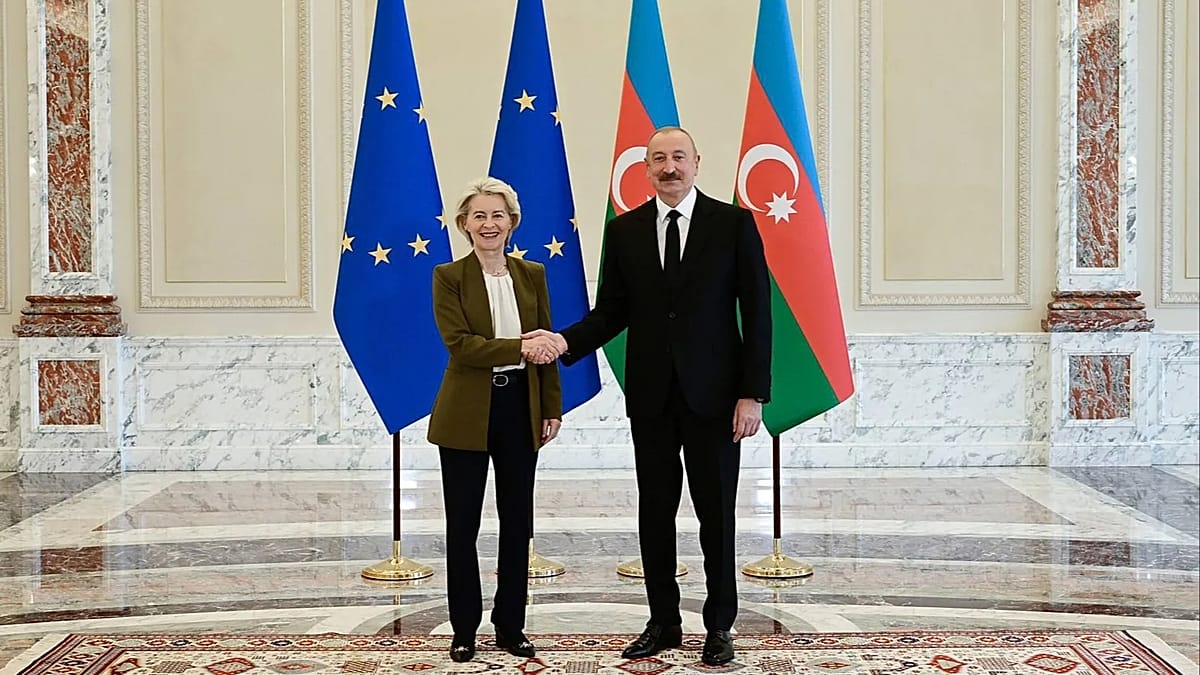
European Commission President Ursula von der Leyen met Azerbaijani President Ilham Aliyev in Baku on Tuesday, kicking off a two-day visit to the South Caucasus that signals the European Union’s intensifying focus on the region as a strategic partner for energy diversification, transport connectivity, and conflict resolution.
Baku is the first stop before von der Leyen travels to Yerevan, with the European Commission framing the trip as part of sustained high-level engagement with partners across the South Caucasus. At a joint press conference following their talks, the two leaders zeroed in on the Armenia-Azerbaijan peace process, transport corridors, energy cooperation, and the broader EU-Azerbaijan strategic partnership.
Energy Security and the Southern Gas Corridor
Von der Leyen described Azerbaijan as a key partner for the 27-member bloc, highlighting its role in supporting Europe’s energy security amid geopolitical uncertainty. “In recent years, Azerbaijan has proven to be a reliable, trusted energy partner to the European Union. We have not forgotten that at a time when Russia weaponized energy in terms of gas for Europe, Azerbaijan stepped up. The Southern Gas Corridor indeed strengthened Europe’s energy security, and it is a remarkable success story,” she said in Baku on Wednesday.
Since the EU signed a strategic energy partnership with Azerbaijan in 2022, cooperation has expanded beyond natural gas to include renewable energy, digital infrastructure, and the development of the Trans-Caspian International Transport Route, commonly known as the Middle Corridor. Aliyev noted that half of Azerbaijan’s gas exports now go to EU member states, calling the Southern Gas Corridor “the main artery for transportation of natural gas from Azerbaijan to Europe.”
Peace Process and Connectivity
Von der Leyen welcomed progress in the peace process between Armenia and Azerbaijan, saying a final agreement could unlock broader regional cooperation. “I want to congratulate you for initiating a historic peace agreement with Armenia. You showed personal leadership in promoting peace and cooperation across the region. Together we can indeed turn peace on paper into peace in practice,” she said.
The European Commission president announced that Brussels would propose launching an EU-Azerbaijan Connectivity Partnership, covering transport, energy, and digital infrastructure. She said the EU’s Global Gateway initiative would provide up to €200 million in grants for projects across the South Caucasus, with the potential to mobilise up to €2 billion in public and private investment. Von der Leyen also announced a €20 million programme to support peace-building initiatives, including demining, healthcare, rural development, and backing small and medium-sized enterprises.
Aliyev described relations with the European Commission as entering an “unprecedented” active phase, pointing to a series of high-level visits between Brussels and Baku over the past year. “We have a very active phase of relationship between the European Commission and Azerbaijan. This is unprecedented dynamism in our relationship, which reflects the mutual view of all sides to intensify our cooperation and to strengthen partnership,” he said.
Beyond energy, both leaders identified transport connectivity as a central pillar of future cooperation. Von der Leyen described the South Caucasus as a strategic crossroads linking Europe, the Caspian region, and Central Asia, while Aliyev highlighted Azerbaijan’s role in developing east-west and north-south transport corridors and expanding cargo flows through the country. This aligns with broader EU efforts to diversify supply routes, as seen in Kazakhstan’s plans to boost oil exports via the Baku-Tbilisi-Ceyhan pipeline.
Von der Leyen’s visit coincides with a broader week of EU diplomacy in the region. On the same day, EU foreign policy chief Kaja Kallas, Commissioner for Enlargement Marta Kos, and Commissioner for Internal Affairs and Migration Magnus Brunner held talks in Ankara with Turkish President Recep Tayyip Erdoğan and Foreign Minister Hakan Fidan, focusing on regional security, migration, trade, and connectivity. The parallel engagements reflect the EU’s broader strategy to strengthen ties with the South Caucasus and Türkiye as Brussels seeks to deepen cooperation on energy, transport, economic resilience, and regional stability.
The visit underscores how the EU is pivoting toward the South Caucasus as a critical node in its post-Ukraine strategy to reduce dependence on Russian energy and develop alternative trade routes. For more on the EU’s engagement in the region, see Von der Leyen’s broader tour.