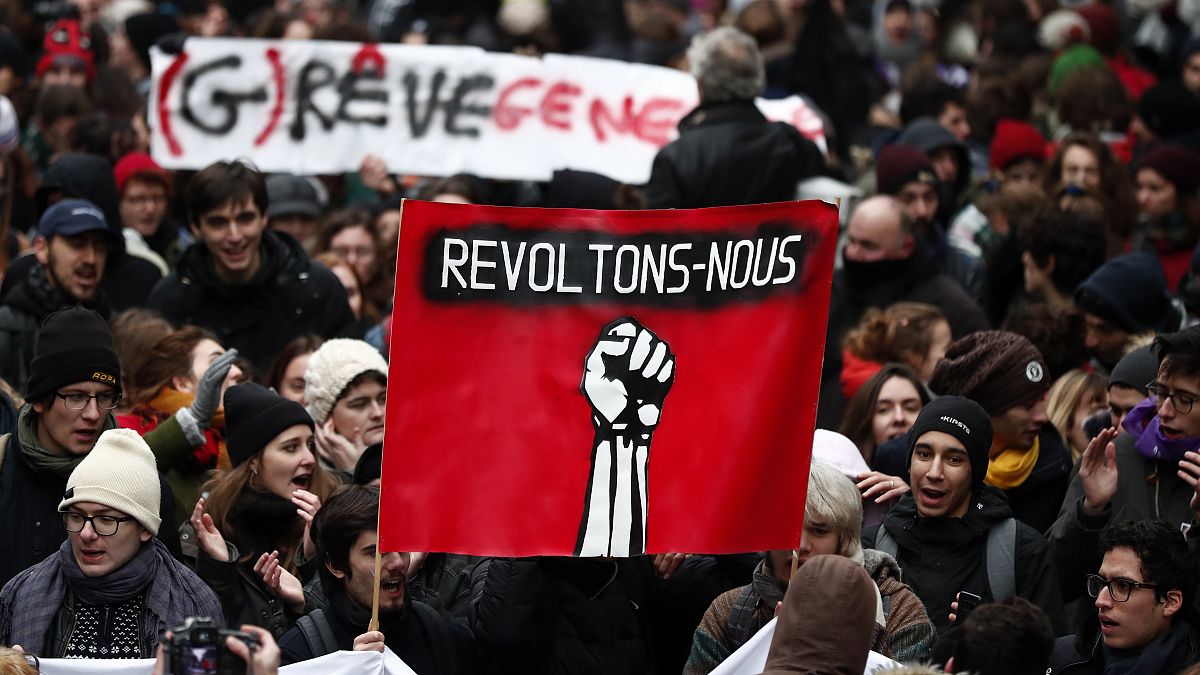
Railway workers in France walked off the job on Tuesday in the latest wave of industrial action against President Emmanuel Macron's pension overhaul, which would raise the retirement age. It was the sixth nationwide strike since the reform was unveiled in January, and similar protests have erupted in other sectors.
The United Kingdom has also seen a resurgence of strikes, with nurses staging their first walkout in over a century in December 2022, followed by rail workers, teachers, and health staff in early 2023. Spain and Germany have also experienced recent strikes, mostly over pay and working conditions.
But which European countries are most prone to strikes? And is industrial action becoming more or less common? To answer that, analysts typically look at "working days lost" per 1,000 employees, a metric that fluctuates sharply from year to year, making long-term trends more telling than single-year snapshots.
Strike hotspots: from Spain to Cyprus
Data from the European Trade Union Institute (ETUI) shows that between 2000 and 2009, Spain topped the list with an average of 153 working days lost per 1,000 employees annually, followed by France (127 days) and Denmark (105 days). Belgium and Finland each recorded 70 days. In contrast, the UK lost just 28 days, Germany 13, and the Netherlands 8, while Switzerland and Poland saw fewer than 10.
Between 2010 and 2019, Cyprus emerged as the strike capital, losing an average of 275 days per 1,000 employees, with France second at 128 days. No other country exceeded 100 days; the UK and Germany both averaged under 20 days. For the pandemic years of 2020-2021, France led with 79 days, followed by Belgium (57), Norway (50), and Denmark and Finland (49 each).
Year-by-year figures reveal spikes: France hit 364 days in 2010, while Spain saw 365 days in 2002 and over 300 in 2000 and 2004. The UK and Germany rarely exceeded 57 days in any single year over the past two decades.
A continent-wide decline
Despite these hotspots, the overall trend is downward. OECD data comparing the 1990s with 2008-2018 shows dramatic falls in most countries. Spain's average dropped from 309 to 76 days, Turkey from 223 to 10, and Denmark from 169 to 105. The UK saw a decline from 30 to 20 days, and by 2017 the number of striking workers hit its lowest level since the 1890s, according to the Office for National Statistics.
Belgium is a notable exception, with strike days rising from 31 to 98 over the same period. This suggests that while the culture of striking remains strong in some countries, it is fading in others.
Collective bargaining and the right to strike
The right to strike is a cornerstone of labour relations, and collective bargaining coverage—the share of employees covered by union-negotiated agreements—varies widely across Europe. According to the International Labour Organization (ILO), Italy has the highest coverage at 99%, followed by France and Austria at 98%. Germany stands at 52%, while the UK lags at 27%. Turkey and Lithuania have the lowest rates in Europe at just 7%.
These figures help explain why strikes are more frequent in some countries than others. In France, for instance, high union density and a tradition of protest make industrial action a common tool. In Germany, a system of co-determination and sectoral bargaining often resolves disputes before they escalate to strikes.
As Europe's economies recover from the pandemic and face inflation, the balance between workers' demands and fiscal constraints will continue to shape industrial relations. While the overall number of strike days is falling, the recent unrest in France and the UK shows that labour disputes remain a potent force in European politics.