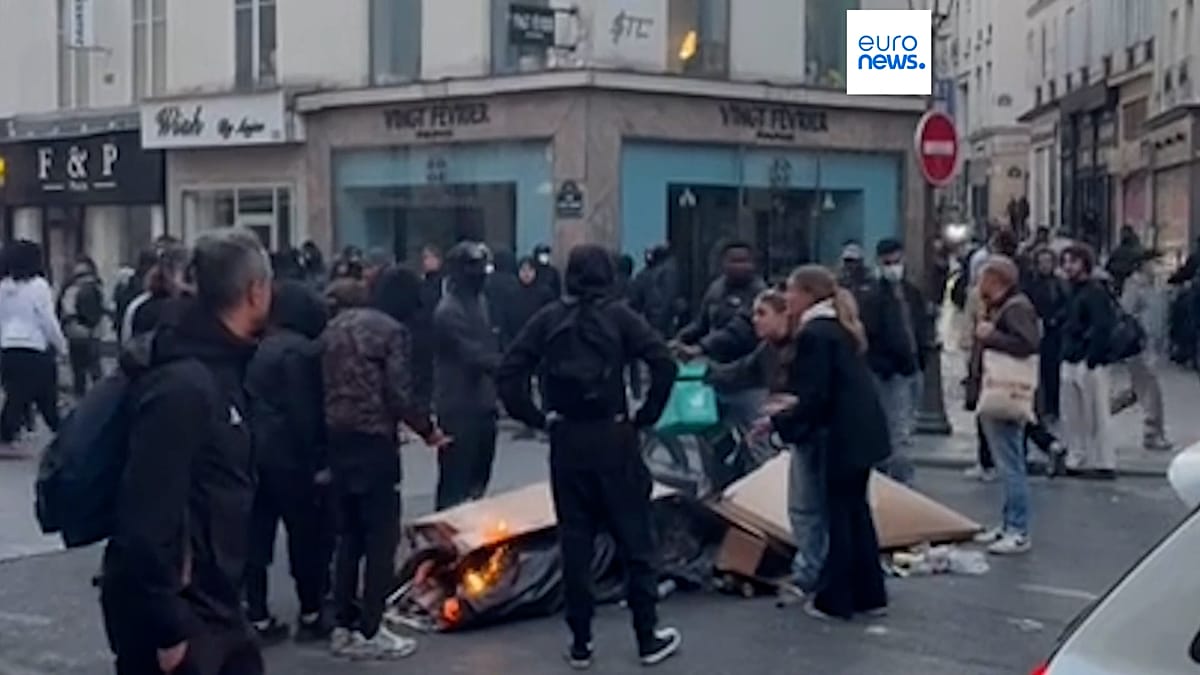
Paris remained on edge on Sunday evening as new clashes erupted in the heart of the city, adding to a week of mounting unrest over France's cost-of-living crisis. Demonstrators gathered near Place de la République, where fires were lit and police moved in to secure the area. Firefighters worked to extinguish the flames as smoke drifted over the surrounding streets.
Footage from the scene showed the looting of a clothing store in the neighbourhood, while bicycles were set alight nearby. Euronews crews on the ground reported a tense atmosphere, with sporadic confrontations between protesters and security forces continuing into the night.
Nationwide unrest
The Paris clashes are the latest in a wave of protests that have swept across France in recent days. From Lyon to Marseille, demonstrators have taken to the streets to voice anger over soaring prices, stagnant wages, and the squeeze on household budgets. In several cities, the demonstrations have turned violent, with arson, looting, and damage to public buildings.
In Limoges, the historic town hall was gutted by fire during the protests, a symbol of the depth of public frustration. The destruction has shocked many, and local officials have condemned the violence while acknowledging the underlying economic grievances.
The unrest has not been confined to France. Similar cost-of-living protests have erupted in other European countries, including violent clashes in Brussels and Liège, and dozens detained in Italian cities. The continent-wide nature of the discontent underscores a broader challenge for European governments as inflation and energy costs continue to bite.
Government response and public anger
French authorities have deployed significant police reinforcements to prevent further escalation. In Paris, officers secured key intersections and squares, while riot units stood by. The government has called for calm, but many protesters remain defiant, arguing that the political establishment has failed to address the root causes of the crisis.
“People are struggling to make ends meet,” said one demonstrator near République, who asked not to be named. “We are not here for the violence, but the government needs to listen.” The sentiment echoes across the country, where fuel, food, and housing costs have risen sharply, hitting low- and middle-income households hardest.
Economists point to a combination of factors, including post-pandemic supply chain disruptions, the war in Ukraine, and energy price volatility. France, like much of Europe, has seen inflation reach levels not witnessed in decades, eroding purchasing power and fueling social tensions.
Looking ahead
As the clean-up begins in Paris and other affected cities, the question is whether the protests will subside or intensify. Paris is cleaning up after the latest night of violence, but the underlying anger remains. Trade unions and grassroots movements have called for further demonstrations, and the government faces the delicate task of responding to public anger without appearing to capitulate to violence.
The situation in France is being closely watched across Europe, as other governments grapple with similar pressures. The European Union has proposed measures to ease energy costs, but national governments retain primary responsibility for social policy. The coming weeks will test the resilience of European democracies in the face of economic hardship.
For now, Parisians are left to navigate a city on edge, with the memory of fires and shattered storefronts fresh in their minds. The hope is that dialogue can replace confrontation, but the path forward remains uncertain.