Italy became the latest European country to see cost-of-living protests turn violent, as demonstrations in Milan, Turin, and Bologna on Saturday led to clashes with police, dozens of detentions, and significant damage to city centres. The unrest followed similar scenes in France, where protests over rising prices have repeatedly escalated in recent weeks.
Milan: 50 detained after clashes in city centre
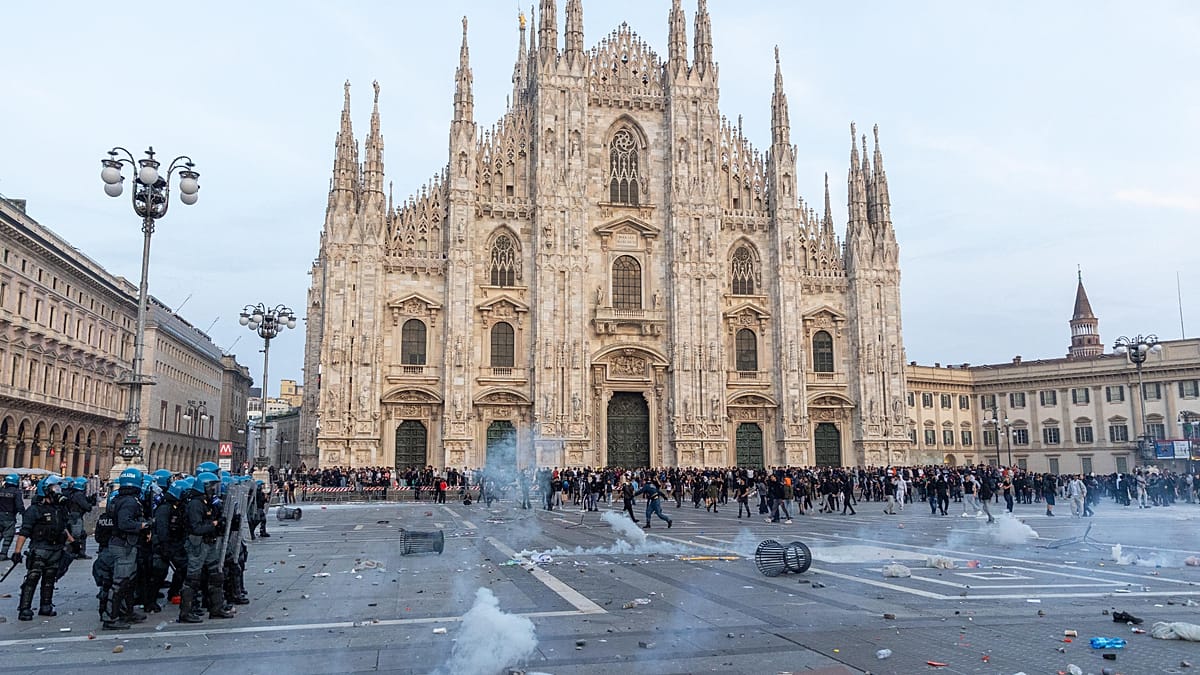
The worst violence occurred in Milan, where a march that began peacefully degenerated in Via Broletto and later spread to Piazza del Duomo. Police fired tear gas and used water cannons, while demonstrators threw firecrackers, rubbish bins, and barriers. Riot officers charged through the Galleria Vittorio Emanuele II, and the M1 and M3 metro lines were temporarily closed.
Several shops were vandalised, a portable toilet was set on fire in Piazza del Duomo, and chairs, tables, and benches were ripped up in side streets. According to local authorities, 25 people were injured and taken to hospitals, including ten police officers; none required emergency red-code transport. By the end of the protest, 50 people had been detained, half of them minors.
Turin and Bologna see similar unrest
In Turin, hooded protesters—many of them very young—blocked roads with rubbish bins and used tables and chairs from outdoor terraces as barricades. Bottles, firecrackers, sticks, and stones were thrown at police. Officers detained 12 people, ten of them minors, and said they found petrol bombs, firecrackers, cobblestones, and emergency window hammers in their possession.
In Bologna, clashes concentrated around the railway station and Piazza Medaglie d'Oro, where protesters threw stones and objects and knocked over dozens of hire bikes. The march had started in the early afternoon from Piazza Minghetti with chants against price rises, before a group broke away near the station to throw smoke bombs and glass bottles. Police again used water cannons and tear gas, and seven people were detained.
Political reactions: Meloni urges opposition to condemn violence
The violence quickly became a political battleground. Prime Minister Giorgia Meloni, referring to the CGIL trade union demonstration held the same day, said that taking to the streets is a right but condemned the clashes. In a post on social media, she said: "I renew my request to the opposition: do not be ambiguous on this. Any reticence becomes a justification."
Deputy Prime Minister and Foreign Minister Antonio Tajani accused part of the centre-left of "fanning the flames in an attempt to make up for its lack of ideas and proposals." Transport Minister Matteo Salvini went further, claiming the squares were filled with "social centres, maranza and rotten left-wing riff-raff," and asked whether there were still those who would "protect and defend them."
On the other side, Milan's mayor Giuseppe Sala acknowledged the protesters' grievances but condemned the violence: "The reasons for the protest were understandable. The violence against the police and the serious damage to the city are unjustifiable. Politics can choose to exploit the situation in search of electoral consensus. Or it can choose to face this extremely difficult moment in history with wisdom: I hope that is the path taken."
Pierfrancesco Majorino, leader of the Democratic Party in the Lombardy regional council, said the violent incidents were "absolutely unjustifiable and must be firmly condemned," but warned against using them to "criminalise the female and male students who have been taking to the streets peacefully for days, raising crucial issues such as the right to housing, education and, more broadly, their future."
The protests in Italy echo the unrest that has swept across France, where cost-of-living demonstrations have led to arson and looting in several cities. In Brussels and Liège, similar clashes have occurred, and in Marseille, protesters stormed the town hall. The spread of such violence across the continent highlights the growing frustration among citizens struggling with inflation and stagnant wages.
As Italy's interior ministry assesses the situation, the focus now shifts to whether the government will take additional measures to address the underlying economic pressures. For many observers, the scenes in Milan, Turin, and Bologna are a stark reminder that the cost-of-living crisis is far from over, and that political responses will be closely watched in the coming weeks.