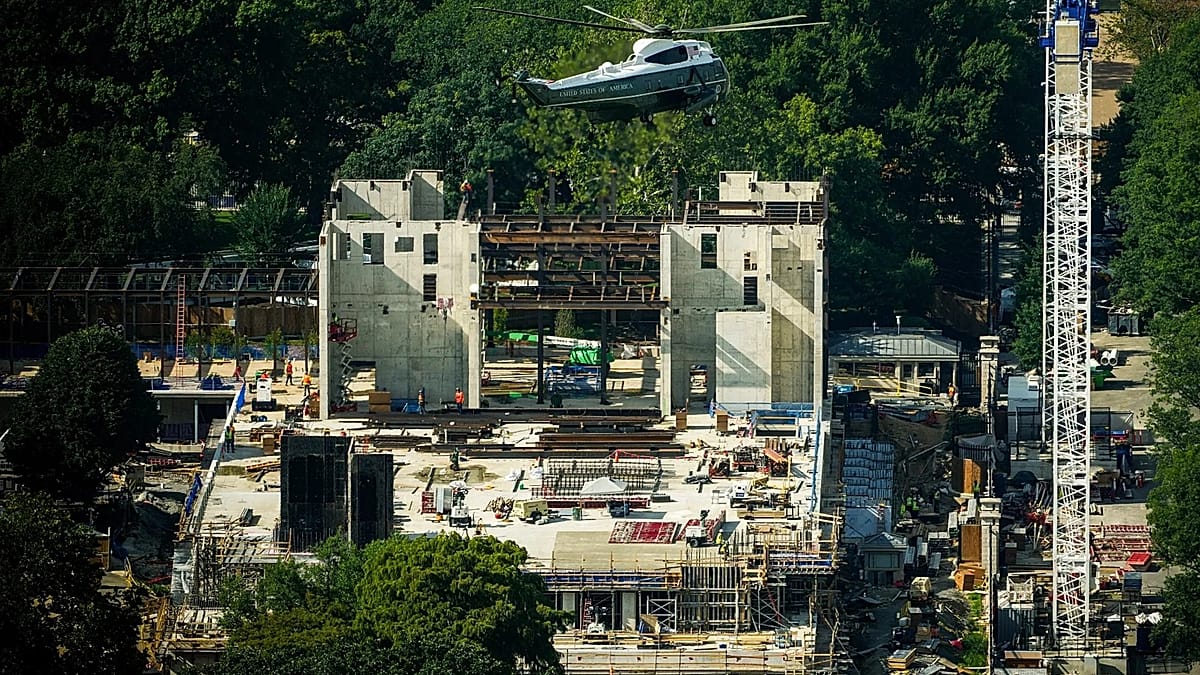
The White House is set to gain a grand new ballroom at a cost approaching $400 million, a project that President Donald Trump says will be financed entirely by private donors and corporations. The announcement came as the US Supreme Court issued a temporary order allowing above-ground construction to continue, just hours before lower-court rulings were due to halt the work for lack of congressional approval.
Speaking at a political event in South Carolina, Trump thanked the high court and the chief justice for the decision. “When they say proceed, I think that's a good thing. That's a good thing,” he said.
The president had earlier detailed the funding model: “We're spending hundreds of millions of dollars on the ballroom, and it's all from people like me and great companies that are putting it up. It's going to be close to $400 million, and it's all paid for by patriots and patriotic companies, big companies. I'll name the companies probably over the next couple of weeks, but I want to ask if they mind. But and really, most of them have said you could use my name gladly. So that's all money. No, no taxpayer money for the ballroom at all.”
A test of executive authority
The case has become a flashpoint in the broader debate over the limits of presidential power. The administration argues that the president holds absolute authority to alter the White House and other federal properties at his discretion, and it has invoked national security grounds to justify the construction. Yet when Trump first unveiled the plans, he made no mention of national security, instead framing the project as a privately funded venture supported by himself and other donors.
The National Trust for Historic Preservation, which filed the legal challenge, contends that the president lacks the unilateral authority to carry out the work, which involves razing the East Wing. The organisation's legal counsel accused the White House of trying to “outrun the courts” by accelerating construction before a full judicial review could take place.
The Supreme Court's temporary order is just that—temporary. The full court is expected to deliberate next on whether building work can proceed while the broader legal battle plays out. The decision will have implications not only for the ballroom but for the scope of presidential power over federal property.
For European observers, the case offers a striking contrast with the checks and balances that govern similar decisions in many European democracies. In countries like Germany or France, major alterations to state residences—such as the Élysée Palace or the Chancellery in Berlin—typically require parliamentary oversight and public procurement processes. The idea of a privately funded renovation of a head of state's official residence, with the courts as the only brake, is unfamiliar to most European legal systems.
The project also raises questions about historic preservation, a value that resonates strongly across Europe, where centuries-old buildings are often protected by strict heritage laws. The National Trust for Historic Preservation's concerns echo those of European heritage bodies, which have long argued that modernisation must not come at the cost of architectural and historical integrity.
As the legal saga continues, the White House ballroom has become a symbol of the current administration's approach to governance: bold, fast, and willing to test the boundaries of established norms. Whether the courts ultimately allow the project to proceed will be a defining moment for American constitutional law—and a case study for the rest of the world.