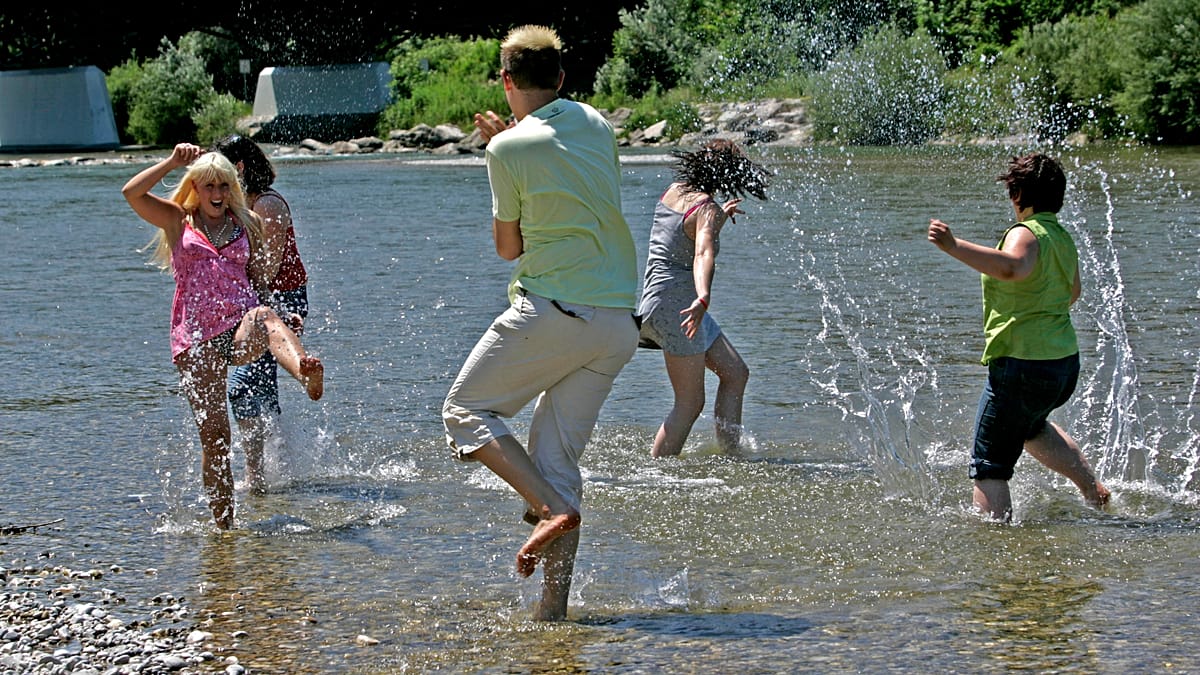
On a sweltering August afternoon in Basel, the Rhine is alive with swimmers. They drift past the Mittlere Brücke, their bright orange Wickelfisch float bags bobbing in the current, while tourists lick ice cream above. This is not a special event—it is a daily scene in Switzerland's third-largest city, where the river is treated as a public amenity rather than a hazard.
Basel's relationship with its river stands in stark contrast to many German cities. In Cologne and Düsseldorf, swimming in the Rhine is strictly forbidden, with fines up to €1,000. Yet the same river flows through both countries. Why the difference?
Basel's recipe: rules, infrastructure, and trust
Tim Edler, co-founder of Flussbad Berlin, an association campaigning for swimming in the Spree, recently visited Basel for the Swimmable Cities European Forum. He describes Basel as "one of the city's central features"—a model for urban river bathing. The city has marked safe swimming zones with buoys, installed showers and entry steps, and published clear guidelines on water temperature and currents. Swimmers are advised to enter only when the water is at least 18°C, to always swim with others, and to stay within designated areas.
Conradin Cramer, president of the Basel cantonal government, told SRF that for many residents, the Rhine is an essential part of everyday life. The annual Rhine Swim in mid-August attracts around 4,500 participants, who float two kilometres from Kleinbasel to the Johanniter Bridge. Christoph Bosshardt, head of Basel's location marketing, emphasizes that clean water alone is not enough: "Showers, steps, entry points, rescue plans and clear rules are just as important."
Basel's swimmable Rhine is not a gift of nature. After a 1986 chemical warehouse fire, toxic firefighting water and chemicals poured into the river, causing an ecological disaster. That catastrophe prompted a long-term rethink and decades of investment in water quality and riverside infrastructure. As Edler puts it, "This is something you can achieve through persistent, focused change."
Why Germany says no
In Germany, the Rhine is managed primarily for shipping. The riverbed has been modified with groynes—stone or gravel walls that jut into the water to maintain the navigation channel. These structures create dangerous currents and suction effects near the shipping lane. Cologne's city authorities cite numerous fatal accidents as the reason for the ban, noting that whirlpools and suction are invisible to swimmers.
Edler acknowledges the immediate danger: "If people fall into the water from one of these groynes that stick out into the river, they are automatically in an area of deadly whirlpools." He agrees that a temporary ban is sensible. But he argues that the groynes "did not just fall from the sky"—they were built for shipping, and could be redesigned to make the river safer for people.
The core issue, Edler believes, is administrative. "First and foremost we have an administration that develops the river in inner-city areas solely according to the principles of optimising it for shipping," he says. In Basel, by contrast, the authorities are willing to let people use the river on their own responsibility, providing information and rules rather than prohibitions.
Basel sits at the tripoint of Switzerland, France, and Germany. A few hundred metres downstream, the Rhine becomes the border—and swimming is banned on both the French and German sides. It is the same water, but treated completely differently.
This contrast is not merely academic. As climate change intensifies, European rivers face new pressures—from record low water levels to debates about constitutional climate protections. The question of how cities use their rivers is becoming more urgent. Basel offers a model that balances safety, ecology, and public enjoyment—one that other European cities might learn from.