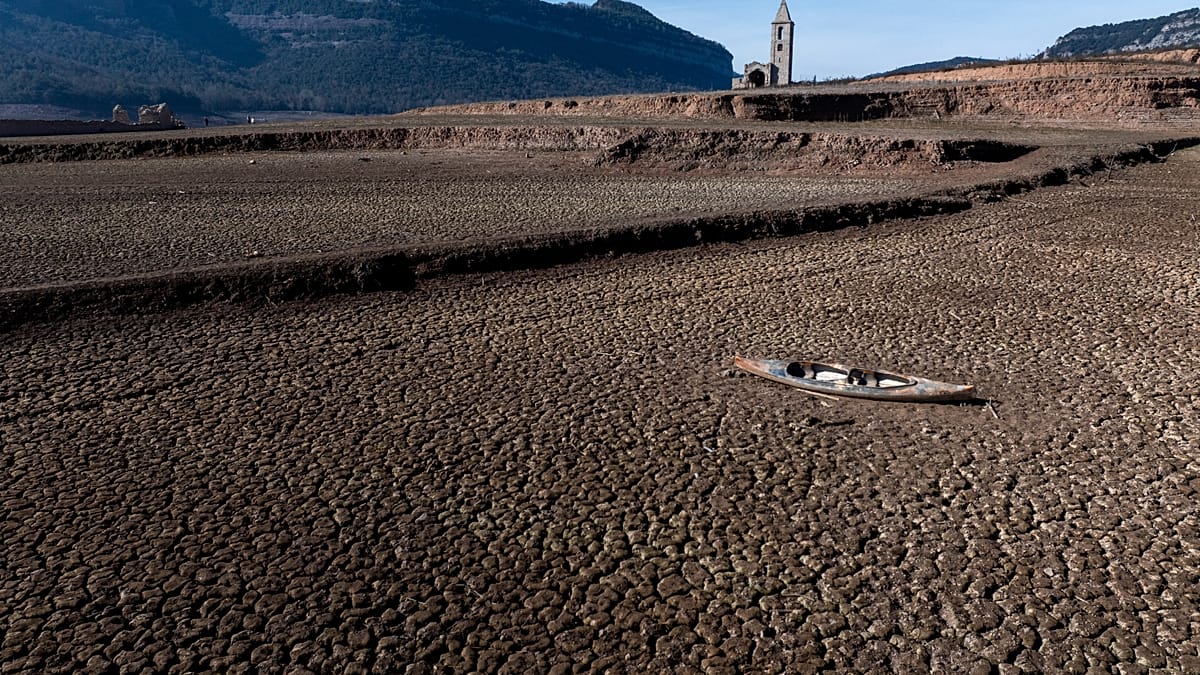
As August draws to a close, much of Europe remains under water restrictions. Record temperatures have accelerated evaporation from rivers and lakes, deepening drought conditions from the Iberian Peninsula to the Balkans. But the heat is only the final push on a shortage the European Union has been building for decades.
Europe's dependence on water is immense. According to the European Environment Agency (EEA), electricity cooling consumes 33 percent of the bloc's water, agriculture 31 percent, public supply 21 percent, and industry 14 percent. To meet these demands, the EU extracts roughly 200,000 billion cubic metres annually—far exceeding what natural systems can replenish. This over-extraction depletes groundwater and reduces river flows, leaving ecosystems and communities vulnerable.
Pollution and leaks compound the scarcity
Low water levels concentrate pollutants, making clean water harder to find. The EEA's latest data shows that only 37 percent of Europe's surface water achieves good or high ecological status, and just 29 percent meets good chemical standards. Meanwhile, an estimated 23 percent of treated water is lost through leaky pipes before it ever reaches a household tap—a staggering inefficiency for a continent facing shortages.
The problem is not uniform. Southern member states like Spain, Italy, and Greece face acute stress, while northern countries such as the Netherlands and Denmark manage better. Yet even water-rich regions are not immune: the Danube's falling levels have exposed relics of the past, a stark reminder of how far the river has receded.
The European Commission's 2025 Water Resilience Strategy is the bloc's response. It aims to make water supply climate-resilient by boosting efficiency by at least 10 percent by 2030. The plan focuses on restoring and protecting water quality and quantity, reducing pollution and over-extraction, and fostering a water-smart economy that minimizes waste. Digital tools, such as smart metering and leak detection, are central to improving management.
But critics argue the strategy lacks teeth. Without binding targets for member states, progress may remain uneven. Some municipalities are already experimenting with rooftop rainwater harvesting to ease pressure on urban supplies, but such initiatives remain patchy.
The stakes are high. Water scarcity affects not only households but also energy production, agriculture, and industry—sectors that underpin Europe's economy. As climate models predict more frequent and intense heatwaves, the EU's ability to adapt will be tested.
For now, the bloc is treading water. The question is whether the 2025 strategy will be a turning point or another missed opportunity. As the summer of 2026 shows, the cost of inaction is measured in dried-up reservoirs and parched fields.