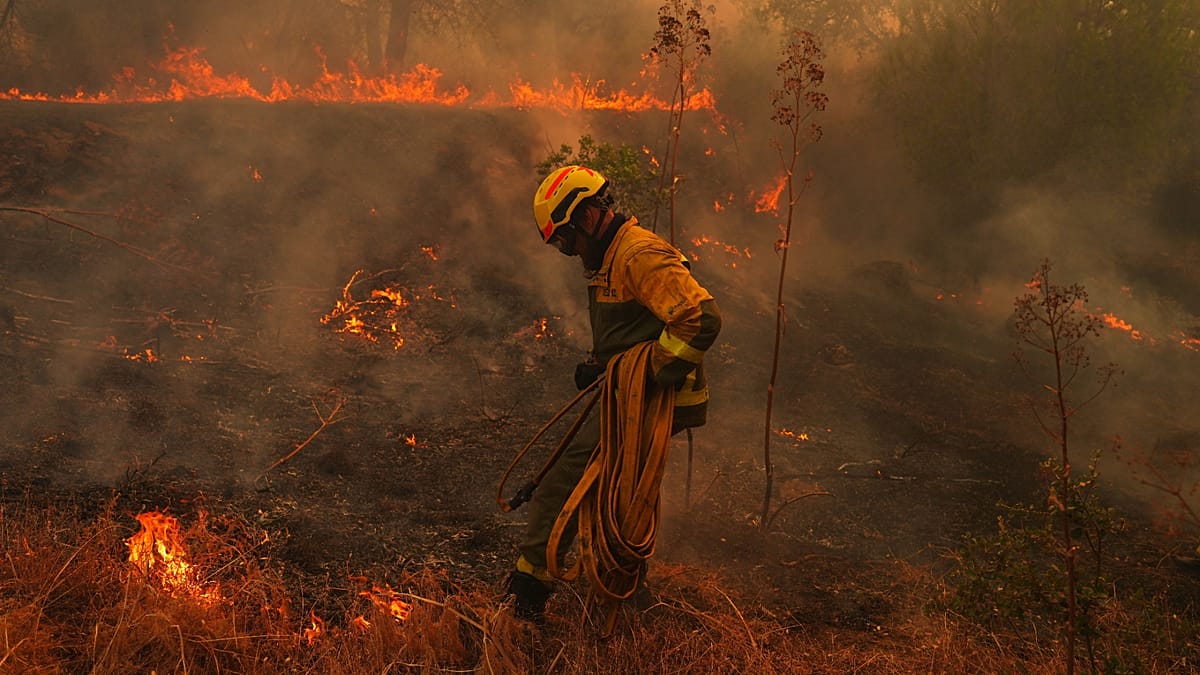
Wildfires have swept through Spain's central province of Ávila, leaving a trail of destruction that includes burned-out homes, charred vehicles, and vast stretches of scorched countryside. The blazes, which erupted amid a prolonged heatwave, have tested the region's firefighting capabilities and raised fresh concerns about the impact of climate change on the Iberian Peninsula.
Firefighters on the front line
Emergency crews, including ground teams and aerial units, have been working around the clock to contain the flames. The fires have been particularly intense in rural areas around the provincial capital, Ávila, where dry vegetation and strong winds have fueled rapid spread. Local authorities have reported that several villages were evacuated as a precaution, with residents seeking shelter in temporary accommodation.
Images from the affected areas show the stark reality of the disaster: a family car reduced to a blackened shell, the skeletal remains of a stone farmhouse, and fields that once held crops now reduced to ash. The human toll, while not yet fully assessed, is evident in the faces of those who have lost their livelihoods.
"We have seen fires before, but nothing like this," said one resident of a village near the fire zone, who asked not to be named. "The flames came so fast, we had to leave everything behind."
Regional and national response
The regional government of Castilla y León has activated emergency protocols, and Spain's central government has offered additional support, including military units from the Unidad Militar de Emergencias (UME). The UME, which specializes in disaster response, has been deployed to assist in the most challenging areas.
Spain's Prime Minister, Pedro Sánchez, expressed solidarity with the affected communities, stating that "the government will spare no resources to protect lives and property." He also urged citizens to follow safety instructions and to remain vigilant, as the risk of new fires remains high.
The fires in Ávila are part of a broader pattern of extreme weather events across Europe this summer. In neighboring Portugal, wildfires have also forced evacuations, while in Greece, firefighters have battled blazes on multiple islands. The heatwave has also triggered toxic alerts in Spain and forced shutdowns of nuclear reactors in France, highlighting the continent-wide strain on infrastructure and emergency services.
Climate change and fire risk
Scientists have long warned that climate change is increasing the frequency and intensity of wildfires in the Mediterranean region. Rising temperatures, prolonged droughts, and changing land-use patterns have created conditions that make fires more likely and more difficult to control.
"The Mediterranean basin is a climate change hotspot," said Dr. Elena López, a fire ecologist at the University of Salamanca. "We are seeing longer fire seasons and more extreme fire behavior. This is not a temporary anomaly; it is a trend that will require significant adaptation."
Local authorities are now focusing on recovery and prevention. In Ávila, officials are assessing the damage and planning for the restoration of affected areas. Meanwhile, firefighters remain on high alert, with forecasts of continued hot and dry weather.
The destruction in Ávila is a stark reminder of the challenges facing rural communities across Europe. As climate change intensifies, the need for coordinated European action on fire prevention, disaster response, and climate adaptation has never been more urgent.
For now, the people of Ávila are left to pick up the pieces, their resilience tested by the flames. The road to recovery will be long, but the spirit of the community remains unbroken.