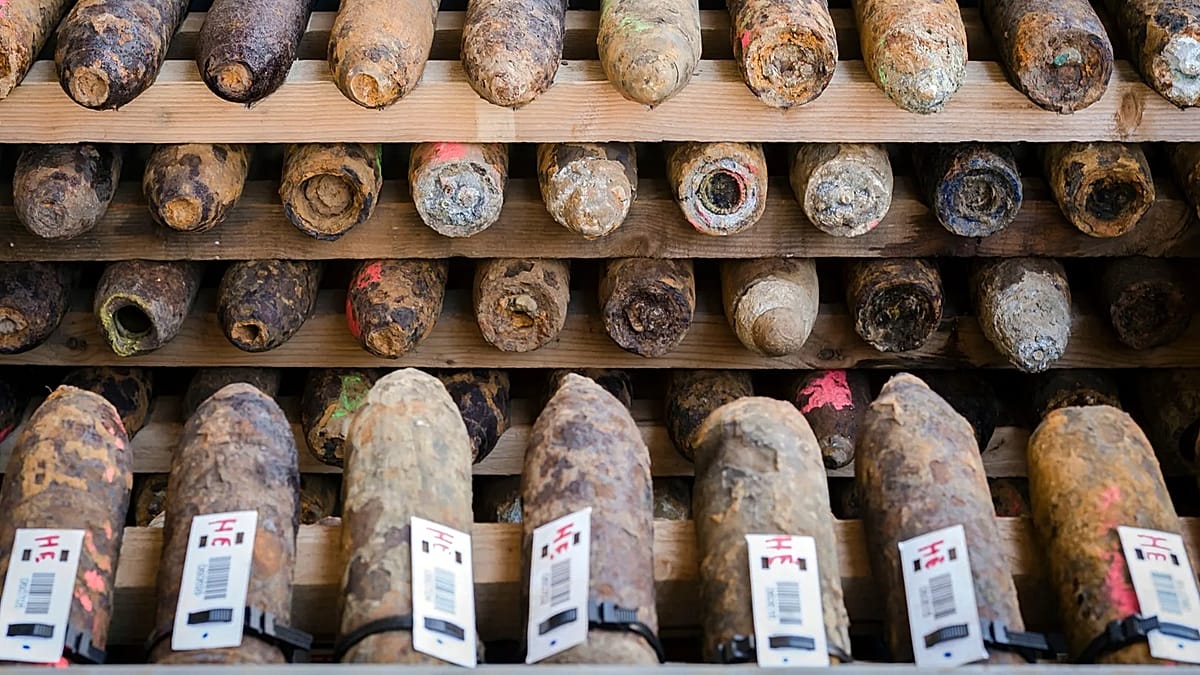
As Europe endures another summer of extreme heat and drought, firefighters are confronting a hidden hazard beneath the scorched earth: unexploded ordnance left over from the world wars. Recent blazes in France, Germany, Belgium, and the Netherlands have not only consumed vast tracts of land but have also brought buried munitions back to the surface, sometimes with lethal consequences.
In southwestern France, a fire near Bordeaux has exposed a cache believed to be World War II-era ammunition. Meanwhile, in Belgium's Liège province, Governor Hervé Jamar said emergency services have had to adjust their operations to account for munitions buried in the fire zone, noting that “a few sporadic detonations” had been heard in recent days.
A battlefield reawakened
The High Fens, a peat bog and moorland area straddling the Belgian-German border, has seen particularly fierce fires this summer. This region was the scene of the Battle of the Bulge, one of the bloodiest engagements of the Second World War. On 16 December 1944, German forces launched a surprise offensive against Allied troops, catching American units off guard. The attack eventually stalled as Allied reinforcements arrived and German supplies ran out.
Now, the same terrain that once echoed with artillery fire is again producing explosions, as heat and flames destabilize ordnance that has lain dormant for decades. “Climate change is now doing the work of unburying and reactivating what was previously stable,” said Sarah Njeri, a peace and conflict scholar at London's School of Oriental and African Studies.
The problem extends beyond wildfires. Prolonged drought has caused rivers across Europe to shrink, revealing relics of past conflicts. On the Danube, between Romania and Serbia, the wreck of a German warship has emerged near the Djerdap II dam. Elsewhere, a Wehrmacht motorbike and a bomb have been uncovered as water levels drop.
Christina Greene, a researcher at the University of Arizona, said the phenomenon is a stark reminder of how the past refuses to stay buried. “It's reliving the legacies of war and conflict in a way that we haven't had to deal with in a while in certain places,” she explained.
The immediate danger is clear: firefighters and residents in affected areas face the risk of accidental detonation. But the longer-term implications are also significant. As climate change intensifies, the continent's buried wartime legacy is becoming an increasingly unpredictable factor in disaster response.
Authorities in several countries are now mapping known ordnance sites and updating emergency protocols. In Liège, officials are coordinating with bomb disposal units to ensure that firefighting efforts do not inadvertently trigger explosions. Similar measures are being considered in other regions with a heavy military history.
The phenomenon is not limited to the western front. In the Balkans, where conflicts have left their own scars, the Danube's receding waters have revealed not only warships but also potential unexploded devices. The region's complex history of warfare means that the threat is widespread.
For now, the immediate focus is on containing the fires and keeping people safe. But as the summer heat persists, the ground continues to give up its secrets, reminding Europeans that the scars of the past are never far beneath the surface.