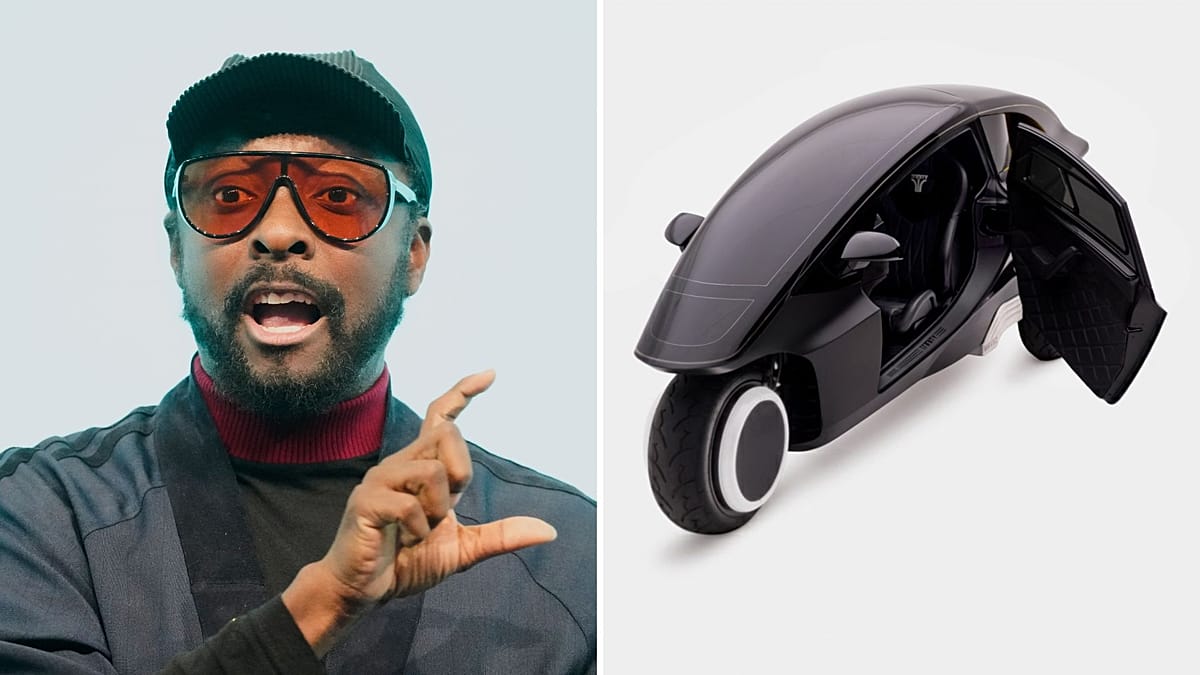
At Nvidia's annual artificial intelligence conference in Silicon Valley, musician and entrepreneur will.i.am presented a new vision for urban mobility: a compact, three-wheeled electric vehicle he calls "brains on wheels." The project, named Trinity, is a single-passenger autocycle designed specifically for navigating dense city streets.
The vehicle is engineered for rapid acceleration in stop-start traffic, with a stated target of reaching 60 miles per hour in under two seconds. "The vehicle doesn't have to go 120 miles an hour. Who's going 120 miles an hour in the street anyway? You just want to go quick through the city," will.i.am told AFP at the event.
An AI Co-Pilot for the Commute
Trinity's defining feature is its integrated artificial intelligence agent. A network of 360-degree cameras and onboard sensors allows the system to detect other vehicles, cyclists, pedestrians, and traffic signals. This awareness is used to provide alerts and assist with route planning.
Beyond navigation, the AI is designed to transform travel time into productive time. The system allows drivers to interact with documents and manage tasks verbally. "Say, for example, I'm home, going to work, and someone sent me a PDF or a draft. I could then add the draft into the dash, and I could have a conversation with the vehicle about that draft," will.i.am explained.
Despite its advanced capabilities, Trinity is not an autonomous vehicle. The startup emphasises that human control remains central, with the AI acting as an enhanced infotainment and assistance system. "The human drives this car. It's not self-driving yet. The infotainment system is what we're trying to reimagine," said will.i.am.
Market Ambitions and Production Plans
The company behind Trinity is targeting a price point below $30,000 (approximately €26,000), positioning it as a potential mainstream option rather than a luxury product. This push for accessible, AI-enhanced transport arrives as European consumers face broader economic pressures, including energy costs that could influence adoption of new technologies.
Initial production will be limited, with manufacturing set for a facility in Los Angeles. This site is also planned to serve as a development hub for robotics and next-generation AI systems, indicating the project's scope extends beyond a single vehicle.
The unveiling at a major AI conference highlights the growing convergence of consumer technology, automotive design, and artificial intelligence. While the project is based in the United States, its focus on sustainable urban mobility and smart city integration resonates with transportation debates across Europe, from Berlin to Barcelona.
European cities, many of which are actively promoting electric vehicles and rethinking urban space, represent a logical future market for such compact, connected transport solutions. The development mirrors a global trend where tech companies and startups are increasingly challenging traditional automotive paradigms.
The success of Trinity will depend on its execution, safety certification, and eventual performance in real-world urban environments. Its development will be watched by an industry where European automakers and tech firms are also heavily investing in electric and intelligent vehicle systems.
As with any new entrant, regulatory hurdles in key markets will be significant. The path to European roads would require navigating the EU's stringent vehicle type-approval process and data governance rules, particularly for its AI systems. This comes amid wider European scrutiny of technology, as seen in cases like the Vienna court's recent ruling on a case involving sensitive documents.