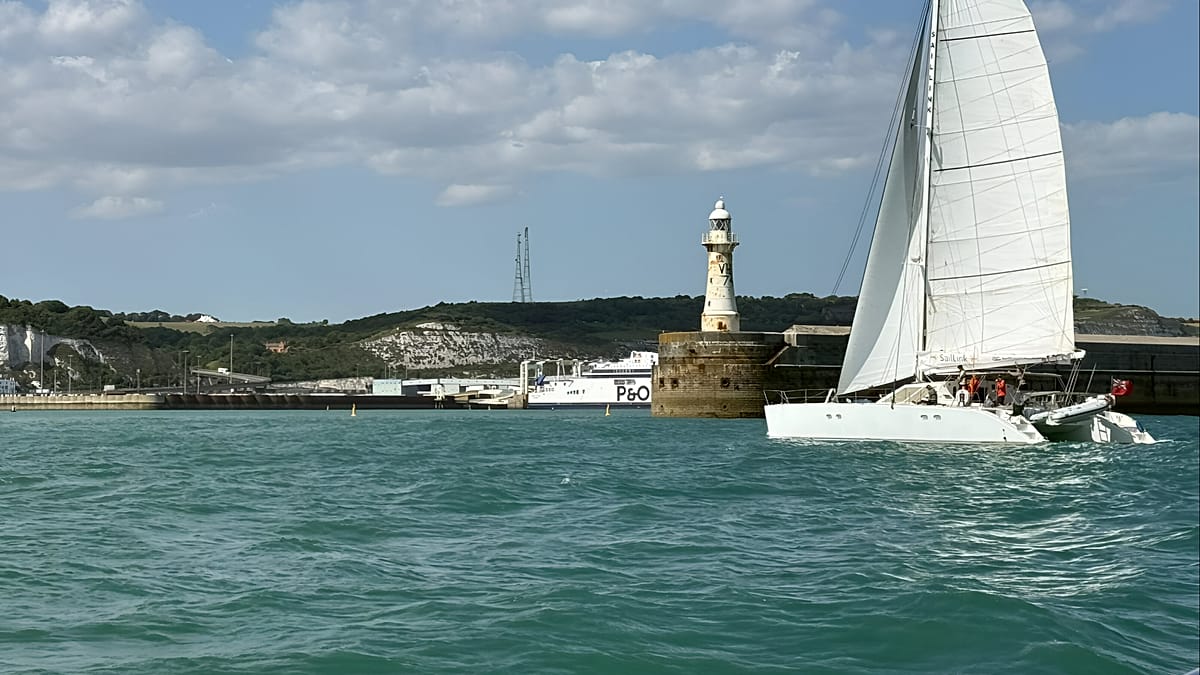
The English Channel remains one of the world's busiest and most carbon-intensive maritime corridors. While conventional ferries continue to shuttle thousands of vehicles and passengers daily, a small British company is betting on a quieter, wind-driven alternative.
SailLink, which already operates a sail-powered service between Dover and Boulogne-sur-Mer, is launching a one-week pilot route connecting Shoreham-by-Sea in West Sussex with Fécamp in Normandy. If the trial proves successful, the company hopes to establish a permanent second link between the two town-centre marinas.
The vessel is an 18-metre sailing catamaran, skippered by Michel Desjoyeaux, a two-time winner of the Vendée Globe, one of sailing's most demanding solo races. SailLink's founder, Andrew Simons, will join him on board. The boat is constructed largely from recycled ocean-racing components, including the mast and rudders from Desjoyeaux's former IMOCA 60 race boat.
Designed for speed, the catamaran carries a 23-metre mast and 165 square metres of sail, yet its cockpit offers enough space for up to 12 passengers and eight bicycles per crossing. Unlike the sprawling car ferries that dominate the route, this service is strictly for foot passengers and cyclists.
Last year, SailLink—which is self-funded—transported 465 passengers and 135 bikes across the Dover-Boulogne route. Nearly 70% of those crossings were completed using sail power alone, with engines reserved for harbour manoeuvres or calm spells.
A different kind of Channel crossing
The trial crossings will run from 8 to 13 September 2026, with departures alternating between Shoreham and Fécamp. The journey is expected to take around eight hours, weather permitting, and passport checks will be handled dockside at both ports.
Cycling tourists are a particular focus, as the route connects directly to the National Cycle Route 2 and the Downs Link in England, and to La Vélomaritime (EuroVelo 4) and the GR21 coastal path along the Alabaster Coast in France. For those who prefer to feel the wind and salt spray rather than queue in a duty-free shop, the experience is deliberately minimal: no cabins, no entertainment, just the sea and the sky.
The initiative comes at a time when cross-Channel travel is under scrutiny for its environmental impact. While the driest July on record in England and Wales has highlighted broader climate concerns, SailLink's approach offers a niche but tangible alternative for conscious travellers.
If the trial succeeds, a permanent route could provide a sustainable link between two regions that are already popular with cyclists and walkers. The company's model remains small-scale, but its backers argue that even a modest reduction in emissions on one of Europe's busiest sea lanes is a step worth taking.
For now, the timetable is still being finalised, and bookings are expected to open closer to the sailing dates. Those interested in a low-carbon Channel hop should keep an eye on SailLink's website.