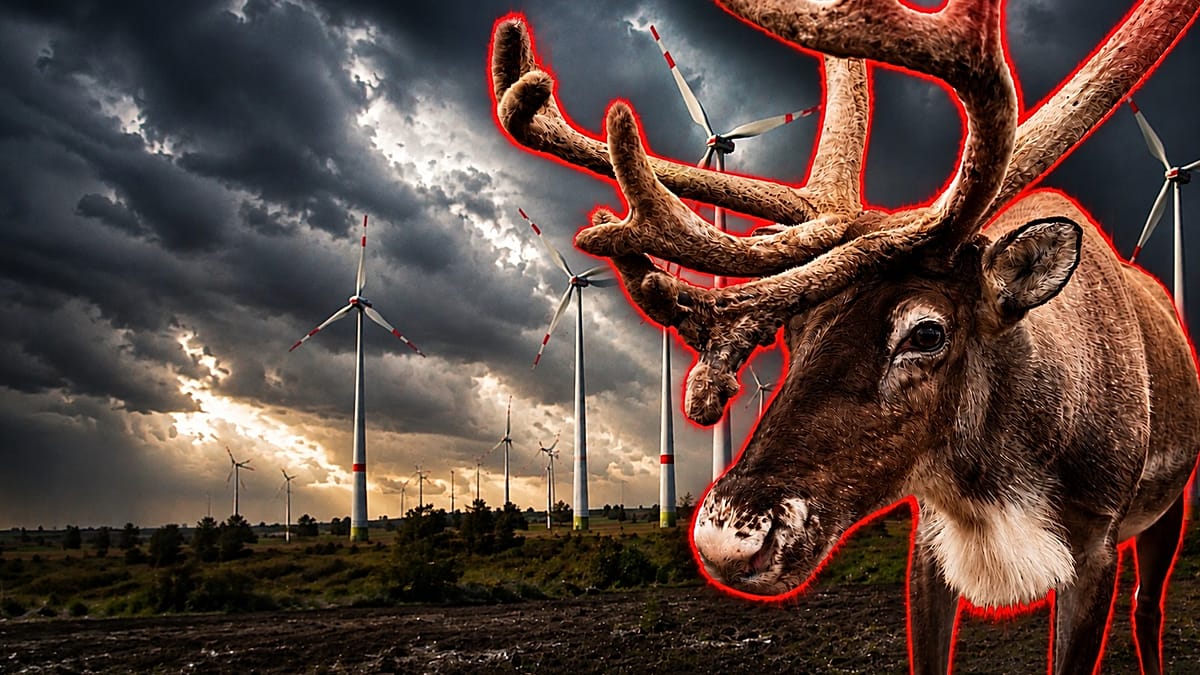
In March 2024, Norway reached a landmark agreement with the Sámi community over the Fosen wind farm, one of Europe's largest onshore wind sites. The deal allowed 151 turbines to remain in the coastal district, while granting reindeer herders more winter grazing land, partial free electricity, and a veto over future wind concessions. It was a historic compromise between renewable energy and indigenous rights.
Two years later, a false social media narrative twisted this story. Posts with hundreds of thousands of views claimed that Norway's Supreme Court had ordered the turbines removed because they were causing reindeer to be born with deformities. The claim is false, but it has a kernel of truth: the court did rule in 2021 that the operating licences were invalid, but solely because the project violated the Sámi people's cultural rights under international law. No animal health issues were involved.
Where did the deformed reindeer conspiracy come from?
The conspiracy feeds into a broader theory that wind turbines harm health through infrasound and low-frequency noise, typically in the 35–45 dB range. Allegations range from tinnitus and ear pain to vertigo, back pain, and even accelerated ageing. These claims circulate widely on social media, often without scientific backing.
However, a substantial body of research contradicts these fears. A paper published in the National Library of Medicine states: "Based on the findings and scientific merit of the research conducted to date, it is our opinion that the weight of evidence suggests that when sited properly, wind turbines are not related to adverse health effects." The paper adds that this conclusion is supported by several government health and medical agencies and legal decisions.
Some people living near turbines do report headaches, stress, and sleep disruption. But researchers suggest these symptoms are more likely linked to annoyance, visual cues, or the nocebo effect—where people experience real symptoms because they expect something to be harmful—rather than to the sound itself. The physical evidence for direct harm remains elusive.
The Norwegian case is a reminder of how complex the debate around wind energy can be. While the turbines at Fosen were not removed, the legal battle highlighted the need to balance renewable energy expansion with the rights of Europe's indigenous peoples. Similar tensions have emerged elsewhere on the continent, from Sweden to Finland, where wind projects have clashed with reindeer herding.
For those interested in the broader lifecycle of wind turbines, a Swedish firm has found a creative way to repurpose old blades into tiny homes and skis, reducing waste and giving the structures a second life. This innovation underscores that the industry is evolving beyond just energy generation.
The viral claim about deformed reindeer is a textbook example of how a grain of truth can be distorted. The court ruling was real, but its meaning was twisted. As with many conspiracy theories, the underlying message—that wind turbines are dangerous—remains unproven. The scientific consensus is clear: when properly sited, wind turbines do not cause adverse health effects in animals or humans.
For Europe, which is rapidly expanding its wind capacity to meet climate goals, separating fact from fiction is crucial. Misinformation can undermine public trust in renewable energy, slowing the transition that many governments, including Norway's, are committed to. The Fosen agreement shows that with careful negotiation, even the most contentious projects can find a path forward.