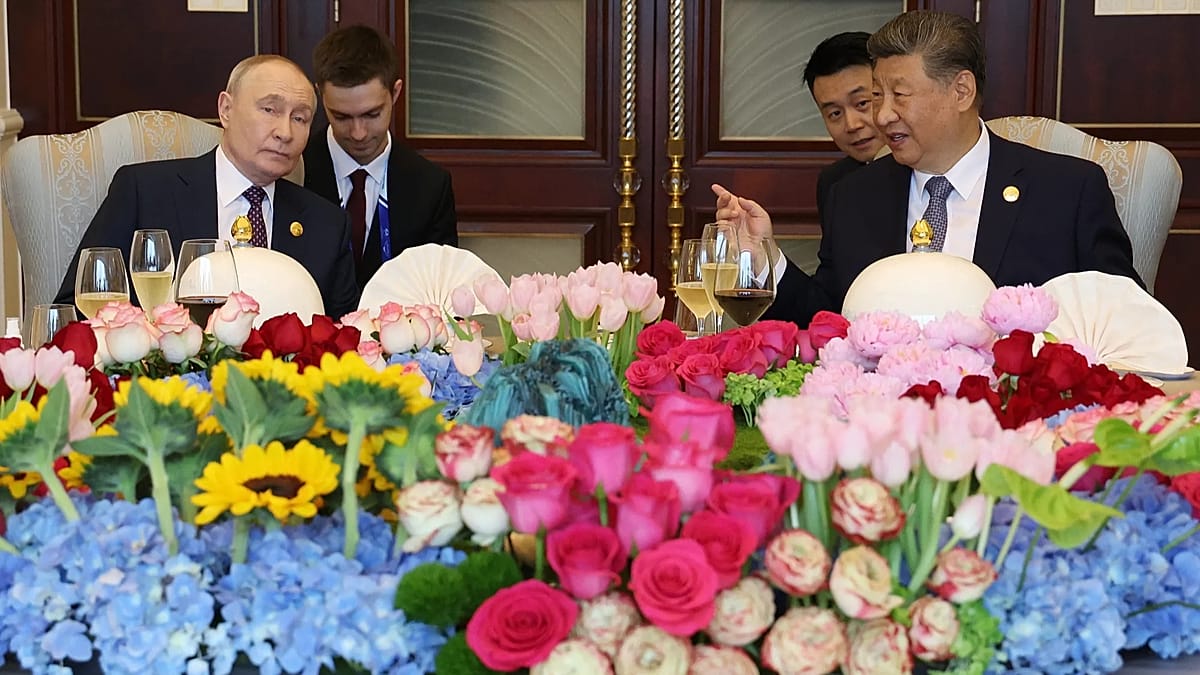
Chinese President Xi Jinping and Russian President Vladimir Putin met in Shenzhen on Wednesday, a day before a first-of-its-kind trilateral summit with US President Donald Trump in the southern Chinese city. The meeting, confirmed by Chinese and Russian state media, was their fifth encounter this year, including one held by video link.
The upcoming trilateral, scheduled on the sidelines of the Asia-Pacific Economic Cooperation (APEC) summit, has unsettled Kyiv and European capitals. There are fears that the three leaders might settle the future of Ukraine without European participation, potentially carving the world into new spheres of influence. Washington initially said Ukraine would not be on the agenda, but Trump later indicated it would be. Beijing has maintained that the war is not China's concern.
According to a Chinese foreign ministry statement, the leaders will hold “in-depth exchanges on safeguarding world peace and promoting strategic stability in major-power relations.” Washington has also indicated that Iran and nuclear disarmament will be discussed, particularly after the US-Russia bilateral nuclear weapons treaty expired in February. China has long insisted that the US and Russia must first reduce their much larger arsenals before it will consider limits on its own.
APEC opening and calls for cooperation
Opening the APEC CEO summit, Xi called for stronger international cooperation on artificial intelligence and free trade. He pledged that China would pursue “deep-seated reform,” starting with lower tariffs, wider market access, and work on regulation and management standards.
Putin, who has been largely isolated by Western leaders since his full-scale invasion of Ukraine in 2022, told the APEC gathering that he expected the trilateral to be “highly useful.” With military and political risks rising, he said, “what is desperately needed is unity rather than division... and dialogue rather than ultimatums.” He also argued that Western sanctions had failed, claiming they could not fully halt growth or wreck the economies of rival states.
Trump, who was still in the Philippines on Wednesday attending an ASEAN summit, had met with Quad leaders from Australia, Japan, and India a day earlier. The Quad is widely seen as a counterweight to Chinese influence in the Indo-Pacific. Trump expressed hope for one-on-one talks with both Putin and North Korean leader Kim Jong Un in Shenzhen, adding that Kim “would like” to meet in China. Secretary of State Marco Rubio, speaking in Manila, stopped short of confirming a Kim meeting but said engagement was the only way to resolve problems with North Korea.
The trilateral summit comes at a time of heightened transatlantic tension over how to handle Russia's war in Ukraine. European leaders have repeatedly stressed that any peace negotiations must include Kyiv and the EU. The stalled push for direct peace talks has been a point of friction, with Russia showing little willingness to engage in meaningful dialogue.
Meanwhile, the EU is preparing its 22nd sanctions package against Russia, targeting Moscow's ability to sustain its winter campaign against Ukraine's energy infrastructure. The bloc's efforts to maintain pressure on the Kremlin are complicated by the possibility that the US and China might seek a deal that bypasses European interests.
The meeting in Shenzhen also underscores the growing importance of China as a potential mediator in global conflicts, even as it deepens its strategic partnership with Russia. For European observers, the trilateral raises questions about the future of the rules-based international order and the role of smaller nations in shaping it.
As the leaders prepare to sit down together, the world will be watching whether they can agree on anything beyond vague calls for stability. The stakes are high, not least for Ukraine, whose fate could be discussed without its representatives at the table.