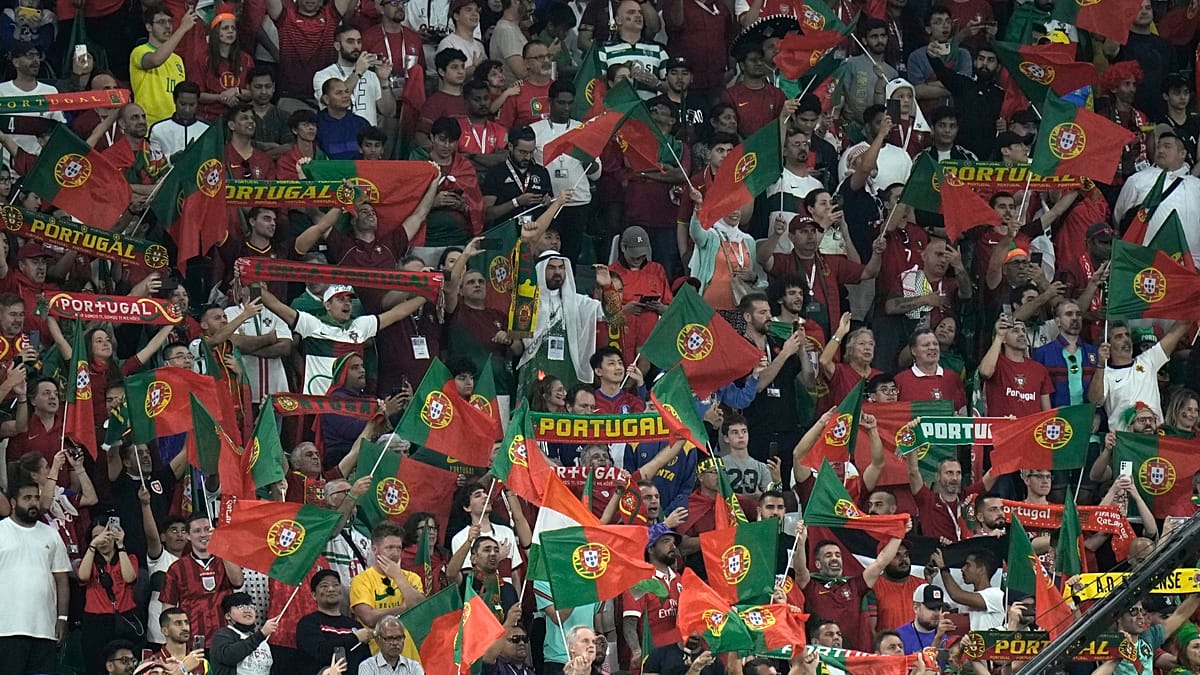
Portugal may not host a single match in the 2026 FIFA World Cup, but a new study suggests the tournament could inject up to €945 million into the country's economy. The analysis, conducted by the Sports Marketing Research Unit at IPAM (Portuguese Institute of Marketing Administration), argues that football's economic impact is no longer tied to geography but to the digital and consumer behaviour of fans.
From Stadiums to Screens: A Shift in Football's Economic Model
The study estimates a range of outcomes based on the performance of the Portuguese national team. If Portugal is eliminated in the group stage, the economic impact could be €378 million. Reaching the round of 16 would push that figure to €561 million, while a tournament victory could generate €945 million. For context, Portugal's win at Euro 2016 produced an economic impact of €609 million, meaning the maximum projection for 2026 exceeds that by more than €300 million.
According to IPAM, four factors drive this growth: higher purchasing power among fans; the tournament being hosted in economically strong markets—the United States, Canada, and Mexico; the expansion of the World Cup to 48 teams and 104 matches; and the consolidation of the digital economy as a new source of value.
“Portugal does not need to host the World Cup to generate significant economic impact,” said Daniel Sá, IPAM's executive director, in a statement. “What this study shows is that football’s value is no longer concentrated in the stadium or in the host country. Today, the impact is created through consumption, attention, digital interaction and the ability of fans to amplify the event.”
The Fan as an Economic Asset
The research breaks down spending by fan type. A casual supporter, described as “a consumer of moments,” could generate between €40 and €70 during the tournament. In contrast, highly engaged, digital-first fans could spend up to €3,500 through recurring consumption, multi-platform activity, and social influence. This reflects a broader trend where the World Cup activates emotional and collectable economies, from trading cards and stickers (5% of total impact) to merchandising (4%) and betting (6%).
Traditional consumption still accounts for 77% of the estimated impact, but the digital component has grown to 23%. Within that, streaming and OTT platforms contribute 10%, social media engagement 7%, and the so-called “content economy” 6%. Household consumption is the largest single category at 26%, followed by restaurants and catering (15%) and advertising and media (14%). Travel, by contrast, accounts for just 4%, reflecting the tournament's location outside Europe and the study's central conclusion that physical attendance is no longer the primary driver.
“Football continues to generate consumption, but growth increasingly lies in how that consumption is shared, commented on, turned into content and amplified,” Sá added. “Almost one in every four euros generated by the World Cup now comes from digital.”
Lessons for 2030 and Beyond
The study also offers strategic lessons for brands, media organisations, and public authorities, particularly as Portugal prepares to co-host the 2030 World Cup. IPAM warns that rigid planning models will not suffice; brands must invest in real-time activations, and media must blend television, streaming, and digital content. The wider economy could benefit through hospitality, retail, and tourism, but also through new revenue streams linked to platforms and the attention economy.
“Those who know how to interpret the 2026 World Cup will gain more than those who simply broadcast it,” Sá concluded. “This is perhaps the study’s main conclusion: the World Cup’s value no longer lies only in the event itself, but in the way it is activated.”
As Portugal braces for a heat wave that could reach 45°C this summer, the economic forecast for 2026 offers a different kind of warmth. Meanwhile, other analyses, such as a BCA Research model predicting France to win the 2026 World Cup, underscore the competitive landscape Portugal will face on and off the pitch.