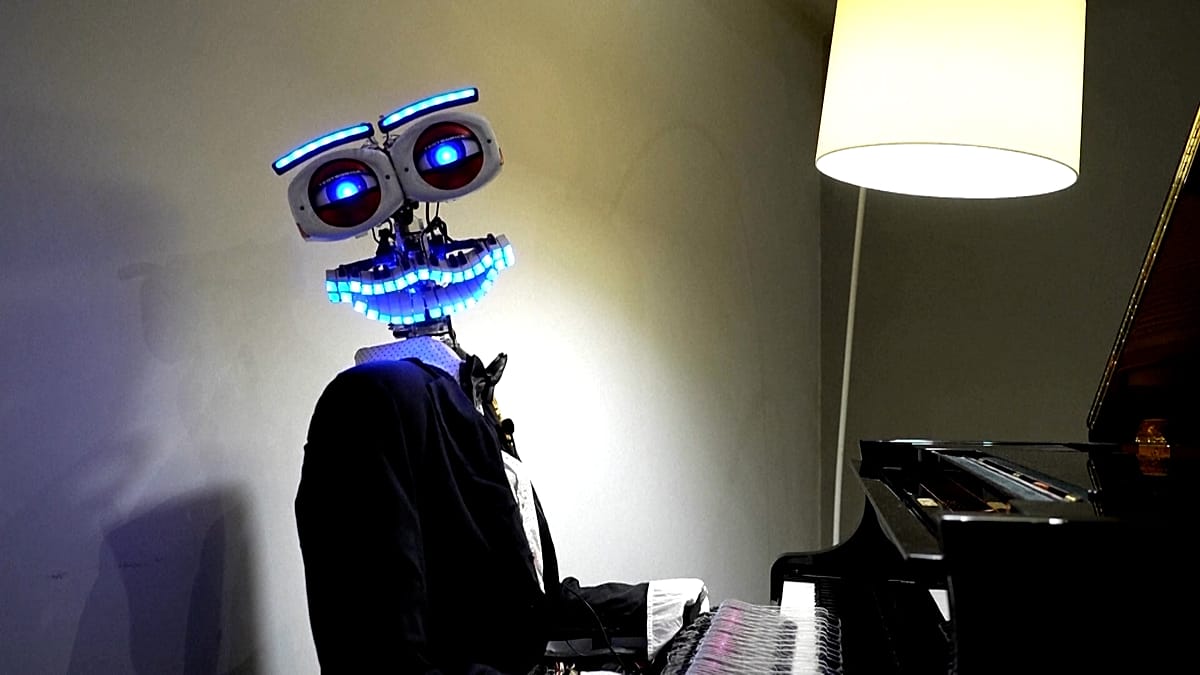
In a Milan concert hall, the grand piano faced an unusual duet partner: TeoTronico, a robot with 53 fingers, sat opposite the Italian pianist Roberto Prosseda. Together they performed Frédéric Chopin's works, blending human touch with mechanical precision in a performance that has reignited a familiar debate: can a machine truly express emotion through music?
The event, held in Italy, was not merely a novelty act. Prosseda, known for his interpretations of Chopin and his advocacy for rediscovered piano repertoire, approached the collaboration with intellectual curiosity. TeoTronico, developed by a team of engineers and musicians, is designed to replicate the complex finger movements of a human pianist, complete with velocity and articulation controls that mimic the subtleties of touch.
Human-robot duet: a new frontier for classical music
The performance was structured as a dialogue rather than a solo showcase. TeoTronico played one part of a Chopin duet, while Prosseda responded with the other. The robot's 53 fingers allow it to strike chords and rapid passages that would be impossible for a human hand, yet the musical phrasing remained surprisingly organic. Prosseda noted that the robot's programming was refined to avoid a mechanical feel, with algorithms that introduce slight timing variations to emulate human rubato.
"The goal was not to replace human pianists but to explore what a machine can teach us about music," Prosseda said in an interview after the performance. "TeoTronico forces us to ask what we mean by expression. If a robot can make an audience feel something, does it matter that it doesn't feel it itself?"
The question is not purely academic. As artificial intelligence and robotics advance, the cultural sector is increasingly confronting the role of machines in creative fields. The performance in Milan echoes discussions at recent tech conferences, including humanoid robots at Lisbon's Web Summit, where the line between human and machine creativity is blurring.
TeoTronico's design is a marvel of engineering. Its 53 fingers are arranged in a curved array, allowing it to cover a wider range of keys than a human hand. Each finger is independently actuated, with sensors that measure pressure and velocity. The robot can play trills and glissandos with superhuman speed, yet its programming emphasizes musicality over mere technical display.
Critics, however, remain skeptical. Some argue that the robot's performance, however impressive, is ultimately a simulation of emotion, not the real thing. Music, they contend, is rooted in human experience—love, loss, joy, sorrow—and a machine that has never felt these emotions cannot truly convey them. The debate has gained urgency as AI tools become more prevalent in composition and performance, prompting institutions like the Cambridge Dictionary to name "human" its 2026 Word of the Year amid AI unease.
Prosseda, for his part, embraces the ambiguity. "I don't think we need to resolve this question," he said. "The beauty of art is that it can hold contradictions. TeoTronico is a mirror that reflects our own assumptions about creativity."
The performance also highlights a broader European conversation about technology and culture. From the Dardenne brothers' plea for cinema to retain its humanity to debates over AI in the workplace, Europe is grappling with how to integrate machines without losing what makes us human. The Milan duet is a small but telling example of that tension.
TeoTronico's creators hope to continue the project, with plans to perform other composers and possibly collaborate with orchestras. They also see potential in education, using the robot to demonstrate piano techniques to students. But for now, the image of a 53-fingered robot and a human pianist sharing a bench remains a powerful symbol of the questions that lie ahead.
As the final notes of the Chopin piece faded, the audience in Milan rose to its feet. Whether they were applauding the robot, the pianist, or the idea itself, was unclear. But the moment captured something essential about our time: the uneasy, fascinating coexistence of human and machine in the realm of art.