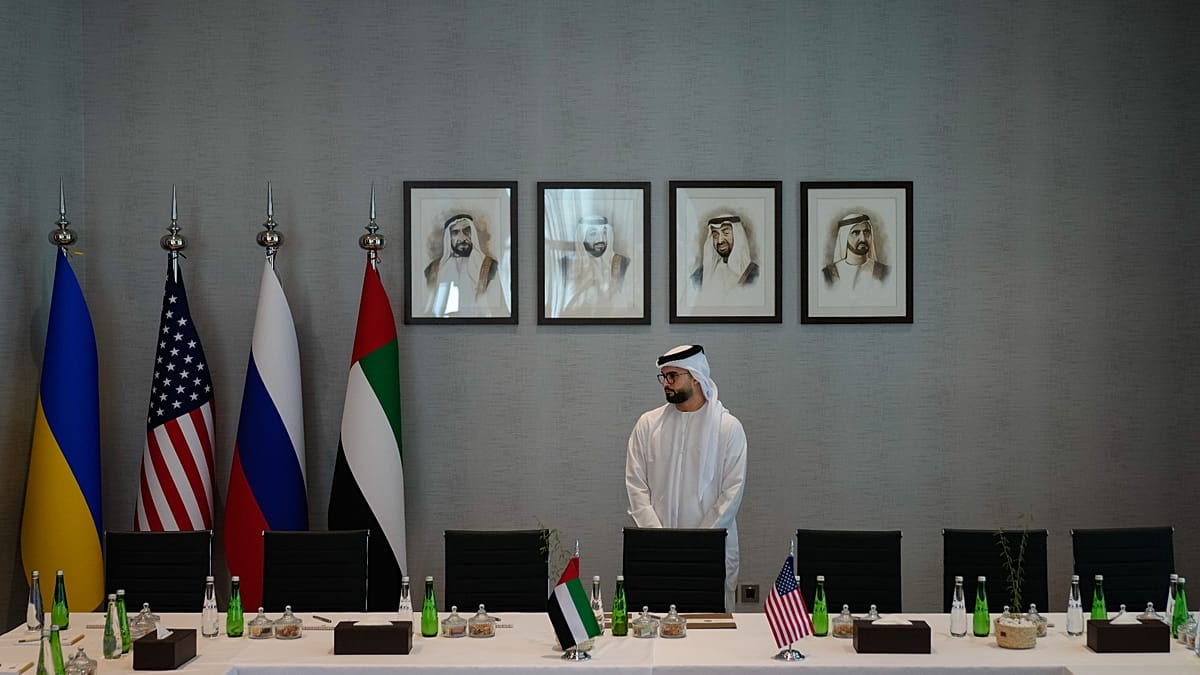
US-mediated negotiations between Ukraine and Russia resumed in Abu Dhabi on Wednesday, with Kyiv expressing cautious optimism about Washington's new approach even as fundamental disagreements over territory, security guarantees and the terms of any ceasefire remain unresolved.
Speaking to reporters in Copenhagen on Tuesday, Ukrainian President Volodymyr Zelenskyy said he had noticed a change in the attitude of American mediators. "I see changes. I'm very happy with what I hear," he said, describing the discussions as "constructive and quite substantive." US Secretary of State Marco Rubio echoed that sentiment, calling the talks "very productive," while US envoy Jared Kushner claimed Washington had narrowed the gaps between the two sides, without offering specifics.
Despite the upbeat assessments, the gulf between Kyiv and Moscow remains wide. Wednesday's agenda is expected to focus on de-escalation measures, including the protection of energy infrastructure and navigation in the Black Sea, as well as the possibility of a trilateral meeting at the leaders' level.
Territorial disputes remain the hardest hurdle
Territory is arguably the most intractable issue. Moscow insists that Ukrainian forces withdraw from eastern regions, including areas that remain under Kyiv's control. Zelenskyy said Russian negotiators had falsely claimed that Moscow's troops had captured half of the Ukrainian-held territory in the Donbas. He said Kyiv's delegation challenged those assertions with video evidence, and that NATO's Supreme Allied Commander Europe, General Alexus Grynkewich, who was present in Abu Dhabi, confirmed that Ukrainian battlefield maps were closer to reality.
The Ukrainian president suggested that Vladimir Putin may be misinformed about the actual state of Russia's military advances, believing his forces could overrun the remaining Ukrainian-held areas in the east within months—despite having failed to fully conquer the Donbas since Russia's first invasion in 2014. Zelenskyy stressed that territorial questions would ultimately have to be settled at the leaders' level, not by negotiators in Abu Dhabi.
Ahead of the talks, US President Donald Trump hinted that Ukraine might have to accept territorial changes, saying the country would end up with "a little bit different shape."
Security guarantees and Europe's role
Washington and Moscow are also trying to reshape Europe's broader security architecture as part of the negotiations. Kushner said the US wanted a new security framework involving Ukraine, Russia and Europe, while a source within the Russian delegation described ending the war as just one item on Moscow's agenda.
The presence of Russian Deputy Foreign Minister Sergei Ryabkov is significant. Before the 2022 full-scale invasion, he was involved in Moscow's demands for NATO to roll back its military presence in eastern Europe. European officials have held separate consultations in Abu Dhabi but are not part of the trilateral talks. Russian Foreign Minister Sergei Lavrov dismissed their presence, saying: "Well, they flew to Abu Dhabi. Let them sit there in the hotel."
Rubio, however, acknowledged that Europeans would eventually need to join the negotiations because they were "part of solving this problem." The question of Europe's role is a sensitive one, as European leaders push back on Russia's security architecture gambit and seek to ensure their own interests are not sidelined.
Ceasefire and prisoner exchange
Moscow continues to reject an immediate ceasefire, with Lavrov accusing European governments of trying to give Ukraine time to recover its military losses. Yet Russia itself used the years following the 2014–15 Minsk ceasefire agreements to consolidate its military and political foothold in eastern Ukraine, before launching its full-scale invasion in February 2022.
Kyiv hopes that limited truces could pave the way for a broader ceasefire, following last month's humanitarian operation in Russian-occupied Oleshky, which allowed aid deliveries and civilian evacuations. A large-scale prisoner exchange is also under discussion. Zelenskyy said the sides were considering exchanging 1,000 prisoners each, or potentially 1,500 each, with US officials expected to travel to Russia for further talks.
The proposal follows the May 2025 negotiations in Istanbul, when Kyiv and Moscow agreed to exchange 1,000 prisoners each despite failing to secure a ceasefire. No new agreement has yet been officially announced. As the talks continue, the prospects for a ceasefire remain slim, and the prisoner swap and security guarantees are still on the table.