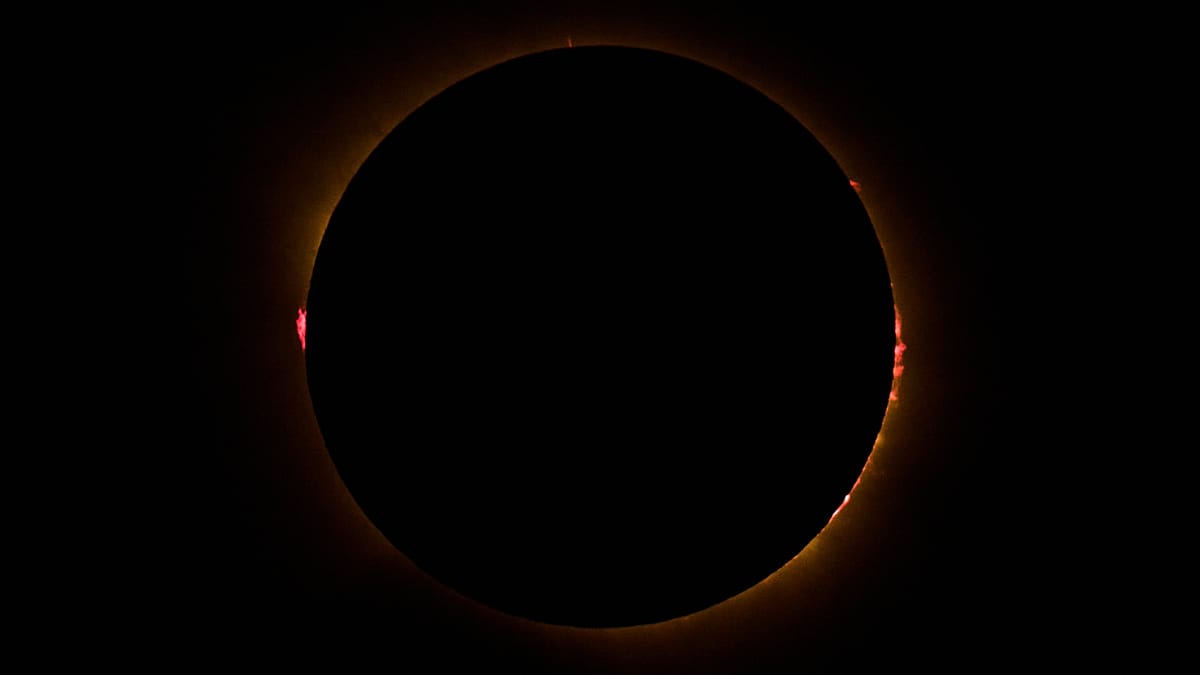
For the first time in more than a hundred years, a total solar eclipse traced a path across Spanish skies on Wednesday, drawing thousands of spectators and offering scientists a rare opportunity to study the sun's corona. The celestial event was visible in its full glory from the northern coast, particularly around the Basque Country, where aerial footage showed the moon's shadow sweeping over the Atlantic and the rugged shoreline near the Port of Bilbao.
In Getxo, a town overlooking the estuary of Bilbao, residents and visitors gathered along the promenade as the sky darkened in the middle of the day. The eclipse, which occurs when the moon passes directly between the Earth and the sun, reached totality for just over a minute in some locations, a moment marked by an eerie twilight and a noticeable drop in temperature.
A rare alignment for Europe
Total solar eclipses are not uncommon globally, but they are rare for any given spot on Earth. Spain's last total eclipse was in 1905, and the country will not see another until 2026, when the path of totality will cross the Balearic Islands and parts of the mainland. Wednesday's event was therefore a significant draw for astronomers, photographers, and curious onlookers from across Europe.
The Basque government had prepared for the influx, setting up viewing points and distributing certified eclipse glasses to protect eyes. Local authorities in Getxo and nearby Bilbao reported large crowds, but no major incidents. The region's typically variable weather cooperated, with clear skies allowing an unobstructed view.
Scientists used the occasion to study the sun's outer atmosphere, the corona, which is normally hidden by the sun's bright light. "During totality, we can see the corona in a way that is impossible at any other time," said Dr. Elena García, an astrophysicist at the University of the Basque Country in Bilbao. "This is a unique laboratory for solar physics."
The eclipse also had a cultural dimension, echoing historical interpretations of such events. In medieval Europe, eclipses were often seen as omens, but today they are celebrated as spectacles of nature. In Getxo, a local choir performed a short piece as the sky darkened, adding a communal, almost theatrical atmosphere to the event.
For those who missed Wednesday's show, the next total solar eclipse visible from Spain will occur on August 12, 2026, with the path of totality crossing the Balearic Islands and the Iberian Peninsula. Meanwhile, the country continues to grapple with other pressing issues, from wildfires in Aragon to debates over nuclear energy policy.
The eclipse also served as a reminder of the sun's influence on our planet, a topic that has gained attention in light of recent research on solar storms and their potential risks to aviation. While Wednesday's event was purely a visual delight, it underscored the dynamic nature of our solar system.
As the moon's shadow retreated eastward across the Mediterranean, the spectacle ended as quickly as it had begun. For the people of the Basque Country, it was a moment to remember—a brief, dramatic alignment of celestial bodies that will not be repeated in their lifetimes.