In the rolling hills of the Hallertau, the world's largest contiguous hop-growing region, a quiet crisis is unfolding. Over the past two decades, the number of German hop farms has plummeted by 40 percent—from over 2,000 in 2006 to just 904 today. Farmers cite falling global prices, declining beer consumption, and increasingly, the effects of climate change: rising temperatures, water shortages, and drying soils.
Josef Wimmer, a hop grower in Neuhub near Osseltshausen, knows the struggle firsthand. “When I did my training 30 years ago, there were more than 2,000 hop growers in the Hallertau; today it is well below 1,000,” he says. To secure his farm's future, Wimmer turned to an unconventional solution: agri-PV, or agricultural photovoltaics.
Solar Panels Seven Metres Up
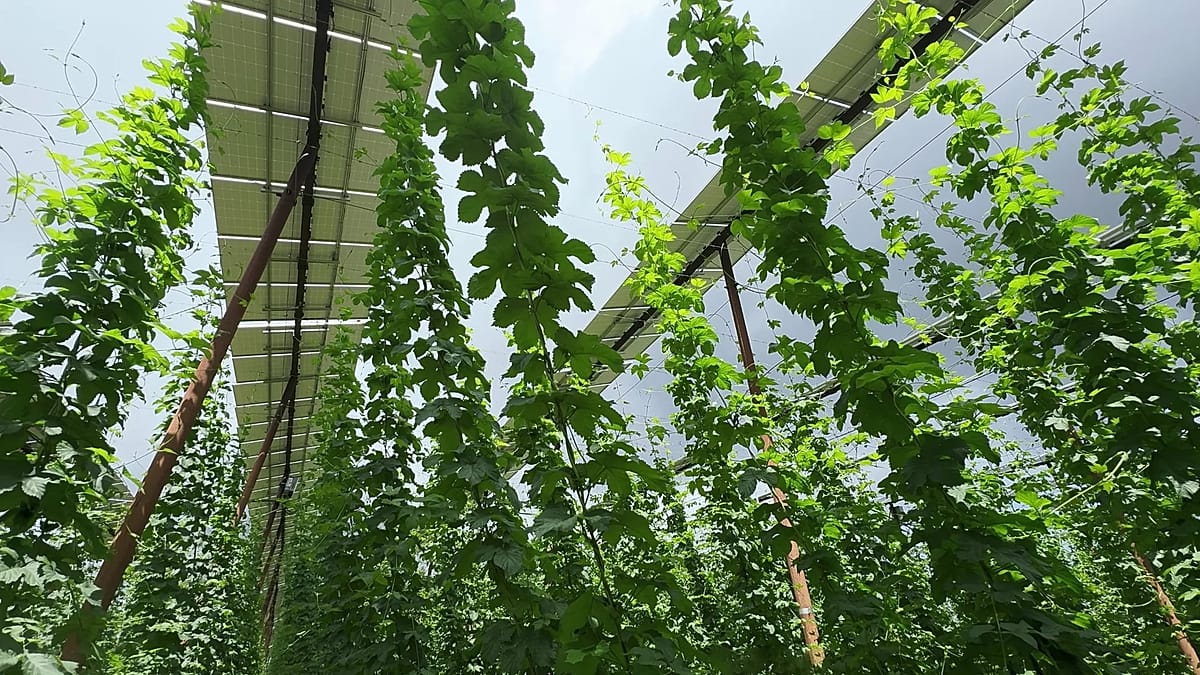
Wimmer has installed photovoltaic modules seven metres above the ground, just above the hop poles. The panels provide shade for the hop plants, which naturally prefer cooler conditions. “We wanted to shade the hops because hops are a shade-loving plant,” he explains. The pilot system covers five hectares and generates two megawatt peak (MWp) of electricity. Encouraged by the results, Wimmer plans to expand to 20 hectares over the next two to three years, adding battery storage with a capacity of one megawatt.
The system was designed by Bernhard Gruber, a former Airbus engineer who now specialises in agri-PV. Gruber spent months calculating structural stability, wind loads, and the optimal tilt angle for the panels. “In a first step we covered five hectares of hops with PV,” Wimmer reports. “That gives us an output of two megawatt peak.” The expansion will bring total capacity to eight MWp.
Agri-PV offers a dual benefit: it generates renewable energy while protecting crops from heat stress. Soil moisture sensors on Wimmer's farm show that the ground has become wetter under the panels, a critical advantage as summers grow hotter and drier. This approach aligns with broader European trends—solar power recently hit a record 25% of EU electricity in June, led by Germany, Spain, and Poland.
Bureaucratic Hurdles Slow Progress
Despite the promise, adoption of agri-PV faces significant obstacles. Wimmer waited nearly two years for a building permit. “Two years is a long time if you want to expand renewables quickly,” Gruber notes. The engineer criticises the slow approval process, which he says discourages many farmers from investing. “Long approval procedures are a problem. They put some farmers off from going for agri-PV on a larger scale, because the bureaucratic effort is simply too great for many of them,” Gruber says.
Wimmer also faces infrastructure costs: he must pay for a five-kilometre cable to connect his system to the substation. “We now have to lay a five-kilometre cable, but we have to pay for it ourselves,” he says. The financial burden, combined with regulatory delays, threatens to limit the technology's potential.
The situation in Bavaria mirrors broader European challenges. Climate change is already disrupting daily life across the continent, and agriculture is on the front line. For hop growers, the stakes are existential: without hops, there is no beer—a staple of Bavarian culture and economy.
Gruber believes politicians must act. “Especially for hop growing, but also for other agricultural speciality crops, the decisions and approvals could be made much more easily. Why things aren’t moving faster is honestly a mystery to me,” he says. In the shade of the towering hop plants, Wimmer nods in agreement. The future of his farm—and perhaps of Bavarian hops—depends on cutting through the red tape.