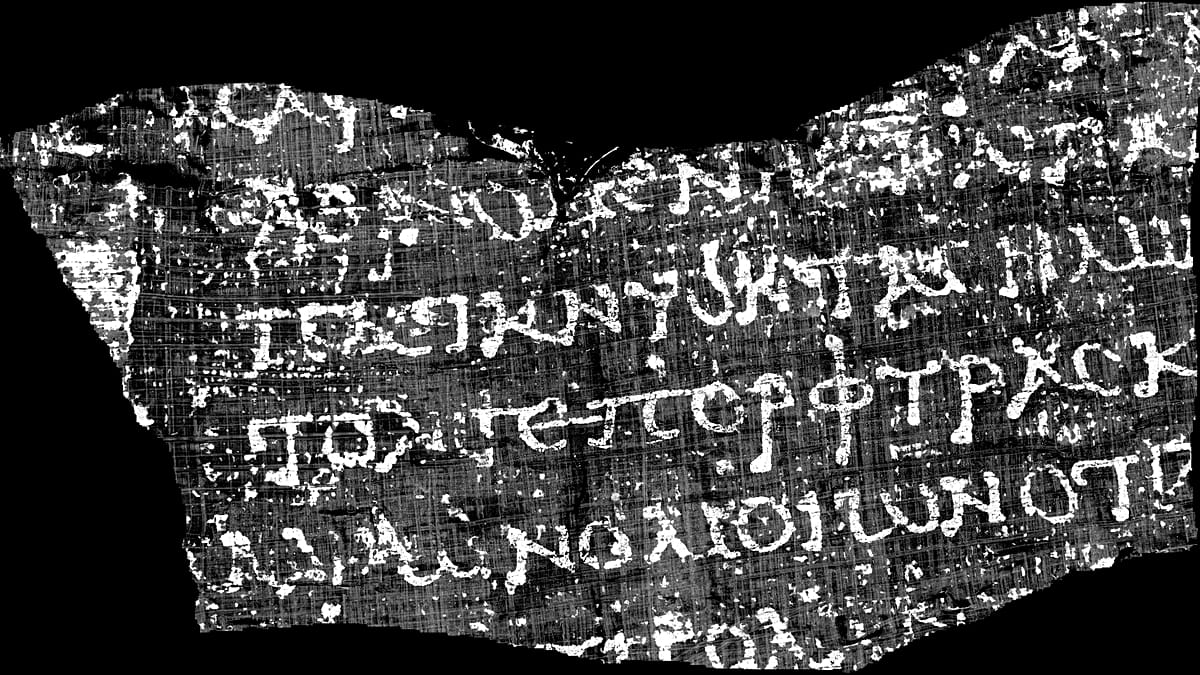
An ancient scroll that survived the catastrophic eruption of Mount Vesuvius in 79 AD has finally yielded its contents—thanks to artificial intelligence. Researchers from European and US universities used high-resolution X-ray imaging and machine learning to read the carbonized papyrus without ever unrolling it. The text turned out to be a philosophical treatise on ethics, human nature, and moral progress, written in the 2nd century BC.
The scroll, catalogued as PHerc. 1667, was part of a library of carbonized manuscripts first unearthed in the 1750s in the ancient Roman town of Herculaneum. The collection, consisting of some 1,800 papyrus fragments, was preserved under the ruins of a lavish villa destroyed by the eruption. It remains the only complete surviving library from the Greco-Roman world.
For centuries, the scrolls presented a paradox: they had survived a volcanic disaster and centuries of burial, but were now too fragile to open. Earlier attempts to unroll PHerc. 1667 damaged the papyrus, leaving only 8 cm of its original 19–24 cm height. The team managed to recover the full text from that surviving portion.
How AI Unlocked the Scroll
In 2023, the Vesuvius Challenge turned the puzzle into a global competition with cash prizes, encouraging researchers and enthusiasts to use computer vision and machine learning. That year, a 21-year-old computer science student became the first person in two millennia to read a word—'purple'—from an unopened scroll, earning $40,000.
This month, a multinational team of scientists from institutions including the University of Oxford and the University of Kentucky succeeded in deciphering the entire surviving text of PHerc. 1667. 'To read it, we never unrolled it physically,' the Vesuvius Challenge stated. 'Instead, we scanned it with high-resolution X-rays, reconstructed the wound sheet inside the volume, flattened it into a readable surface, and used machine learning to bring out the faint traces of ancient ink.'
The text names Aristocreon, a nephew and disciple of the Stoic philosopher Chrysippus. Scholars date the work to the 2nd century BC and say its language and subject matter reflect Stoic doctrine. The discovery also led to the identification of a new book by Epicurean philosopher Philodemus from another scroll.
'For nearly two millennia, many of these texts have been physically preserved but intellectually inaccessible,' said Brent Seales, co-founder of the Vesuvius Challenge. 'Today—after years of interdisciplinary work combining advanced imaging, artificial intelligence, academic research and an innovation contest—we are finally able to read them.'
The achievement is part of a broader trend where AI is helping researchers unlock historical and scientific mysteries. For instance, Spanish scientists drilling into a meteorite crater are using similar imaging techniques to study Mars-like environments. Meanwhile, climate scientists have warned that Europe's recent heatwaves are virtually impossible without climate change, highlighting how advanced modeling is reshaping our understanding of natural phenomena.
With just one manuscript deciphered, the Vesuvius Challenge is far from over. Hundreds more scrolls remain sealed, their secrets waiting to be uncovered. 'Today, we are hearing voices that have been silent for 2,000 years,' Seales said. 'For the first time, we are uncovering and reading them—but most importantly—we are beginning to understand them.'