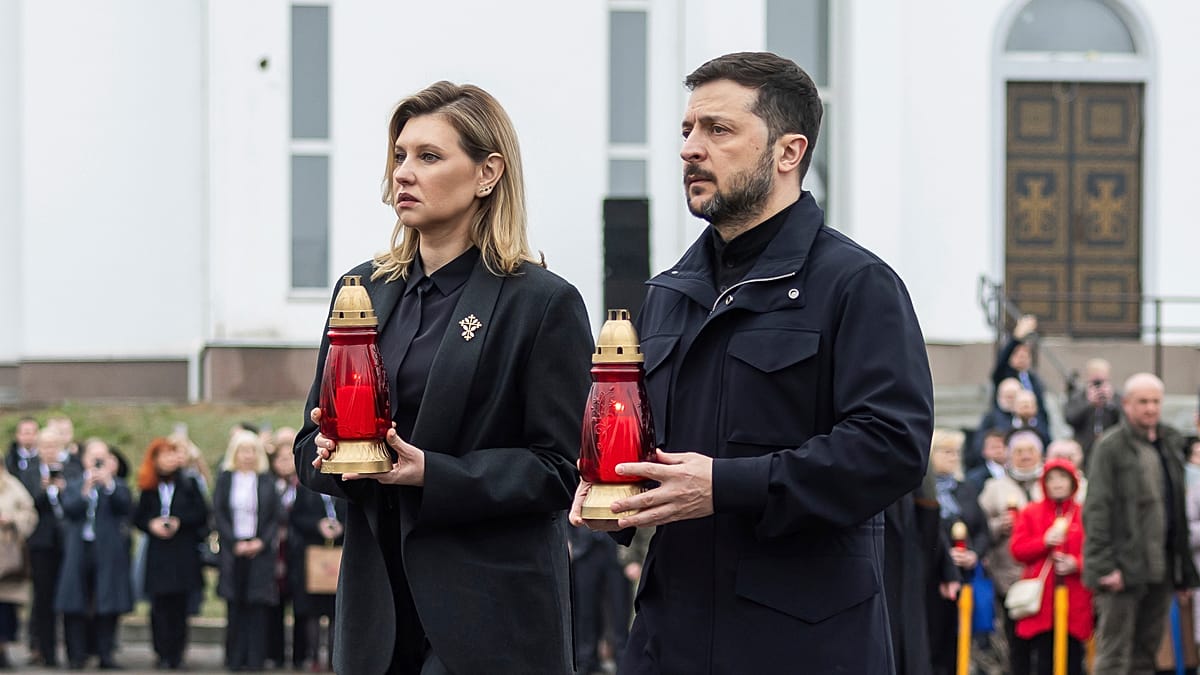
A fabricated image purporting to show Israeli passports belonging to Ukrainian President Volodymyr Zelenskyy and First Lady Olena Zelenska has resurfaced on social media, reviving a disinformation narrative that has circulated intermittently since at least 2023.
The post, published on Facebook in early September, carried a caption claiming the couple's "homeland of choice" is Israel rather than Ukraine. It has accumulated thousands of views. The image itself is a forgery: the fact-checking team at Euronews, The Cube, confirmed with Ukrainian official sources that the documents are fake, and an AI-detection tool identified the image as machine-generated.
A recycled forgery with telltale flaws
The fake document attributed to Zelenska lists her place of birth as the Ukrainian Soviet Socialist Republic — a detail that does not appear on genuine Ukrainian identity documents issued to people born before independence in 1991. Official papers normally record Ukraine as the place of birth, not the defunct Soviet republic that existed from 1922 until 1991.
The image also appears to have been built from a sample passport template published on the Council of Europe's website, according to The Cube. That detail points to a crude production process rather than any genuine leak.
Ukrainian law adds a further layer of implausibility. Under legislation that took effect in January, public officials are barred from holding multiple citizenships — a restriction that does not apply to ordinary Ukrainians. Zelenskyy, as president, would be ineligible for a second passport under that rule.
Not the first time
This is not an isolated case. In April 2026, an image of an alleged Israeli passport for Zelenskyy spread across Instagram, X and Facebook, drawing thousands of interactions. Those posts claimed the Ukrainian president was an agent of Israel's intelligence services whose mission was to "Ukrainianise Europe and lead it to its own self-destruction."
That forgery contained a basic spelling error: it rendered the president's surname as "Zelensky" rather than the official English stylisation "Zelenskyy," as listed on his presidential website. A large portion of the document was also cropped out of frame.
Earlier iterations targeted Zelenska directly. Pro-Russian channels and Facebook posts claimed she had spent a holiday in Israel and obtained an Israeli passport, with one caption asking whether she was "preparing for a possible escape from Ukraine."
The pattern is consistent: an AI-generated document is used to manufacture a scandal, wrapped around a few real details to make it seem credible, with the aim of eroding international support for Kyiv as Russia's full-scale war continues. The broader information campaign around Zelenskyy has also included diplomatic efforts at the UN being drowned out by competing narratives online.
Contradiction at the heart of the claim
The passport forgeries sit awkwardly alongside one of Vladimir Putin's stated justifications for the February 2022 invasion: the pledge to "demilitarise and de-Nazify" Ukraine. Zelenskyy is the grandson of a Holocaust survivor and has Jewish origins, a fact he has repeatedly cited when responding to Kremlin attacks on his background.
"How can I be a Nazi? Explain it to my grandfather, who went through the entire war in the infantry of the Soviet army, and died a colonel in an independent Ukraine."
That remark, delivered in Russian in a video address to the Russian public shortly before the invasion, remains one of his most direct rebuttals of the Kremlin's framing. The claim that he secretly holds Israeli citizenship is, in effect, an attempt to invert that biography — recasting his Jewish heritage as evidence of divided loyalty rather than as a rebuttal to Moscow's pretext.
For European audiences, the episode is a reminder that disinformation targeting Ukraine rarely arrives as a single, coherent story. It comes in fragments — a doctored document here, a cropped image there — designed to accumulate into a general atmosphere of doubt. Fact-checkers have traced versions of this particular forgery across multiple platforms and languages, and each revival tends to add new embellishments while keeping the same core falsehood.
The technical bar for producing such material has fallen sharply. Off-the-shelf AI image tools can now generate plausible-looking documents in seconds, and detection remains an after-the-fact exercise. The Cube's use of Hive Moderation to flag the image as AI-generated is one example of that cat-and-mouse dynamic, but the post had already gathered thousands of views by the time it was debunked.
Ukrainian officials have consistently rejected the claims. The wider context — a war entering its fifth year, with Kyiv pressing allies for continued support — means such forgeries are likely to keep appearing. The pressure on EU sanctions policy and the ongoing diplomatic push around high-level meetings provide fertile ground for narratives designed to sow doubt about Ukraine's leadership and its Western backing.