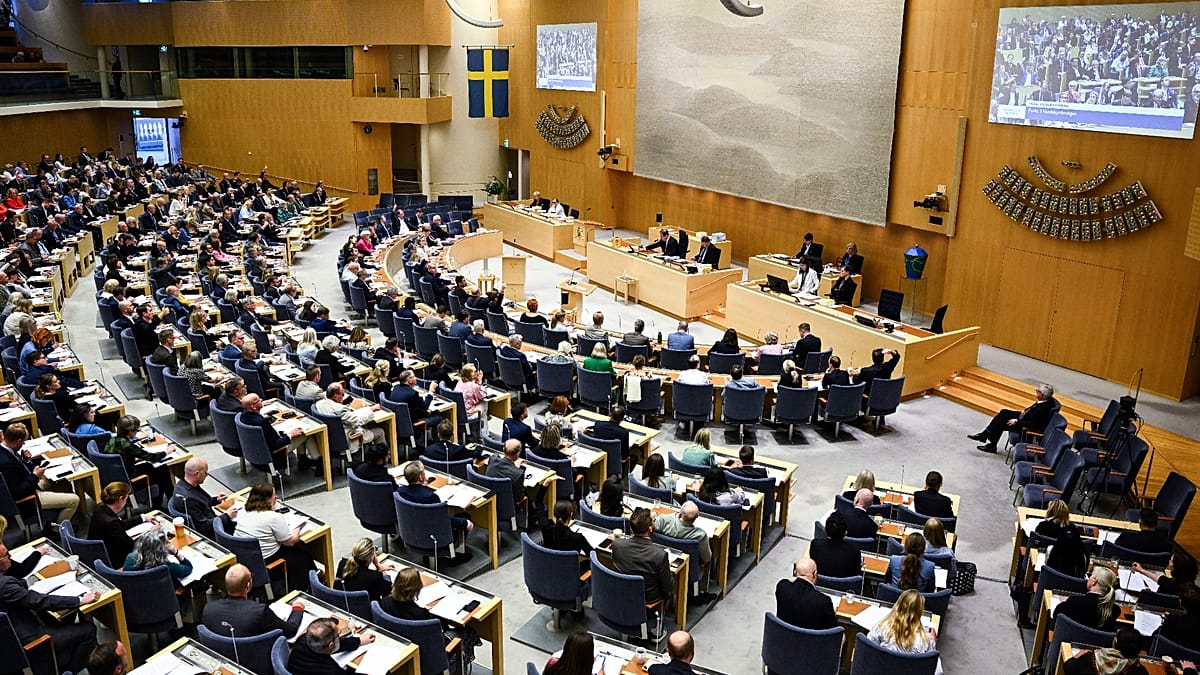
Politicians in Sweden and the United Kingdom are quietly turning to artificial intelligence to draft parliamentary texts, according to a new study that found no disclosure of AI use in any of the documents examined. The findings raise questions about transparency and accountability in democratic processes across Europe.
Researchers from Chalmers University of Technology in Gothenburg and Edinburgh Napier University analysed 13,565 Swedish parliamentary motions and 4,209 UK parliamentary statements published between 2021 and April 2026. Using AI detectors trained to distinguish between human and machine-generated political writing, they found that about 15% of UK statements in 2026 contained at least one paragraph classified as AI-generated. In Sweden, 9.4% of motions submitted during the 2025–2026 parliamentary year—roughly 300 motions—showed signs of AI assistance.
The figures mark a sharp increase from previous years: the UK rate stood at about 3.5% in 2022, while Sweden’s was 1.7% in the 2022–2023 period. Despite this growth, the researchers found no explicit disclosure of AI use in any of the texts they identified.
Calls for transparency grow
Jan Riise, a Swedish MP for the Green Party (Miljöpartiet) and its spokesperson on AI and digitalisation, said he was “not surprised” by the findings. He told Euronews Next that his party uses AI for “research purposes” and has an internal policy urging caution. “I personally prefer to rely on my own words,” Riise said, adding that politicians should label AI use. “If you need to write an entire proposal, that’s another story,” he said, noting he had “never asked [AI] to write the whole thing.”
The study’s lead author, Minerva Suvanto, a PhD student at Chalmers, stressed the risks of undisclosed AI use. “Regardless of the extent to which AI has been used, there may be risks associated with a lack of transparency,” she said. “We also note that texts produced with the help of AI are often very well-written and persuasive, which increases the risk that errors will not even be spotted by the writers themselves.”
The findings come at a time when some European leaders are openly embracing AI. Swedish Prime Minister Ulf Kristersson revealed in August 2025 that he regularly uses tools like ChatGPT and the French chatbot LeChat to seek a “second opinion” on political questions. This openness contrasts with the lack of disclosure found in parliamentary texts.
How the detection works
The researchers developed separate detection systems for Swedish and English parliamentary texts, training them on human-written documents from before generative AI became widespread, alongside AI-generated versions on similar political topics. They then applied the detectors to texts published from 2021 onwards, analysing both full documents and individual paragraphs. A text was counted as containing AI-assisted content if at least one sufficiently long paragraph was classified as AI-generated.
When tested on parliamentary material from 2021, before ChatGPT became publicly available, only one full text in each country was incorrectly classified as AI-generated, according to the study. “We use what is known as interpretable AI,” said Mattias Wahde, professor of applied artificial intelligence at Chalmers. “This means that we can not only investigate whether AI has been used but also where it is evident in the text. But you can’t say that individual words are ‘AI words’—it’s more complex than that.”
The study cannot establish which AI tool was used or exactly how it was used in drafting the texts. However, the researchers argue that the lack of transparency poses a risk to democratic accountability, as voters may be unaware of the extent to which their representatives rely on machine-generated content.
As AI becomes more integrated into political work across Europe, the study adds to a growing debate about the need for clear guidelines. Some countries, like research on other societal impacts, are already exploring regulatory frameworks, but the parliamentary use of AI remains largely unregulated. The researchers hope their findings will prompt politicians to disclose AI use and spark a broader conversation about the ethical boundaries of AI in governance.