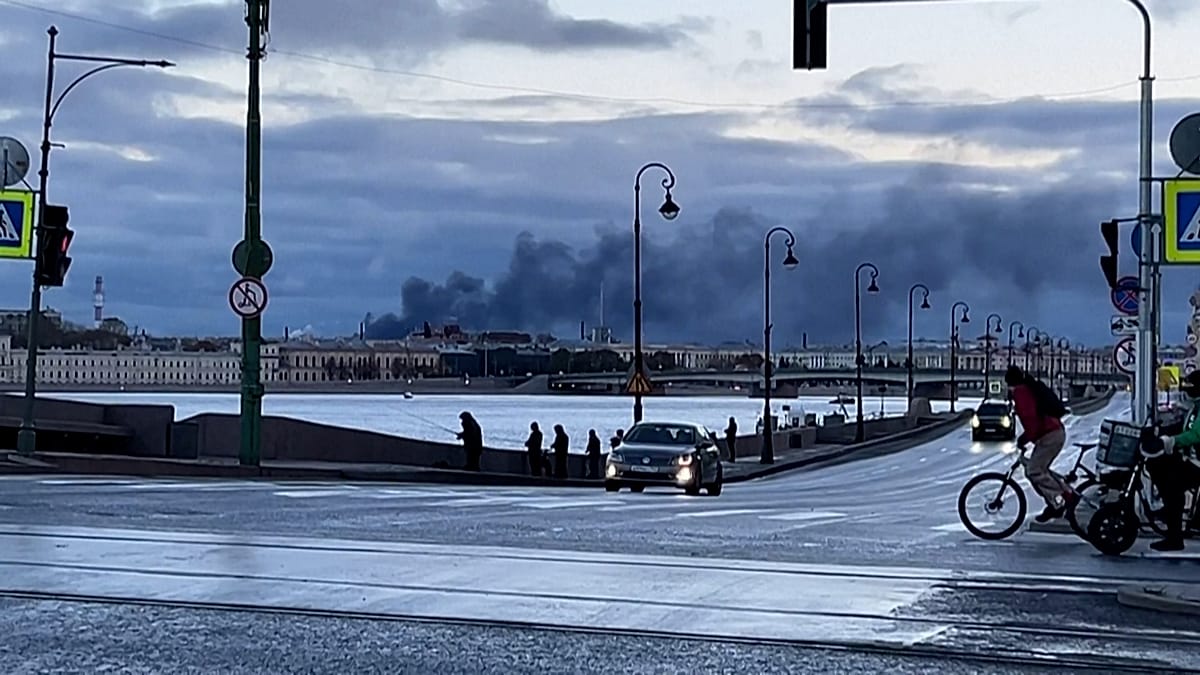
Thick columns of black smoke rose over St Petersburg on Sunday as a coordinated Ukrainian drone assault targeted industrial and logistics sites in and around Russia's second-largest city. The attack, which marked one of the most significant strikes on the city since the start of the full-scale war, prompted Russian officials to report the interception of 126 drones in the Leningrad region.
Videos circulating on social media and verified by local news outlets showed towering flames and dense smoke plumes visible from several districts of the city, which lies roughly 700 kilometres from the Ukrainian border. The precise extent of the damage remains unclear, but unconfirmed reports suggest that at least one fuel depot and a warehouse complex were hit.
Escalation in the air war
The strike comes amid a broader intensification of long-range drone warfare, with both sides seeking to disrupt each other's logistics and energy infrastructure. For St Petersburg, a city often seen as relatively insulated from the conflict due to its distance from the front lines, Sunday's attack signals a new phase in the campaign. Ukrainian drones hit St Petersburg and the surrounding region in what appears to be a deliberate effort to bring the war home to Russia's economic heartland.
Russian authorities have not disclosed the full scale of the damage, but local residents reported hearing multiple explosions in the early hours. Emergency services were deployed to several sites, and some roads were temporarily closed as firefighters battled the blazes. The governor of the Leningrad region, Aleksandr Drozdenko, said in a statement that air defence systems had been activated and that there were no immediate reports of casualties.
The attack also drew attention to the vulnerability of Russia's critical infrastructure, particularly in areas previously considered safe. Analysts point out that Ukrainian drones have repeatedly demonstrated their ability to penetrate deep into Russian territory, as seen in a suspected drone blast near Lithuania's border with Latvia earlier this year, which underscored the regional security implications of the conflict.
European dimension
For European observers, the strike on St Petersburg carries significant geopolitical weight. The city is a major economic hub and a symbol of Russia's imperial past, and attacks on it could further strain relations between Moscow and the West. The incident also comes at a time when the Trump administration has suspended new Russia sanctions amid a diesel deal, raising questions about the unity of the Western response to the war.
European leaders have largely refrained from commenting directly on the drone strikes, but the attacks are likely to feature in discussions about military aid to Ukraine. Some EU member states, particularly those in the Baltics and Scandinavia, have expressed concern about the potential for escalation and the need for continued support for Kyiv. A Latvian MEP has called the Trump diesel deal 'dubious', reflecting broader unease about mixed signals from Washington.
The drone assault also highlights the growing role of technology in the conflict. Ukraine has developed a range of long-range drones, some of which have been used in tests of a drone ambulance for battlefield evacuations, demonstrating the dual-use nature of these systems. While the St Petersburg attack was clearly offensive, it underscores the rapid evolution of drone warfare and its implications for European security.
As the war enters its third year, the ability of both sides to strike deep into each other's territory is reshaping the strategic calculus. For Russia, the attack on St Petersburg is a reminder that no city is beyond reach. For Europe, it is a sobering illustration of the conflict's expanding footprint, with potential consequences for energy security, migration, and regional stability.
The full impact of Sunday's strike is still being assessed, but it is already clear that the war has entered a new and more volatile phase. European policymakers will be watching closely, aware that the conflict's ripple effects are being felt far beyond the battlefield.