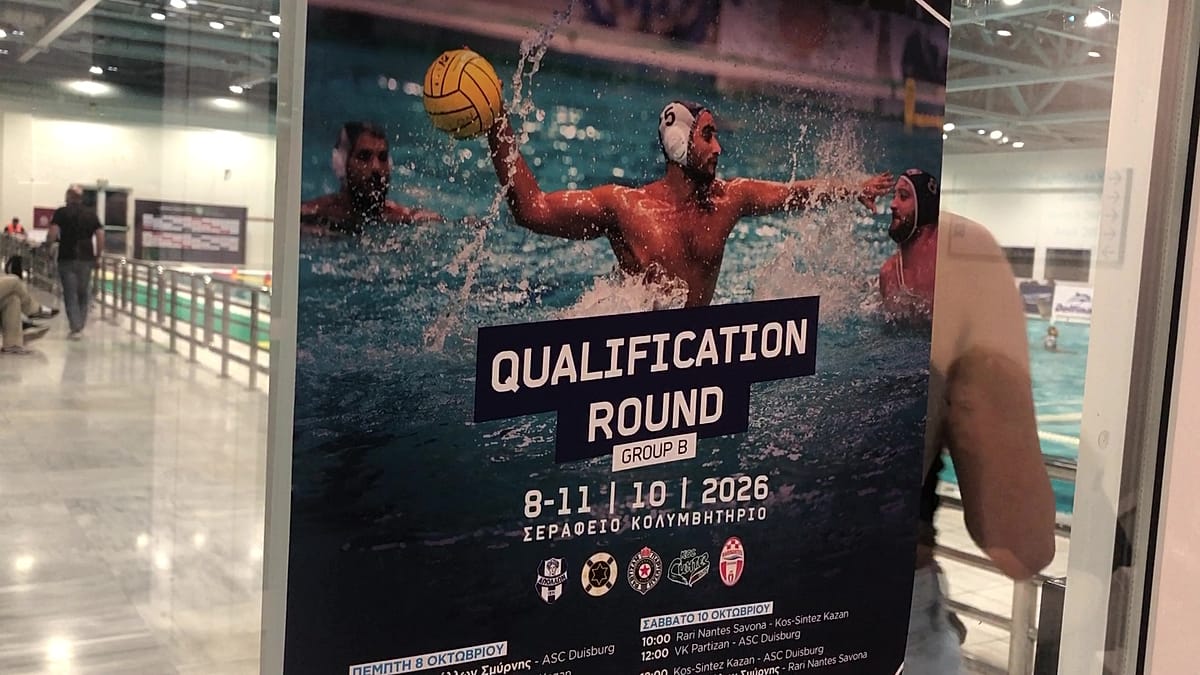
When Sintez Kazan stepped into the Serafeio Swimming Pool in Athens on Thursday night, it marked a quiet but significant milestone: the first Russian club to take part in an official European team competition since the full-scale invasion of Ukraine in 2022. The water polo match, part of the Euro Cup qualifying group hosted by Apollon Smyrnis, was the result of months of diplomatic manoeuvring and a gradual thaw in sporting sanctions.
The draw by the European Aquatics federation placed the Kazan club in a group that included Partizan Belgrade, Duisburg, Savona, and the hosts. But the return was far from routine. Greek authorities, mindful of the country's participation in EU-wide sanctions against Moscow, moved discreetly to ensure that the event did not become a platform for Russian symbolism.
Behind-the-scenes diplomacy
According to information obtained by Euronews, the Greek Ministry of Foreign Affairs issued guidance that included heightened but low-profile security measures and a ban on Russian flags or the playing of the Russian national anthem at the Serafeio pool. The solution was to play no national anthems at all—not even the Greek one—only club anthems such as that of Apollon Smyrnis. The tournament poster made no mention of the teams' countries of origin, a deliberate omission.
Inside the venue, a row of flags displayed the City of Athens, Apollon Smyrnis, and several nations including Greece, Germany, and Israel—but not Russia. The Greek government confirmed to Euronews that it had been assured the Kazan team would compete as a neutral side, as had been the case for Russian athletes in aquatics until last summer.
However, that neutrality is now a thing of the past. European Aquatics, the continental governing body, has changed its stance. On its official website, Kazan is explicitly listed as representing Russia, with the Russian flag displayed alongside the club's name. This shift reflects a broader relaxation of sporting sanctions that began in July, when the International Olympic Committee (IOC) largely lifted its restrictions and left decisions to individual federations.
Federations diverge
World Aquatics was among the first to act, fully restoring the membership rights of Russia and Belarus in April, on the grounds that "sport must stay out of political conflicts." The decision allowed the use of national symbols, provided federations complied with regulations. European Aquatics initially sought a delay to protect summer events, and it was agreed that no Russian athlete or team would return with full national symbols before 1 September 2026.
After that extension expired, a new framework came into force. At youth level, Russian athletes compete without restrictions. At senior level, Russian clubs may enter European competitions, but their athletes and staff must retain the status of "Approved Neutral Athlete" during matches. This compromise allowed Sintez Kazan to play, but with the team officially representing Russia in the eyes of the governing body.
The match itself saw Partizan Belgrade defeat Kazan 14-13. Over the weekend, the Russian side will face Duisburg, Savona, and Apollon Smyrnis. The presence of a Russian team in Athens has not gone unnoticed, especially given the ongoing war in Ukraine and the EU's collective sanctions. Greek officials have stressed that the event was handled with the utmost care to avoid any diplomatic incident.
Other European federations have been more cautious. UEFA, FIBA, the handball federation EHF, and volleyball's CEV have not lifted restrictions on Russian clubs. Only last week, CEV decided to allow Russian national teams back into its competitions in indoor and beach volleyball, but it stopped short of permitting Russian clubs in European tournaments. The athletics federation continues to ban Russian athletes, a decision Moscow has challenged at the Court of Arbitration for Sport.
The return of Russian teams to European competition is a sensitive issue, and Athens has become the stage for this first step. As one official put it, "we are talking about Russia's comeback to aquatics." The diplomatic tightrope walked by Greek authorities reflects the broader European dilemma: balancing the principle that sport should remain separate from politics with the reality of a war that has reshaped the continent's security landscape.